
一美分硬币

Search documents
流通两个多世纪 一美分硬币为何停产
Sou Hu Cai Jing· 2025-11-16 23:02
Core Viewpoint - The U.S. Mint has announced the cessation of the production of the one-cent coin, marking the end of its regular production after 232 years due to high production costs exceeding its face value [1][2]. Reasons for Cessation - The production cost of a one-cent coin has risen significantly, from 1.42 cents to 3.69 cents over the past decade, leading to substantial financial losses for the Mint [1][2]. - The one-cent coin was first introduced in 1793 and has become increasingly obsolete, often found in piggy banks rather than in circulation [1]. Current Circulation of One-Cent Coins - Approximately 300 billion one-cent coins are currently in circulation, far exceeding commercial demand, and they will remain legal tender despite the halt in production [3][4]. - The Federal Reserve has already suspended orders for one-cent coins at 100 of its 181 distribution points, with more expected to follow [3]. Impact on Banking and Retail - The American Bankers Association has indicated that the Federal Reserve will no longer accept deposits of one-cent coins once they are depleted from distribution points, complicating their circulation [3]. - Retailers are encouraged to help mitigate the slowdown in circulation by accepting one-cent coins and advising customers to bring them to banks or exchange kiosks [3]. Future of Other Low-Denomination Coins - There is ongoing discussion about the potential for other low-denomination coins, such as the five-cent coin, to face similar fates due to high production costs [5][6]. - A proposed bill to establish a national rounding standard for cash transactions is currently stalled in Congress, which could impact how cash transactions are handled in the absence of one-cent coins [5][6].
一美分硬币为何停产
Sou Hu Cai Jing· 2025-11-16 22:03
Group 1 - The U.S. Mint announced the cessation of the production of the one-cent coin, marking the end of its regular production after 232 years [1][2] - The production cost of the one-cent coin has increased significantly over the past decade, rising from 1.42 cents to 3.69 cents per coin, leading to substantial financial losses for the Mint [1][2] - In the fiscal year 2024, the Mint reported a loss of $85.3 million due to the production of the one-cent coin, which is considered a "money-losing" coin [2] Group 2 - Despite the cessation of production, the one-cent coin remains legal tender in the U.S., with an estimated 300 billion coins currently in circulation, far exceeding commercial demand [2] - The Federal Reserve has begun to suspend orders for one-cent coins at various distribution points, with 100 out of 181 points already halting orders [2] - The American Bankers Association indicated that the Federal Reserve will no longer accept deposits of one-cent coins once they are depleted at distribution points, complicating the circulation of existing coins [2] Group 3 - Retailers are facing challenges in adjusting to the discontinuation of the one-cent coin, with no federal guidance on handling cash transactions, leading to various practices such as rounding prices or requiring customers to bring change [3] - Industry organizations are advocating for legislation to establish a federal standard for rounding cash transactions to the nearest five cents to protect businesses from legal risks [3] - There are concerns that ongoing inflation may diminish the actual value of the five-cent coin, potentially leading to its gradual elimination in the future [3]
流通232年,一美分硬币正式停产
Huan Qiu Shi Bao· 2025-11-13 22:39
Core Points - The U.S. Mint has officially ceased the production of the one-cent coin after 232 years, marking the end of its circulation due to rising production costs and declining relevance [1][2] - The decision is expected to save taxpayers approximately $56 million, as the cost to produce a one-cent coin has increased significantly, reaching 3.69 cents per coin in 2024, nearly four times its face value [1] - Approximately 300 billion one-cent coins are still in circulation, and they will remain legal tender indefinitely [1] Industry Reactions - Some retailers have expressed concerns about the implications of the one-cent coin's discontinuation, with the National Association of Convenience Stores advocating for its elimination for 30 years but not in this manner [2] - Collectors and historians emphasize the historical significance of the one-cent coin, which was first introduced in 1793 and has cultural value as it once could purchase basic items like a cookie or a candle [2]
【环球财经】流通两个多世纪,一美分硬币为何停产
Sou Hu Cai Jing· 2025-11-13 13:44
Group 1 - The U.S. Mint has announced the cessation of the production of the one-cent coin, which has been in circulation for 232 years, due to the high cost of production exceeding its face value [1][2] - The production cost of a one-cent coin has increased from 1.42 cents to 3.69 cents over the past decade, leading to significant financial losses for the Mint [1][2] - In the fiscal year 2024, the Mint reported a loss of $85.3 million attributed to the production of one-cent coins [2] Group 2 - Approximately 300 billion one-cent coins are currently in circulation, far exceeding commercial demand, and they will remain legal tender despite the halt in production [3] - The Federal Reserve has already suspended orders for one-cent coins at 100 of its 181 distribution points, with more expected to follow [3] - The banking industry is encouraging the public to deposit their one-cent coins to address the slowdown in circulation [3] Group 3 - The cessation of the one-cent coin raises questions about the future of other low-denomination coins, as the production costs of five-cent coins and others are also significantly higher than their face values [2][4] - Retailers are seeking federal legislation to establish a standard for rounding cash transactions to the nearest five cents to mitigate potential legal risks [4][5] - There is speculation that inflation may lead to the gradual elimination of the five-cent coin in the coming years, although this could complicate cash transactions [5]
流通两个多世纪,一美分硬币为何停产?
Sou Hu Cai Jing· 2025-11-13 13:15
Core Points - The U.S. Mint has announced the cessation of the production of the one-cent coin, marking the end of its regular production after 232 years [1] - The decision to stop minting the one-cent coin is primarily due to the high production costs, which have risen significantly over the past decade [1][2] - The U.S. Mint reported a loss of $85.3 million in the fiscal year 2024 due to the production of the one-cent coin [2] Reasons for Cessation - The production cost of a one-cent coin has increased from 1.42 cents to 3.69 cents over the past ten years, leading to substantial financial losses [1] - Other low-value coins are also facing similar issues, with the production costs of the five-cent coin nearing 14 cents, the ten-cent coin around 6 cents, the quarter at approximately 15 cents, and the half-dollar coin at about 34 cents, all exceeding their face values [2] Current Circulation of One-Cent Coins - Approximately 300 billion one-cent coins are currently in circulation, far exceeding commercial demand [3] - The Federal Reserve has already suspended orders for one-cent coins at 100 of its 181 distribution points, with more expected to follow [3] - The American Bankers Association has indicated that once the one-cent coins are depleted at distribution points, they will no longer accept deposits of these coins, hindering their circulation [3] Future of Low-Denomination Coins - Retailers are seeking guidance from the government on how to handle cash transactions without the one-cent coin, with some adjusting prices or encouraging customers to bring their own change [4] - A bill to establish a federal standard for rounding cash transactions to the nearest five cents has passed a committee but has not yet been voted on by the full House [4] - There are concerns that the ongoing inflation may lead to the gradual elimination of the five-cent coin in the future, which could complicate cash transactions [5]
经济热点问答|流通两个多世纪,一美分硬币为何停产
Sou Hu Cai Jing· 2025-11-13 12:45
Core Viewpoint - The U.S. Mint has announced the cessation of the production of the one-cent coin, which has been in circulation for 232 years, due to the high cost of production exceeding its face value [1][2]. Group 1: Reasons for Cessation - The production cost of the one-cent coin has risen significantly, from 1.42 cents to 3.69 cents over the past decade, leading to substantial financial losses for the U.S. Mint [1][2]. - The one-cent coin was originally introduced in 1793 and has become less useful in modern transactions, often being stored away rather than used [1]. Group 2: Current Circulation of One-Cent Coins - Approximately 300 billion one-cent coins are currently in circulation, far exceeding commercial demand, and they will remain legal tender despite the halt in production [3]. - The Federal Reserve has already suspended orders for one-cent coins at 100 of its 181 distribution points, with more expected to follow, complicating the circulation of existing coins [3]. Group 3: Impact on Other Low-Denomination Coins - The production of other low-denomination coins is also under scrutiny, with the five-cent coin costing nearly 14 cents to produce, and the ten-cent coin costing about 6 cents [2]. - Retailers are seeking legislative guidance on how to handle cash transactions without the one-cent coin, with proposals for rounding transactions to the nearest five cents being discussed [4][5]. Group 4: Legislative and Economic Implications - A bill to establish a national rounding standard has passed a committee but has not yet been voted on by the full House, facing delays due to lobbying and government shutdowns [5]. - The ongoing inflation in the U.S. may lead to further devaluation of low-denomination coins, including the potential gradual elimination of the five-cent coin [5].
经济热点问答丨流通两个多世纪,一美分硬币为何停产
Xin Hua Wang· 2025-11-13 12:45
Core Viewpoint - The U.S. Mint has announced the cessation of the production of the one-cent coin due to the high cost of production exceeding its face value, marking the end of a 232-year circulation of this coin [1][2]. Group 1: Reasons for Cessation - The production cost of the one-cent coin has significantly increased, from 1.42 cents to 3.69 cents over the past decade, leading to substantial financial losses for the U.S. Mint [1][2]. - The U.S. Mint reported a loss of $85.3 million in the 2024 fiscal year solely from the production of one-cent coins [2]. Group 2: Current Circulation of One-Cent Coins - Approximately 300 billion one-cent coins are currently in circulation, far exceeding commercial demand, and they will remain legal tender despite the halt in production [3]. - The Federal Reserve has already suspended orders for one-cent coins at 100 of its 181 distribution points, with more expected to follow, complicating the circulation of existing coins [3]. Group 3: Future of Other Low-Denomination Coins - There is a possibility that other low-denomination coins, such as the five-cent coin, may face similar challenges due to rising production costs, with the cost of producing a five-cent coin nearing 14 cents [2][5]. - Industry organizations are advocating for legislation to standardize cash transactions to the nearest five cents to mitigate potential legal risks for businesses [5].
美国停止生产一美分硬币:成本是面值三倍多
Zhong Guo Xin Wen Wang· 2025-11-13 10:57
Core Points - The United States has officially ceased the production of the one-cent coin, ending a practice that has lasted for over 230 years [1][3] - The U.S. Treasury stated that the rising production costs and changes in consumer habits and technology have made the manufacturing of the one-cent coin economically unfeasible and unnecessary [1][3] Cost Analysis - The current cost to produce a one-cent coin is 3.69 cents, significantly higher than the 1.42 cents a decade ago [3] - The cessation of one-cent coin production is expected to save the U.S. Mint approximately $56 million annually [3] Circulation and Legal Status - It is estimated that around 300 billion one-cent coins are still in circulation and will continue to exist as legal tender, although no new coins will be minted [3] - The decision to stop minting the one-cent coin has prompted adjustments in pricing strategies at gas stations, fast-food chains, and large supermarkets, leading to rounding practices in cash transactions [3]

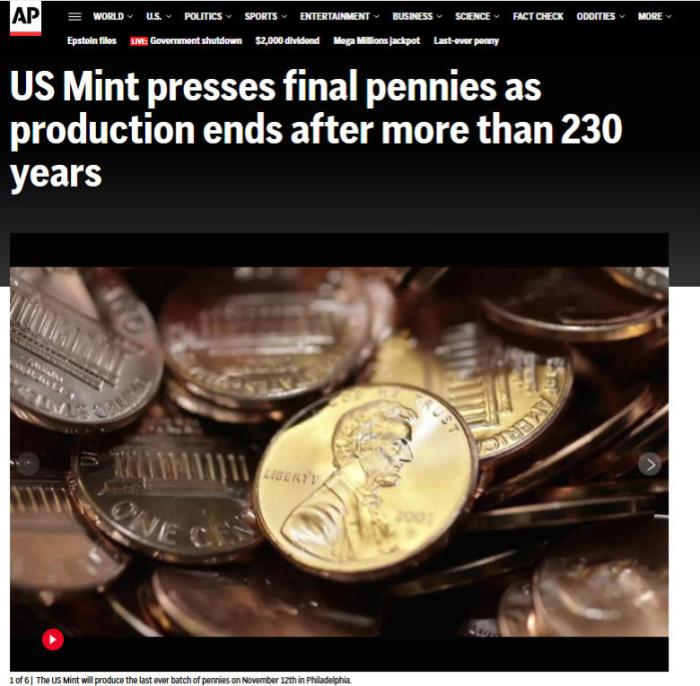
美国铸币局宣布停止生产一美分硬币
Xin Hua Wang· 2025-11-13 07:47
Core Points - The U.S. Mint has officially ceased the regular production of the one-cent coin, marking the end of its 232-year circulation history [1] - The last one-cent coin for circulation was minted by U.S. Treasury's Treasurer, Brandon Beach, during a ceremony at the Philadelphia Mint [1] - The production cost of the one-cent coin has significantly increased over the past decade, rising from 1.42 cents to 3.69 cents per coin, making its production unsustainable [1] Industry Summary - The one-cent coin has played a vital role in American daily life since its inception in 1793, but changing economic conditions and consumer behaviors have led to its discontinuation [1] - Despite the cessation of production, the one-cent coin remains legal tender in the U.S., with an estimated 300 billion coins currently in circulation, far exceeding commercial demand [1] - Retailers and businesses can continue to price items in one-cent increments, and the U.S. Mint plans to produce limited edition one-cent commemorative coins for historical research and collectors [1]
【环球财经】美国铸币局宣布停止生产一美分硬币
Xin Hua Cai Jing· 2025-11-13 05:05
Core Points - The U.S. Mint has officially ceased the production of the one-cent coin, marking the end of its 232-year circulation history [1][2] - The last one-cent coin was minted by U.S. Treasury Secretary Brandon Leitch during a ceremony at the Philadelphia Mint [1] - The production cost of the one-cent coin has increased significantly over the past decade, rising from 1.42 cents to 3.69 cents per coin, making its continued production unsustainable [1] Summary by Sections Production Cessation - The U.S. Mint announced the end of one-cent coin production due to rising costs and changing consumer behavior [1] - The one-cent coin was first authorized by the Coinage Act of 1792 and has played a significant role in American daily life [1] Legal Status and Future Plans - Despite the cessation of production, the one-cent coin remains legal tender in the U.S., with an estimated 300 billion coins still in circulation [2] - Retailers and businesses can continue to price items in one-cent increments [2] - The U.S. Mint plans to produce limited edition one-cent commemorative coins for historical research and collectors [2]