上好佳鲜虾片

Search documents
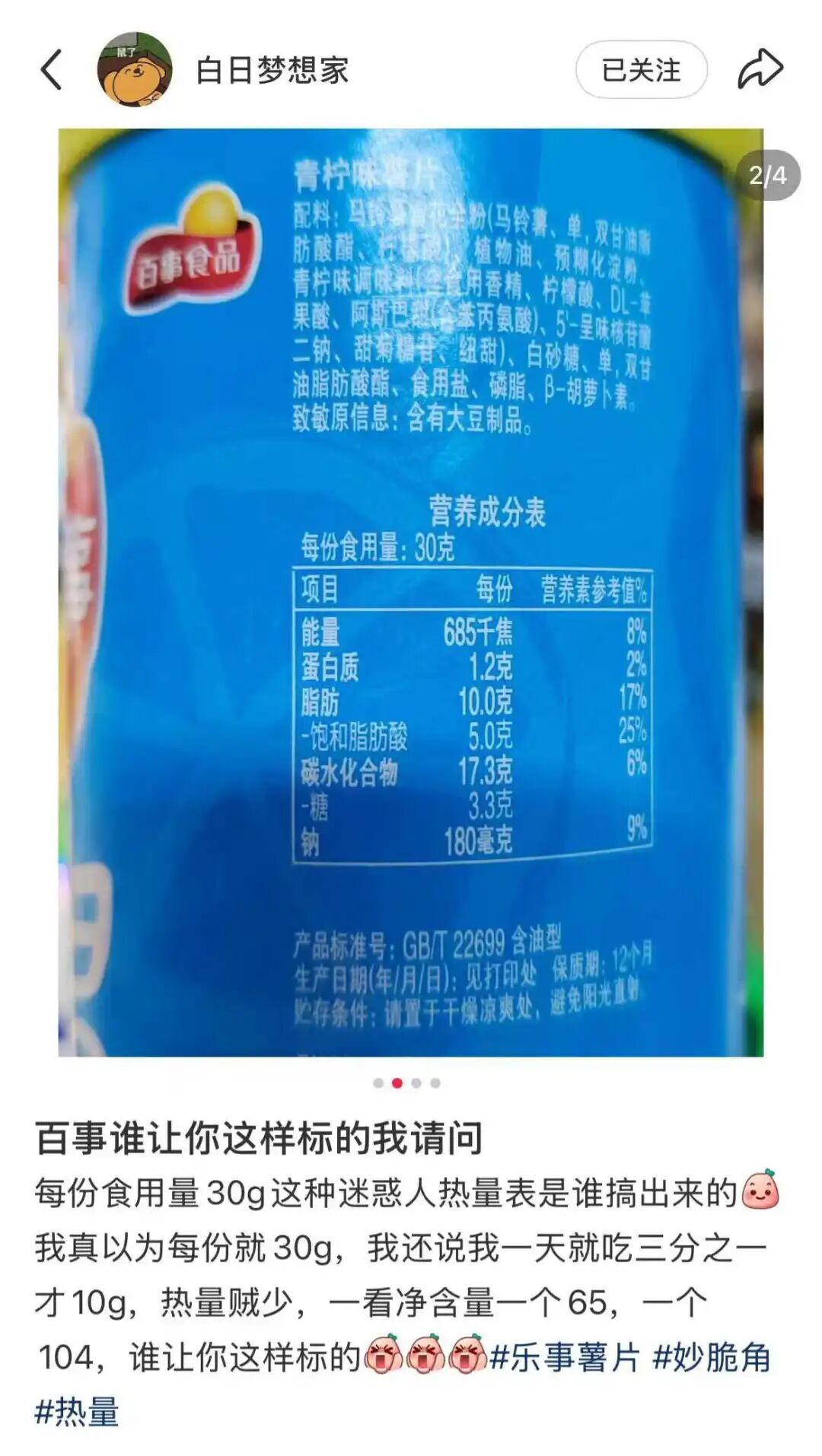
为什么现在的零食热量都按“份”算?
3 6 Ke· 2026-01-05 11:53
Core Viewpoint - The article highlights the issue of snack packaging labeling calories per "serving" instead of the traditional "per 100g," leading consumers to unknowingly consume higher calories than expected [1][4][25]. Group 1: Consumer Awareness - Consumers are increasingly finding that the calorie counts on snack packaging are based on "serving" sizes, which can be significantly smaller than the total package weight, resulting in higher caloric intake than anticipated [1][4]. - The discrepancy in serving sizes can lead to confusion, as some products may label servings in fractions or specific weights that do not align with consumer expectations [4][9]. Group 2: Regulatory Standards - The labeling of nutritional information per "serving" is compliant with national regulations, as outlined in the GB28050-2011 and GB28050-2025 standards, which allow for both "per 100g" and "per serving" formats [19][20]. - The standards specify that serving sizes can vary based on the type of food, and manufacturers are encouraged to use reference values for serving sizes [20][24]. Group 3: Industry Practices - Many snack brands, such as Orion and Lay's, have adopted the "per serving" labeling to standardize nutritional information across various product sizes, which can create a perception of lower calorie content [24][25]. - The choice of serving size often aims to simplify consumer understanding and calculation of caloric intake, although it may also contribute to misleading perceptions of healthiness [24][25].


亿滋报告:86%中国人爱分享童年零食,怀旧风成消费新引擎
东京烘焙职业人· 2025-11-24 08:33
Core Insights - The article emphasizes the growing influence of nostalgia on consumer choices in the snack industry, particularly in China, where 86% of consumers enjoy sharing their childhood favorite snacks [8][12][13]. Group 1: Nostalgia and Consumer Behavior - The sixth annual Mondelēz International State of Snacking report highlights that cherished traditions and warm childhood memories are key factors influencing global snack choices [6][4]. - Brands are increasingly tapping into nostalgia as a mainstream consumer motivation, with successful campaigns like Kang Shifu's "White Moonlight Revival Plan" allowing consumers to vote on classic products to bring back [12][13]. - Mars Wrigley successfully reintroduced the "White Arrow" gum, resonating with older consumers while attracting younger generations, showcasing the importance of emotional connections in brand loyalty [15][17]. Group 2: Balancing Innovation and Nostalgia - The article discusses the challenge of balancing nostalgia with innovation, noting that a high percentage of new products fail within a year, with only 15% of food and beverage innovations surviving [21][22]. - Brands are shifting focus towards upgrading classic products through "micro-innovation," which allows them to leverage existing brand recognition while meeting evolving consumer demands [24][30]. - Examples include the introduction of real fruit juice in popular gummy products and the redesign of classic candy shapes to appeal to younger consumers' social media sharing habits [26][28]. Group 3: Seasonal and Emotional Marketing - Seasonal sentiments play a crucial role in snack consumption, with snacks serving as both a source of enjoyment and a means of emotional connection during holidays [32][34]. - Brands are actively innovating for holidays, with limited edition products designed to enhance festive experiences, such as the Christmas-themed gummy candies from Kuli [35][39]. - The article concludes that emotional marketing significantly boosts brand loyalty, with consumers engaged through emotional connections showing over 30% higher loyalty than average consumers [39][40].