上证50ETF易方达

Search documents
上证50ETF易方达(510100)开盘跌0.35%,重仓股贵州茅台跌0.09%,中国平安跌0.02%
Xin Lang Cai Jing· 2026-03-26 01:32
Group 1 - The core point of the news is the performance of the E Fund's SSE 50 ETF (510100), which opened at a decline of 0.35% on March 26, 2023, priced at 2.856 yuan [1][2] - The major holdings of the SSE 50 ETF include Guizhou Moutai, China Ping An, Zijin Mining, China Merchants Bank, Industrial Bank, Yangtze Power, Cambrian Biologics, CITIC Securities, Heng Rui Medicine, and Industrial and Commercial Bank of China, with most showing slight declines, while Cambrian Biologics saw a minor increase of 0.10% [1][2] - The SSE 50 ETF's performance benchmark is the SSE 50 Index return, managed by E Fund Management Co., Ltd., with a return of 31.56% since its establishment on September 6, 2019, and a recent one-month return of -6.41% [2] Group 2 - A MACD golden cross signal has formed, indicating potential upward momentum for certain stocks [3]





“落袋为安”?14亿,跑了
Zhong Guo Ji Jin Bao· 2026-02-26 04:17
Group 1 - On February 25, the A-share market saw all three major indices rise, but the stock ETF market experienced a net outflow of approximately 1.4 billion yuan [1] - As of February 25, the total scale of 1,344 stock ETFs in the market reached 4.18 trillion yuan, with a reduction of 503 million fund shares, resulting in a net outflow of about 1.48 billion yuan [2] - The Hong Kong stock market ETFs led in net inflows, totaling 1.881 billion yuan, with the CSI 500 Index ETF seeing the highest inflow of 1.678 billion yuan [2] Group 2 - On February 25, 32 ETFs had net inflows exceeding 100 million yuan, with the CSI 500 ETF leading at 1.424 billion yuan, followed by the Electric Grid Equipment ETF and A500 ETF with inflows of 1.059 billion yuan and 618 million yuan respectively [2] - E Fund's ETFs continued to attract net inflows, with the Hang Seng Technology ETF receiving 270 million yuan, the SSE 50 ETF 229 million yuan, and the Artificial Intelligence ETF 203 million yuan [2] - The Electric Grid Equipment ETF and Hang Seng Internet ETF from Huaxia Fund saw significant net inflows of 1.059 billion yuan and 603 million yuan respectively, with their latest scales at 20.465 billion yuan and 37.213 billion yuan [3] Group 3 - The ChiNext Index ETF experienced the largest net outflow on February 25, amounting to 1.946 billion yuan [4] - ICBC Credit Suisse Fund remains optimistic about the A-share market in the medium term, citing that total demand adjustments are nearing equilibrium and supply-side adjustments will enhance confidence in capital return rates [4]
最新!超990亿元,“跑了”!
Zhong Guo Ji Jin Bao· 2026-01-22 06:59
Group 1 - The core point of the article highlights a significant outflow of funds from stock ETFs, exceeding 990 billion yuan, with broad-based ETFs collectively experiencing a net outflow of over 1 trillion yuan [2][3] - On January 21, the total net outflow from the stock ETF market (including cross-border ETFs) reached 994.94 billion yuan, with broad-based ETFs seeing a decline in scale by 940.9 billion yuan [3] - The SGE Gold 9999 index recorded the highest net inflow of 19.29 billion yuan, while the CSI 300 index faced the largest net outflow of 581.98 billion yuan on the same day [3] Group 2 - The top-performing ETFs in terms of net inflow included the Electric Grid Equipment ETF and the Chemical ETF, with net inflows of 14.38 billion yuan and 8.26 billion yuan, respectively [6][7] - Notable inflows were also observed in the Gold Stock ETF and the Semiconductor ETF, with net inflows of 5.74 billion yuan and 5.20 billion yuan, respectively [6] - The report indicates that the Electric Grid Equipment ETF and the Semiconductor ETF from Huaxia Fund saw significant inflows, reflecting investor interest in these sectors [3][4] Group 3 - The article mentions that the CSI 300 ETF and the CSI 1000 ETF were among the largest "bloodletting" ETFs, with substantial net outflows of 168.28 billion yuan and 138.52 billion yuan, respectively [5][7] - The overall market sentiment remains cautiously optimistic, with expectations for a continued upward trend in the Chinese stock market, particularly in growth sectors such as AI and industrial metals [8] - The investment strategy suggested includes focusing on core growth assets, which are currently at historical median valuations, providing potential for valuation recovery [8]

2026开年布局,省钱=赚钱?低费率投资攻略来啦
Sou Hu Cai Jing· 2026-01-14 01:48
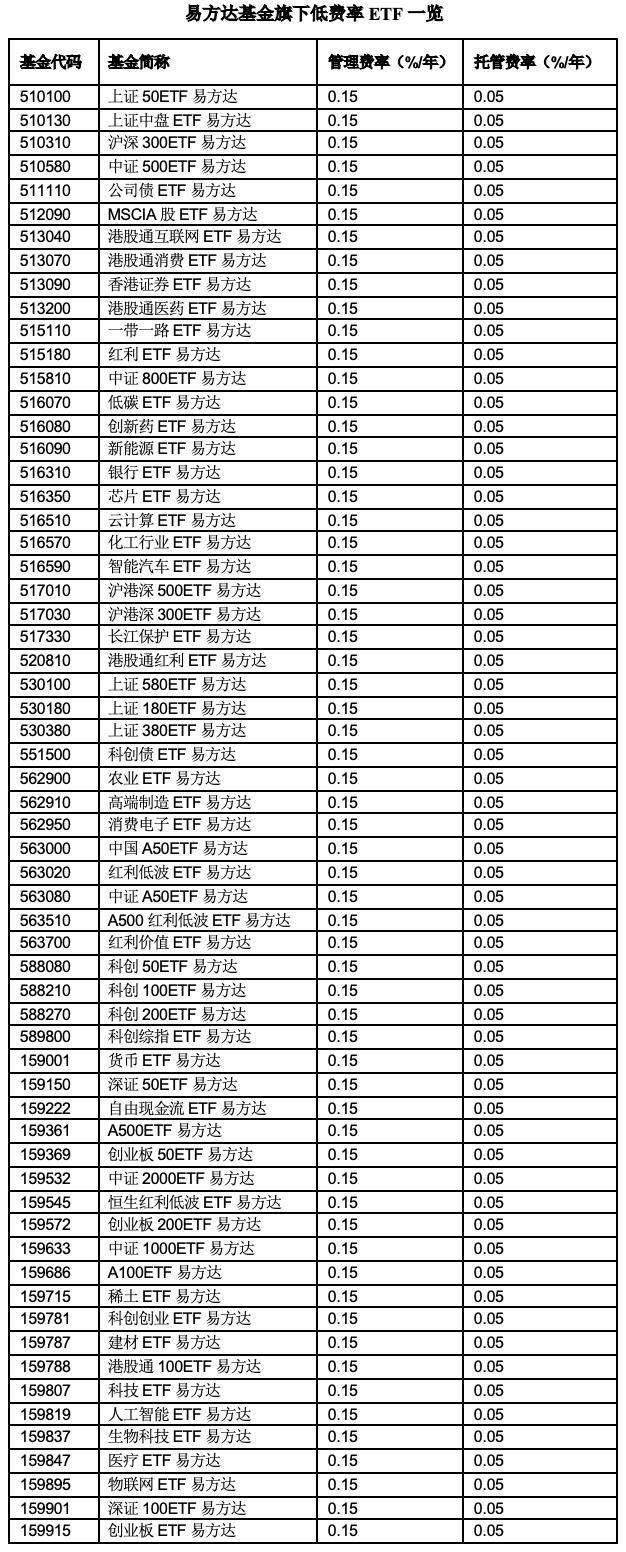
Core Insights - The article emphasizes the importance of low-cost investment tools, suggesting that by choosing these options, investors can retain more profits and benefit from compounding effects [1][2] - Legendary investors like John Bogle and Warren Buffett advocate for low-cost index funds, highlighting their long-term benefits [1] - Recent policy initiatives aim to reduce investor costs by encouraging the reduction of management and custody fees for large-scale index funds [1] Investment Tools - E Fund has been a leader in reducing ETF fees, with its CSI 300 ETF management fee dropping from 0.5% to 0.15% over the years, making it the lowest in the market [2] - As of December 31, 2025, over 370 ETFs in the market have a combined management and custody fee of 0.2% per year, with E Fund managing 62 of these products [2] - The article lists various E Fund ETFs, all with a management fee of 0.15% per year, including products tracking broad indices, industry themes, and style factors [3][5]
“国家队”卖出了?
Sou Hu Cai Jing· 2025-09-28 13:16
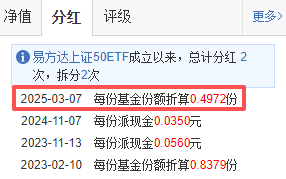
Core Insights - The article discusses the performance and holdings of the E Fund's SSE 50 ETF, particularly focusing on the changes in the holdings of Central Huijin Investment and the impact of share consolidation on reported figures [5][8][12]. Group 1: Fund Performance and Distributions - Since its inception, the E Fund SSE 50 ETF has distributed dividends twice, with the latest distributions being CNY 0.0560 per share on November 13, 2023, and CNY 0.0350 per share on November 7, 2024 [1]. - The fund underwent a share consolidation on March 7, 2025, where each share was converted into 0.4972 shares, affecting the reported number of shares held by investors [8][9]. Group 2: Holdings and Changes - Central Huijin held 185 million shares at the end of last year, which, after the consolidation, translates to approximately 91.76 million shares, indicating no actual selling activity [9][10]. - The overall trend shows that Central Huijin has been consistently increasing its holdings in various ETFs, including the SSE 50 ETF, particularly during market downturns [11][12]. Group 3: Market Strategy and Future Outlook - Central Huijin's strategy appears to focus on stabilizing the market during periods of volatility, with a history of buying during downturns and potentially selling during overheated market conditions [15][16]. - The article suggests that while Central Huijin has not sold any shares recently, future actions will depend on market conditions and the organization's strategic decisions [12][16].
宽基指数ETF“吸金”,沪深300ETF易方达(510310)、上证50ETF易方达(510100)净流入居市场前列
Sou Hu Cai Jing· 2025-08-14 02:56
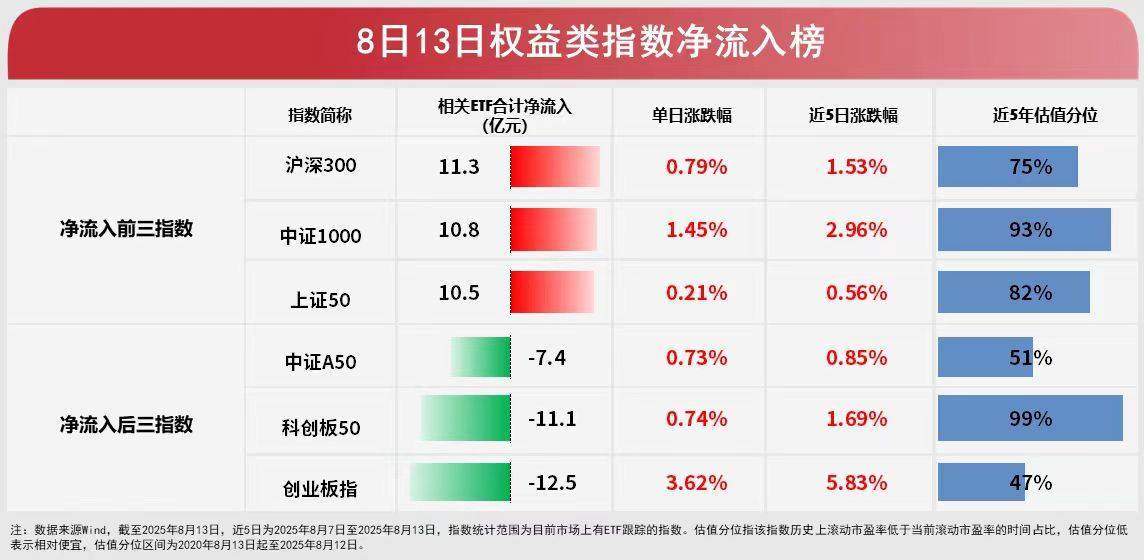
Group 1 - The core viewpoint of the articles highlights a strong performance in the technology sector, with the Shanghai Composite Index surpassing its previous high from October 8 of last year [1] - The net inflow of ETFs related to the CSI 300, CSI 1000, and SSE 50 indices exceeded 1 billion yuan, with notable inflows of nearly 400 million yuan into the E Fund CSI 300 ETF and over 200 million yuan into the E Fund SSE 50 ETF [1][2] - The report from Shenwan Hongyuan Securities suggests two potential main lines for a bull market: domestic technological breakthroughs leading to market expansion and high global market share in manufacturing driving a "reverse involution" [1] Group 2 - The top three indices for net inflow on the 8th and 13th were CSI 300 (1.13 billion yuan), CSI 1000 (1.08 billion yuan), and SSE 50 (1.05 billion yuan), with respective daily and five-day performance metrics provided [2] - Conversely, the bottom three indices for net inflow included the CSI A50, with a net outflow of 740 million yuan, the Sci-Tech 50 with a net outflow of 1.11 billion yuan, and the ChiNext Index with a net outflow of 1.25 billion yuan [2]
又有资金,“跑了”!
中国基金报· 2025-07-07 06:24
Core Viewpoint - The A-share market experienced mixed performance on July 4, with a net outflow of 1.3 billion yuan from stock ETFs, primarily driven by broad-based ETFs and profit-taking behavior from short-term investors [1][2][3]. ETF Market Overview - As of July 4, the total scale of 1,135 stock ETFs reached 3.6 trillion yuan, with a net outflow of 1.302 billion yuan on that day [3]. - Broad-based ETFs saw the largest net outflow, totaling 5.474 billion yuan, with the CSI A500 index leading at 2.192 billion yuan [3]. - Specific ETFs with significant outflows included the CSI 300 ETF (0.983 billion yuan), A500 ETF by Harvest (0.377 billion yuan), and Dividend ETF (0.348 billion yuan) [3][6]. Market Sentiment and Future Outlook - The overall market sentiment has shown signs of recovery due to easing external risks and ongoing domestic growth policies, leading to a generally upward trend in the market [3][4]. - Analysts from HSBC Jintrust suggest that as external disturbances diminish and the Federal Reserve approaches a rate cut, the market's risk appetite is likely to improve, creating a favorable environment for equity assets [4]. Hong Kong Market Performance - Despite the overall outflow in stock ETFs, the Hong Kong market ETFs experienced a net inflow of 4.308 billion yuan, with the Hang Seng Technology Index leading at 1.986 billion yuan [8][9]. - Notable inflows were observed in ETFs managed by leading fund companies, such as E Fund's Hang Seng Technology ETF (0.24 billion yuan) and the SSE 50 ETF (0.12 billion yuan) [8][9]. Investment Opportunities - Analysts from Huaxia Fund maintain an overweight position on Hong Kong stocks, citing the core assets within the Hang Seng Index and Hang Seng Technology Index as having strong investment value due to their historical low valuations [9].