
易方达沪深300ETF

Search documents
(2026-03-25):麦高视野--ETF观察日志
Mai Gao Zheng Quan· 2026-03-26 07:38
- The report introduces the **RSI (Relative Strength Index)** as a factor, which is calculated using the formula: $ RSI = 100 - \frac{100}{1 + RS} $ where RS represents the ratio of the average gain to the average loss over a 12-day period. RSI values above 70 indicate an overbought market, while values below 30 indicate an oversold market[2] - The report also calculates **Net Purchase (NETBUY)** as a factor, using the formula: $ NETBUY(T) = NAV(T) - NAV(T-1) \times (1 + R(T)) $ where NETBUY(T) is the net purchase amount, NAV(T-1) is the ETF's net asset value from the previous trading day, and R(T) is the return on the current day[2] - The report tracks **ETF performance metrics** such as daily price changes, RSI values, net purchases, and trading volumes for various ETFs, categorized into "broad-based" and "thematic" indices. Examples include ETFs tracking indices like CSI 300, CSI 500, and sector-specific indices such as non-bank financials and dividends[2][4] - The report provides detailed **RSI values** for various ETFs, such as: - CSI 300 ETFs: RSI values range from 40.03 to 41.72 - CSI 500 ETFs: RSI values range from 38.32 to 40.20 - CSI 1000 ETFs: RSI values range from 39.63 to 40.21 - Thematic ETFs (e.g., Semiconductor, Renewable Energy): RSI values range from 30.34 to 52.96[4][6] - The report evaluates **net purchase amounts** for ETFs, with examples including: - CSI 300 ETFs: Net purchases range from -20.87 billion to 1.15 billion - CSI 500 ETFs: Net purchases range from -4.85 billion to 1.01 billion - CSI 1000 ETFs: Net purchases range from -12.83 billion to 0.02 billion - Thematic ETFs: Net purchases range from -16.49 billion to 62.07 billion[4][6] - The report highlights **trading volumes** for ETFs, with examples including: - CSI 300 ETFs: Trading volumes range from 0.29 billion to 39.32 billion - CSI 500 ETFs: Trading volumes range from 1.03 billion to 45.84 billion - CSI 1000 ETFs: Trading volumes range from 0.35 billion to 35.07 billion - Thematic ETFs: Trading volumes range from 0.04 billion to 75.07 billion[4][6] - The report provides **qualitative evaluations** of the RSI and NETBUY factors, noting their utility in identifying overbought/oversold conditions and tracking fund flows, respectively[2]
2026-03-19:麦高视野--ETF观察日志
Mai Gao Zheng Quan· 2026-03-20 09:03
- The report introduces the RSI (Relative Strength Index) as a quantitative factor, calculated using the formula: $ RSI = 100 - 100 / (1 + RS) $, where RS represents the ratio of average gains to average losses over a 12-day period. RSI values above 70 indicate an overbought market, while values below 30 suggest an oversold market[2] - Another quantitative factor mentioned is the net subscription amount (NETBUY), calculated using the formula: $ NETBUY(T) = NAV(T) - NAV(T-1) * (1 + R(T)) $, where NETBUY(T) represents the net subscription amount, NAV(T-1) is the ETF's net asset value from the previous trading day, and R(T) is the return rate for the current day[2] - The report tracks daily trends in intraday trading using 5-minute interval price data, highlighting the highest and lowest prices with red dots. However, it notes potential data gaps due to missing intraday information[2] - The report categorizes ETFs into "Broad-based" and "Thematic" groups based on the indices they track, such as CSI 300, CSI 500, and industry-specific indices like non-bank financials and dividends[2] - The report provides detailed metrics for various ETFs, including RSI values, net subscription amounts, institutional holdings, and transaction volumes, offering insights into market trends and fund performance[4][6]
ETF市场与行业配置月报(2026年第3期):“中盘蓝筹”风格强化,关注周期+高端制造-20260310
Orient Securities· 2026-03-10 03:11
Report Industry Investment Rating - Not provided in the content Core Viewpoints - The "mid - cap blue - chip" style is strengthening, and the market in March 2026 may follow the logic of the cycle + high - end manufacturing sectors. The report is optimistic about the cycle and manufacturing fields, suggesting to focus on chemical, non - ferrous (especially small and medium - sized metals), agricultural products and related shipping and transportation in the cycle field, and military industry, large aircraft, new energy, robots, high - end equipment in the manufacturing field. Based on the industry and style rotation model, it also recommends paying attention to non - ferrous metals, communication, national defense and military industry, coal, basic chemical industries and the mid - cap value style in March [7][60]. Summary by Directory ETF Market Overview - As of February 27, 2026, there are 1447 domestic ETF products, an increase of 49 compared with the beginning of the year, and the total scale is 5.39 trillion yuan, a rebound of 584 billion yuan from the previous month [7][10]. Dynamics of ETFs in Each Asset Class - **A - share ETFs**: There are 1093 A - share ETFs, an increase of 6 from the previous month, and the total scale is 3.12 trillion yuan, a rebound of 192 billion yuan. The scale of two products exceeds 100 billion yuan, and oil and gas, ship, and non - ferrous related products have the highest increases in performance [12][14]. - **Cross - border ETFs**: There are 257 cross - border ETFs, an increase of 2 from the previous month, and the total scale is 1.0179 trillion yuan, an increase of 2 billion yuan. South Korea - China chip, S&P oil and gas, and Brazil - related ETFs are relatively active, with the South Korea - China chip ETF from Huatai - Peregrine up more than 30% [21][23]. - **Bond ETFs**: There are 53 bond ETFs, the same as the previous month, and the total scale is 735 billion yuan, an increase of 137 billion yuan. Credit bond ETFs mainly composed of science and technology innovation bonds contribute the most to the increase [29]. - **Commodity ETFs**: There are 17 commodity ETFs, the same as the previous month, and the total scale is 344.3 billion yuan, a continuous increase of 21.4 billion yuan from the previous month. Soybean meal and non - ferrous ETFs have higher increases than gold ETFs in the past month [35]. Manager Landscape - **Manager Scale and Ranking**: The scale of leading fund managers has stabilized this month after a significant decline last month. As of February 27, 2026, Huaxia Fund and E Fund still rank top two in non - monetary ETF management scale. In terms of broad - based ETFs, Huaxia Fund ranks first, and in terms of industry ETFs, Huaxia Fund and E Fund are in the top two. The ranking of the top 20 in total ETF scale is also relatively stable this month [41]. - **Manager Competition Pattern Change**: The concentration of leading ETF managers has been declining since the beginning of 2026. As of February 27, 2026, the scale concentration of the top 10 managers has decreased by about 0.1 percentage points to 72.52% compared with the previous month, but the decline has narrowed significantly compared with the 4 - percentage - point decline last month [44]. Capital Flow Changes - **Large - scale Assets**: Capital has flowed out of A - share ETFs by over 200 billion yuan again, but the intensity has narrowed. It has continued to flow into cross - border and commodity ETFs. In the past month, capital has flowed out of the ETF market by 136.3 billion yuan in total, with A - share products having the largest outflow of 215.1 billion yuan, while cross - border and commodity products have inflows of 48 and 19 billion yuan respectively [7][47]. - **Sub - sectors**: Capital has significantly reduced its allocation to CSI 300, CSI 500, SSE 50, and science and technology innovation bonds, and increased its allocation to communication, Hang Seng Technology, gold, short - term financing bonds, and semiconductor/chip sectors [7][50]. Product Application Dynamics - In February 2026, 54 new product applications were received, an increase of 6 from the previous month. Products related to petroleum, electricity, agriculture and other industries with cyclical attributes had relatively more applications [58]. ETF Monthly Investment Strategy - **Based on Industry and Style Rotation Strategy**: The industry rotation strategy based on prosperity suggests being optimistic about non - ferrous metals, communication, national defense and military industry, coal, and basic chemical industries in March 2026. The style rotation strategy shows that the prosperity of the growth style may decline marginally in March, while the value style may diverge, and the mid - cap value style may continue to expand. - **Based on Subjective Strategy Analysis**: The investment focus will shift to "mid - cap blue - chips". It is recommended to focus on the cycle and manufacturing fields. In the cycle field, pay attention to chemicals, non - ferrous metals, agricultural products and related shipping and transportation; in the manufacturing field, focus on military industry, large aircraft, new energy, robots, and high - end equipment. - **March ETF Asset Pool**: A reference pool of equity ETFs for March 2026 is provided, covering mid - cap broad - based, strategy - based, technology - manufacturing, and cyclical sectors [60][78][79].
公募基金年内豪掷超364亿元“红包” 仅在春节假期后的两个交易日,就有37只公募产品合计分红达3.02亿元
Zheng Quan Ri Bao· 2026-02-25 22:40
Core Viewpoint - The public fund industry is increasingly focusing on investor returns, as evidenced by a significant rise in dividend distributions, with a total of 829 public funds distributing over 36.4 billion yuan in dividends since the beginning of the year [1] Group 1: Dividend Distribution Trends - In the two trading days following the Spring Festival (February 24-25), 37 public fund products distributed a total of 302 million yuan in dividends [1] - This year, over half of the total dividend amount has come from equity funds, marking a shift from previous years where bond funds dominated [1] - Major broad-based ETFs, such as Huatai-PB CSI 300 ETF, led the distribution with over 9.8 billion yuan in dividends, highlighting their significant role in this dividend wave [1] Group 2: Active Management Funds - Actively managed funds have also shown strong dividend distribution, with several funds like China Europe Dividend Enjoyment A and China Europe New Trend A distributing over 350 million yuan in a single payout [2] - Some funds have distributed dividends multiple times within two months, indicating a proactive and stable dividend strategy [2] - Dividend-themed funds have contributed significantly, with products like Huatai-PB SSE Dividend ETF and Fortune CSI Dividend Index Enhanced A collectively distributing over 2.8 billion yuan [2] Group 3: Market Outlook - Fund managers from institutions that have already distributed dividends maintain a positive outlook on the market, particularly for resource and financial sectors [3] - Factors such as declining risk-free rates, ongoing capital market reforms, and supportive domestic demand policies are expected to create a favorable liquidity environment for the A-share market [3] - The anticipated stabilization of the A-share market is supported by improving export conditions and advancements in new technology industries [3]
ETF遭遇巨量抛盘,大A有情况?
Sou Hu Cai Jing· 2026-02-16 05:17
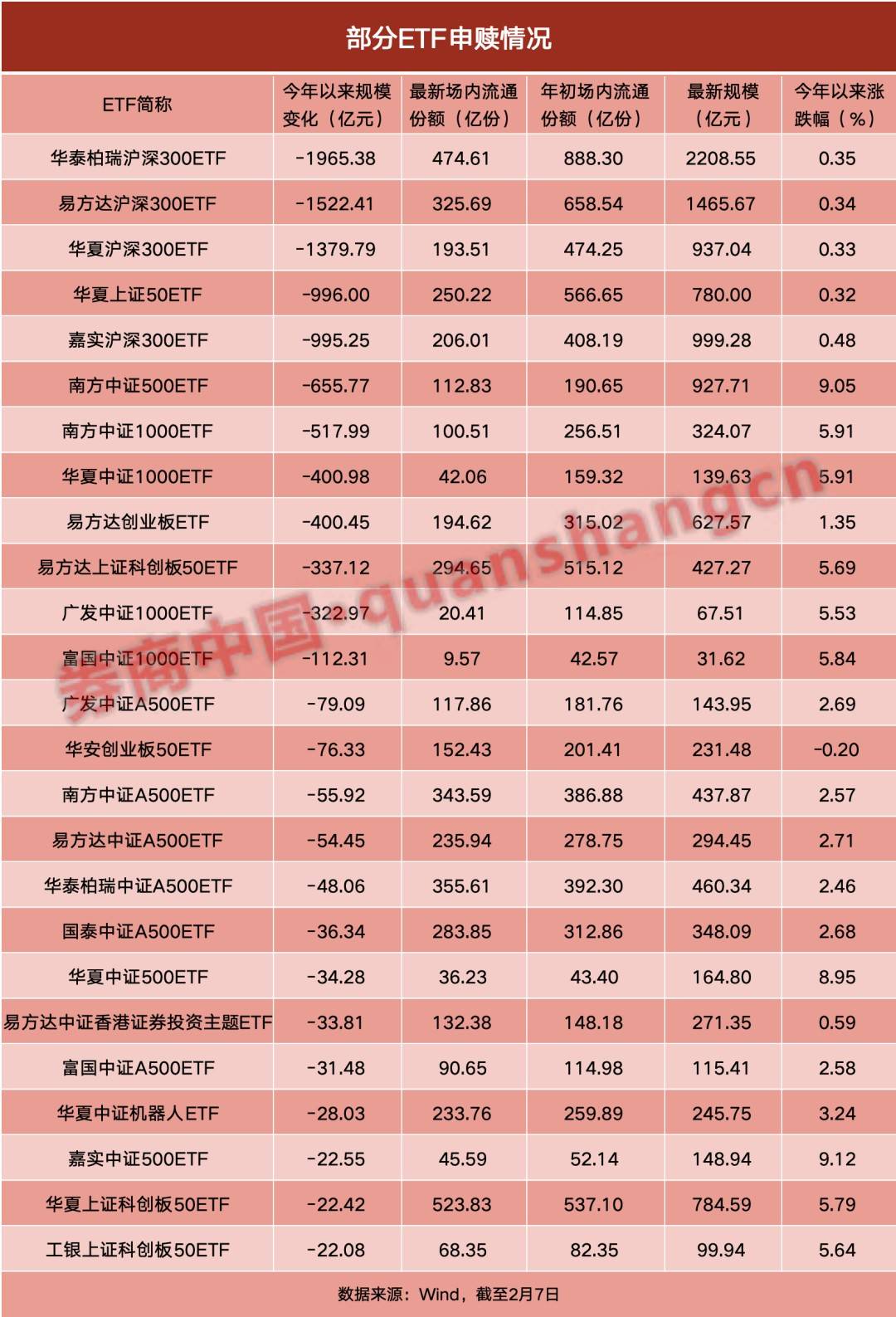
Core Viewpoint - The article discusses the significant outflows from broad-based ETFs since the beginning of the year, highlighting the importance of understanding the underlying behaviors of funds rather than reacting to market fluctuations [1] Group 1: ETF Fund Flows - Many ETFs have experienced substantial shrinkage in scale, with net outflows occurring for over ten consecutive trading days, peaking at over 130 billion [1] - Specific ETFs such as Huatai-PB CSI 300 ETF, E Fund CSI 300 ETF, and others have seen significant reductions in scale, with declines of 196.54 billion, 152.24 billion, and 137.98 billion respectively [2] Group 2: Institutional Participation - The article emphasizes the importance of identifying whether large institutional funds are actively participating in trading, as indicated by "institutional inventory" data [3] - Continuous participation from large funds suggests stability in the underlying asset, while a lack of participation can indicate potential volatility [5] Group 3: Market Adjustments - Market adjustments may not always indicate fund withdrawals; they can also reflect large funds engaging in "institutional shakeouts" to consolidate positions [8][10] - The presence of "institutional shakeouts" indicates that large funds are actively managing their positions, which can provide a foundation for future strategies [13] Group 4: Quantitative Analysis - Quantitative data offers a more objective perspective on market movements, helping to distinguish between panic and strategic adjustments by institutions [14] - Understanding the true motivations behind fund flows can lead to more rational investment decisions, moving beyond emotional reactions to market volatility [14]

东方电气股价涨5.2%,易方达基金旗下1只基金位居十大流通股东,持有1501.59万股浮盈赚取2387.52万元
Xin Lang Cai Jing· 2026-02-12 02:30
Group 1 - The core point of the news is that Dongfang Electric Co., Ltd. experienced a stock price increase of 5.2%, reaching 32.18 yuan per share, with a trading volume of 1.691 billion yuan and a turnover rate of 2.36%, resulting in a total market capitalization of 111.29 billion yuan [1] - Dongfang Electric, established on December 28, 1993, and listed on October 10, 1995, is located in Chengdu, Sichuan Province. The company specializes in the research, manufacturing, sales, and services of various power generation equipment, including thermal, hydro, wind, nuclear, and gas power generation equipment [1] - The revenue composition of Dongfang Electric includes: 43.95% from clean and efficient energy equipment, 27.32% from renewable energy equipment, 11.52% from emerging growth industries, 8.98% from modern manufacturing services, and 8.23% from engineering and supply chain businesses [1] Group 2 - Among the top circulating shareholders of Dongfang Electric, E Fund's Hu Shen 300 ETF (510310) reduced its holdings by 482,700 shares in the third quarter, now holding 15.0159 million shares, which accounts for 0.62% of the circulating shares [2] - The E Fund Hu Shen 300 ETF (510310) was established on March 6, 2013, with a latest scale of 300.22 billion yuan. Year-to-date returns are 1.99%, ranking 4339 out of 5569 in its category; the one-year return is 24.68%, ranking 2710 out of 4295; and since inception, the return is 143.07% [2]

ETF业绩跟踪及资金流动周报-20260211
SINOLINK SECURITIES· 2026-02-11 02:39
Report Overview - The report is titled "ETF Performance Tracking and Fund Flow Weekly Report (2026.1.26 - 2026.1.30)" and was released on February 2, 2026 [1] Core Viewpoints - Overseas ETF funds showed a continuous return trend, with a net inflow of 2.055 billion yuan in the past week, which was lower than the previous week. Large - cap style targets such as CSI 300 and CSI A500 received significant capital inflows, and the electronics industry had the most concentrated capital inflow at the industry level. Overseas funds continued to be positive about the allocation of relevant ETFs, focusing on core assets at the industry level and being relatively balanced at the individual stock level [16] Key Points by Category 1. Broad - based ETFs Average Weekly Returns and Fund Flows - The report presents the average weekly returns and fund inflows/outflows of broad - based ETFs [1][2] Top 10 Funds with Inflows - Funds like LIELEAS NEASOOETF (fund code: 563360.OF) had a net inflow of 1.126 billion yuan, Tianhong CSI Science and Technology Innovation and Entrepreneurship 50 ETF (fund code: 159603.OF) had a net inflow of 928 million yuan, etc [4] Top 10 Funds with Outflows - E Fund CSI 300 ETF (fund code: 510310.OF) had a net outflow of 7.4857 billion yuan, Huatai - Peregrine CSI 300 ETF (fund code: 510300.OF) had a net outflow of 7.4319 billion yuan, etc [6] 2. Industry - themed, Smart Beta, and Hong Kong Stock Connect ETFs Average Weekly Returns and Fund Flows - It includes the average weekly returns and fund inflows/outflows of industry - themed, Smart Beta, and Hong Kong Stock Connect ETFs. For example, in the Smart Beta ETF, different categories such as cycle, green/ESG, etc., had different fund inflow/outflow situations [7][8] Hong Kong Stock Connect ETFs - The average weekly returns and fund inflows/outflows of Hong Kong Stock Connect ETFs in different categories like technology, finance, etc., are presented. For instance, the technology - themed Hong Kong Stock Connect ETF had a net inflow of 1.76 billion yuan [9][12] 3. Equity ETFs - The report provides statistics on the number, scale, and trading volume of equity ETFs, including different index - corresponding funds, their scale, scale proportion, trading volume, and trading volume proportion [13][14] 4. Overseas ETFs Weekly Fund Flows - Overseas ETF funds had a net inflow of 2.055 billion yuan in the past week. Large - cap style targets like CSI 300 and CSI A500 had significant capital inflows, with 1.562 billion yuan and 1.51 billion yuan respectively. The electronics industry had the most concentrated capital inflow of 384 million yuan [16][23] Individual Stock Capital Inflows - Among individual stocks, Kweichow Moutai had the largest capital inflow of 65 million yuan, followed by Contemporary Amperex Technology Co., Limited with 44 million yuan [16][17]
景顺长城:麦高证券麦高金工团队
Mai Gao Zheng Quan· 2026-02-10 11:26
- The report introduces the **RSI (Relative Strength Index)** as a quantitative factor. The construction idea is to measure the relative strength of price movements over a specific period to identify overbought or oversold conditions. The formula is: $ RSI = 100 - \frac{100}{1 + RS} $, where $ RS $ is the ratio of the average gain to the average loss over a 12-day period. $ RSI > 70 $ indicates an overbought market, while $ RSI < 30 $ indicates an oversold market[2] - Another quantitative factor mentioned is **Net Subscription (NETBUY)**, which measures the net inflow or outflow of funds in ETFs. The formula is: $ NETBUY(T) = NAV(T) - NAV(T-1) \times (1 + R(T)) $, where $ NAV(T) $ is the net asset value on day $ T $, $ NAV(T-1) $ is the net asset value on the previous day, and $ R(T) $ is the return on day $ T $[2] - The report also highlights **Intraday Trend Analysis**, which uses 5-minute interval transaction prices to construct intraday price trends. Red dots mark the highest and lowest prices of the day. However, due to data limitations, some intraday data may be incomplete[2] - The **Institutional Holding Ratio** is another factor, calculated based on the latest annual or semi-annual reports of ETFs, excluding holdings by linked funds. The data is an estimate and may have deviations[3] - The report provides detailed tracking of various ETFs categorized into "broad-based" and "thematic" indices, such as CSI 300, CSI 500, and sector-specific indices like non-bank financials and dividends. These indices serve as benchmarks for ETF performance evaluation[2][4] - The report includes a comprehensive table of ETF performance metrics, such as RSI values, net subscription amounts, and institutional holding ratios, for various ETFs tracking indices like CSI 300, CSI 500, CSI 1000, and others. For example, the RSI for CSI 300 ETFs ranges from 50.04 to 54.02, while net subscription values vary significantly across ETFs[4] - The report also tracks thematic ETFs, such as those focused on semiconductors, artificial intelligence, and renewable energy, providing performance metrics like RSI, net subscription, and institutional holding ratios. For instance, the RSI for semiconductor ETFs ranges from 49.16 to 50.40, while net subscription values show significant variation[7]
宝信软件股价涨5.05%,易方达基金旗下1只基金位居十大流通股东,持有1063.16万股浮盈赚取1190.74万元
Xin Lang Ji Jin· 2026-02-09 06:43
Group 1 - The core point of the news is that Baosight Software's stock price increased by 5.05%, reaching 23.30 CNY per share, with a trading volume of 495 million CNY and a turnover rate of 1.02%, resulting in a total market capitalization of 66.889 billion CNY [1] - Baosight Software, established on August 15, 1994, is located in the China (Shanghai) Pilot Free Trade Zone and was listed on March 11, 1994. The company specializes in research, design, development, manufacturing, integration, and related outsourcing, maintenance, and consulting services for computer, automation, and network communication systems [1] - The main revenue composition of Baosight Software includes software development and engineering services at 64.02%, service outsourcing at 35.31%, system integration at 0.48%, and other supplementary services at 0.20% [1] Group 2 - Among the top ten circulating shareholders of Baosight Software, E Fund's HuShen 300 ETF (510310) reduced its holdings by 366,700 shares in the third quarter, now holding 10.6316 million shares, which accounts for 0.37% of the circulating shares. The estimated floating profit today is approximately 11.9074 million CNY [2] - E Fund's HuShen 300 ETF (510310) was established on March 6, 2013, with a current scale of 300.22 billion CNY. Year-to-date return is 0.45%, ranking 4397 out of 5580 in its category; the one-year return is 24.09%, ranking 2737 out of 4290; and the return since inception is 139.41% [2] Group 3 - The fund managers of E Fund's HuShen 300 ETF (510310) are Yu Haiyan and Pang Yaping. As of the report, Yu Haiyan has a cumulative tenure of 15 years and 66 days, with a total fund asset scale of 433.297 billion CNY, achieving a best fund return of 174.06% and a worst return of -78.9% during the tenure [3] - Pang Yaping has a cumulative tenure of 7 years and 116 days, managing a total fund asset scale of 368.472 billion CNY, with a best fund return of 114.63% and a worst return of -37.67% during the tenure [3]

铜陵有色股价跌5.09%,易方达基金旗下1只基金位居十大流通股东,持有9447.53万股浮亏损失3684.54万元
Xin Lang Cai Jing· 2026-02-05 02:26
Group 1 - The core point of the news is that Tongling Nonferrous Metals Group Co., Ltd. experienced a 5.09% drop in stock price, closing at 7.27 yuan per share, with a trading volume of 2.169 billion yuan and a turnover rate of 2.63%, resulting in a total market capitalization of 97.487 billion yuan [1] - The company, established on November 12, 1996, and listed on November 20, 1996, is primarily engaged in copper mining, smelting, and processing, with its main revenue sources being copper products (83.78%), gold and other by-products (13.58%), chemical and other products (2.18%), and others (0.46%) [1] Group 2 - Among the top ten circulating shareholders of Tongling Nonferrous, E Fund's Hu Shen 300 ETF (510310) reduced its holdings by 3.0215 million shares in the third quarter, now holding 94.4753 million shares, which accounts for 0.85% of the circulating shares, resulting in an estimated floating loss of approximately 36.8454 million yuan [2] - The E Fund Hu Shen 300 ETF was established on March 6, 2013, with a current scale of 300.22 billion yuan, showing a year-to-date return of 1.59% (ranking 4353 out of 5566) and a one-year return of 26.33% (ranking 2766 out of 4285), with a cumulative return since inception of 142.12% [2] Group 3 - The fund managers of E Fund Hu Shen 300 ETF are Yu Haiyan and Pang Yaping, with Yu having a tenure of 15 years and 62 days, managing assets totaling 433.297 billion yuan, achieving a best return of 174.06% and a worst return of -78.9% during his tenure [3] - Pang has a tenure of 7 years and 112 days, managing assets of 368.472 billion yuan, with a best return of 114.63% and a worst return of -37.67% during his tenure [3]
