
顺周期板块

Search documents
抄底布局?
第一财经· 2026-03-26 10:51
Market Overview - The A-share market is experiencing an adjustment pattern, with the Shanghai Composite Index opening lower and showing volatility, primarily due to weak support from heavyweight sectors [5] - The Shenzhen Component and ChiNext Index have seen larger adjustments, with previously leading sectors such as computing power, CPO, and consumer electronics collectively realizing profits, contributing to the decline [5] Trading Activity - A total of 915 stocks rose, but there is a clear divergence with more stocks declining than rising [6] - Lithium materials stocks, including lithium mines, electrolytes, and membranes, performed well, while the power sector continued to show strength. However, popular sectors like photovoltaic equipment, insurance, wind power, national defense, and AI applications have seen adjustments [7] Capital Flow - The total trading volume in both markets decreased by 10.8%, indicating a shift towards risk aversion among investors, with funds moving from high-valuation tech growth sectors (AI, photovoltaic, telecommunications) to undervalued defensive and cyclical sectors [7] - Institutional investors are reallocating funds significantly from sectors such as electronics, computers, media, and gaming, while increasing positions in energy metals, basic chemicals, and power reform stocks [9] Investor Sentiment - Retail investors are entering the market to buy low-priced, small-cap defensive stocks (batteries, lithium mines, power), while reducing exposure to high-valuation tech stocks and speculative themes [9] - The sentiment among retail investors shows that 75.85% are optimistic about the market [10] Positioning - As of March 26, 30.20% of investors increased their positions, while 15.78% reduced their holdings, with another 30.20% remaining neutral [13] - The average position held by investors indicates a significant portion is still holding onto their investments, with 51.66% fully invested and 9.82% in cash [19] Profitability - A survey indicates that 4.35% of investors have achieved over 50% profit, while 4.05% have profits between 20% to 50%. Conversely, 45.05% are facing losses of less than 20% [21]


大摩闭门会:油价冲击对美股的影响
2026-03-16 02:20
Summary of Conference Call Industry or Company Involved - The discussion primarily revolves around the U.S. stock market and its response to geopolitical tensions, particularly in the Middle East, and macroeconomic factors affecting various sectors. Core Points and Arguments 1. **Geopolitical Tensions Impacting U.S. Stocks** - The geopolitical situation in the Middle East is analyzed with three potential scenarios: rapid easing, normalization within 1-2 months, and a prolonged effective blockade of the Strait of Hormuz for over four weeks. Each scenario has different implications for U.S. stock performance [4][5]. 2. **Market Expectations and Stock Performance** - In a rapid easing scenario, cyclical sectors like financials, industrials, and consumer discretionary are expected to lead the market, with small-cap stocks performing best. Concerns over rising energy prices could negatively impact consumer spending, but a reversal in these dynamics could lead to a rebound in consumer discretionary stocks [4][5]. 3. **Current Market Dynamics** - The S&P index is projected to remain within the range of 6700 to 7000 points under current conditions, with quality growth stocks leading the way. The market is influenced by both optimistic and pessimistic factors, including potential government actions to stabilize oil prices and fears of a blockade in the Strait of Hormuz [6][7]. 4. **Investment Recommendations** - The healthcare sector is highlighted as a preferred defensive hedge, with strong earnings revisions, particularly in pharmaceuticals and biotech. The sector is seen as a substitute for consumer staples, which are more sensitive to rising oil prices [9][10]. 5. **Market Sentiment and Earnings Growth** - The team maintains a 17% earnings growth forecast for the year, citing that recent market adjustments are more rotational than indicative of a downturn. Historical data suggests that oil prices would need to rise significantly to impact the earnings cycle negatively [11][12]. 6. **Interest Rates and Inflation Concerns** - There are concerns about inflation potentially accelerating if oil prices remain high, which could affect interest rate expectations. However, the discussion suggests that as long as the Federal Reserve does not significantly worsen growth conditions, earnings growth will continue to be healthy [13][16]. 7. **Valuation and Market Positioning** - The valuation of many sectors, including the 'MAG 7' (the seven largest tech companies), is at historically low levels, providing a favorable risk-reward ratio for investors. The current market environment is seen as rational, with a shift towards quality growth stocks [10][12]. Other Important but Possibly Overlooked Content - The discussion emphasizes the importance of monitoring the yield curve, particularly the 10-year Treasury yield, which is approaching 4.20%. A significant change in this yield could negatively impact stock returns, highlighting a risk factor that investors should be aware of [16].
造纸轻工周报:关注造纸、家居顺周期板块,高股息包装,京东工业发布FY25财报-20260310
Shenwan Hongyuan Securities· 2026-03-10 07:43
Investment Rating - The report maintains a positive outlook on the paper, packaging, and home furnishing sectors, indicating potential for recovery and growth in these industries [5][7]. Core Insights - The paper industry is expected to see price stabilization and improvement in profitability due to a favorable supply-demand balance and rising prices for various paper products [5][8]. - The packaging sector is characterized by stability and high dividend yields, with companies like Yutong Technology and Yongxin Co. showing strong growth potential through strategic acquisitions and market expansion [5][13]. - The home furnishing sector is at a valuation bottom, with supportive real estate policies likely to catalyze upward valuation adjustments, alongside accelerated industry consolidation [5][16]. Summary by Sections Paper Industry - Pulp and paper prices are showing signs of recovery, with price increases expected post-holiday due to improved supply-demand dynamics. The report highlights the strong production control willingness of overseas pulp mills and the upward trend in hardwood pulp prices [8][10]. - Companies to watch include Sun Paper, which benefits from a diversified product range and cost advantages, and Nine Dragons Paper, which is positioned to gain from the recovery in corrugated paper demand [10][12]. Packaging Industry - The packaging sector is stable, driven by global supply chain dynamics and high dividend yields. Yutong Technology is noted for its strategic acquisitions and strong customer relationships, while Yongxin Co. is recognized for its leadership in plastic flexible packaging [13][14]. - The report emphasizes the growth potential of Zijiang Enterprise, which is expanding its beverage packaging business and optimizing its product structure [14]. Home Furnishing Industry - The home furnishing sector is expected to benefit from improving real estate policies, which may enhance consumer confidence and demand. The report identifies key players such as Kuka Home and Sophia, which are well-positioned for valuation recovery [16][19]. - The report notes that the industry is undergoing consolidation, with mid-tier companies exiting the market, allowing leading firms to capture greater market share [19][20]. Company Updates - JD Industrial reported a revenue of 23.95 billion yuan for FY25, a 17% year-on-year increase, driven by growth in key accounts [17]. - The report highlights the strong performance of various home furnishing companies, including Kuka Home and Sophia, which are adapting to market changes and enhancing their retail capabilities [27][30].


2026年3月策略观点:春归-20260302
EBSCN· 2026-03-02 02:46
Group 1 - The report indicates a transition from a volatile fourth quarter to a spring market rally, with February showing initial fluctuations followed by a recovery, attributed to pre-holiday trading slowdown and short-term policy impacts [3][5][11] - The spring market is expected to continue, with increased trading activity post-Chinese New Year, supported by upcoming economic data releases and the National People's Congress in March, which will set the policy tone for the year [3][46][50] - The report suggests focusing on growth and cyclical sectors, with small-cap stocks likely to outperform due to increased risk appetite and the influx of retail investors, highlighting sectors such as humanoid robots, computing, and AI as key areas of interest [3][88][90] Group 2 - The report emphasizes the importance of monitoring external uncertainties, particularly geopolitical tensions in the Middle East, which could impact market sentiment and performance [3][76][78] - It notes that historical patterns show small-cap stocks tend to perform better during spring rallies, with a significant focus on growth and cyclical sectors based on past performance trends [3][88][90] - The report outlines specific policy measures in Shanghai aimed at stabilizing the real estate market, which may influence investor sentiment and market dynamics [67]
陆家嘴财经早餐2026年3月2日星期一
Wind万得· 2026-03-01 22:49
Group 1 - Iran's Supreme Leader Khamenei was assassinated on February 28, leading to a 40-day national mourning and an upcoming election for a new Supreme Leader. US President Trump indicated that military actions against Iran could last around four weeks, and he expressed willingness to engage in dialogue with the new leadership [3][5][17]. - The Iranian stock market halted trading following the escalation of conflict, impacting financial markets in the Middle East. Saudi Arabia's stock index fell by 2.18%, while Egypt's EGX30 index dropped by 2.5% [3][5]. - The geopolitical tensions have led to significant disruptions in shipping, with major shipping companies avoiding the Persian Gulf and halting operations in the region [14][20]. Group 2 - Multiple new energy vehicle companies reported their February delivery data, with Li Auto delivering 26,421 vehicles and NIO delivering 20,797 vehicles. These companies are also offering promotional activities for March, including low-interest plans and tax subsidies [6][10]. - The China Securities Regulatory Commission announced that the National People's Congress will convene on March 4, 2026, to discuss the government work report and the 14th Five-Year Plan [6][10]. - The OPEC+ group has agreed in principle to increase oil production by 206,000 barrels per day starting in April, with further adjustments to be determined in future meetings [20]. Group 3 - The Hang Seng Technology Index fell by 6.86% in the first two months of the year, but southbound capital from mainland China continued to flow into Hong Kong stocks, with net purchases of 68.97 billion yuan and 90.57 billion yuan in January and February, respectively [7][8]. - The A-share market has shown a recovery in sentiment post-Chinese New Year, with nearly 90% of active equity funds achieving positive returns year-to-date, driven by resource and technology sectors [8][11]. - The price of PC DRAM products increased by 13.04% in February, marking the 11th consecutive month of price growth, attributed to rising demand from AI investments [11].

策略周报:两会前后市场如何演绎?
Guoxin Securities· 2026-02-28 10:50
Market Performance Insights - Historical data shows a high probability of market gains before and after the Two Sessions, with the probability of increase being 76.2% for the Shanghai Composite Index in the 20 trading days before the sessions[19] - The average gain for the Shanghai Composite Index before the Two Sessions is 1.8%, while the average gain after is 3.1%[20] - The probability of small-cap stocks outperforming large-cap stocks is nearly 90% before the Two Sessions, but drops to 50% afterward[20] Sector Analysis - Resource sectors such as steel and non-ferrous metals have shown high probabilities of gains before the Two Sessions, with probabilities exceeding 80%[22] - Consumer sectors tend to perform better during the Two Sessions, with a 60% probability of gains in industries like food and beverage[20] - Post-Two Sessions, real estate and consumer sectors have a high probability of gains, with real estate at 76.2%[20] Policy Impact - The Two Sessions serve as a critical window for observing economic policy directions, influencing market sentiment and performance[24] - Pre-Two Sessions, there is typically an increase in growth-stabilizing policy expectations, leading to active trading[24] - Post-Two Sessions, the acceleration of policy implementation often boosts optimistic market expectations, particularly for cyclical sectors[24] Current Market Conditions - The spring market rally continues, with the Shanghai Composite Index showing a 3.7% increase since February 3, and a recent weekly gain of 2.0%[1] - Recent trading volumes have increased, with average daily trading rising from 2.1 trillion to 2.4 trillion yuan[1] - Leverage funds have shifted from outflows to inflows, indicating improved market sentiment, with net purchases reaching 258.7 billion yuan recently[1] Investment Strategy - A balanced allocation strategy is recommended, focusing on sectors like AI applications, resources, and real estate, given the current market dynamics[29] - The anticipated continuation of the spring rally is supported by positive macroeconomic policies and increased liquidity in the market[28] - The focus on expanding domestic demand is expected to be a key theme in the upcoming Two Sessions, influencing investment opportunities[24]
策略周报:两会前后市场如何演绎?-20260228
Guoxin Securities· 2026-02-28 09:26
Core Conclusions - Historical data indicates a high probability of market gains before and after the Two Sessions, with cyclical industries showing stronger performance [2][19] - Market performance around the Two Sessions is closely tied to policy expectations, which significantly influence market trends [3][24] - The spring market rally is expected to continue, supported by multiple positive factors, with a balanced allocation strategy recommended, particularly emphasizing AI applications and sectors like resources, real estate, and liquor [1][28] Market Performance Analysis - Since mid-December last year, the spring market rally has gradually unfolded, with a notable increase in trading volume post-holiday. The Shanghai Composite Index has seen a rise of 3.7% from February 3 to the present, with the CSI 300 and the Wind All A Index increasing by 2.3% and 5.2%, respectively [1][13] - Historical analysis from 2005 onwards shows that the market tends to rise significantly in the 20 trading days before the Two Sessions, with probabilities of 76.2% for the Shanghai Composite Index and 85.7% for the Wind All A Index [19][20] Style and Sector Performance - Before the Two Sessions, small-cap stocks outperform, with an 85.7% probability of gains, while post-Two Sessions, the performance of large-cap stocks improves [20][22] - Cyclical sectors tend to perform better before and after the Two Sessions, with resource sectors like steel and non-ferrous metals showing high probabilities of gains [20][22] Policy Influence - The Two Sessions serve as a critical window for observing economic policy directions, with expectations for stable growth policies to rise before the meetings, leading to increased trading activity [3][24] - Post-Two Sessions, as policies are clarified and implemented, there is often a seasonal uptick in high-frequency data, which can enhance optimistic market expectations [3][24] Investment Opportunities - The report suggests a balanced investment approach, focusing on cyclical sectors and real estate, alongside technology driven by AI applications. The resource sector is expected to benefit from domestic policies and global liquidity conditions [28][29] - The real estate sector is highlighted as having a 76.2% probability of gains post-Two Sessions, with recent policy changes in major cities indicating a recovery in the housing market [20][29]
兴银收益增强A(003628)净值再创新高,获济安金信二级债五星基金评级!
Sou Hu Cai Jing· 2026-02-26 03:17
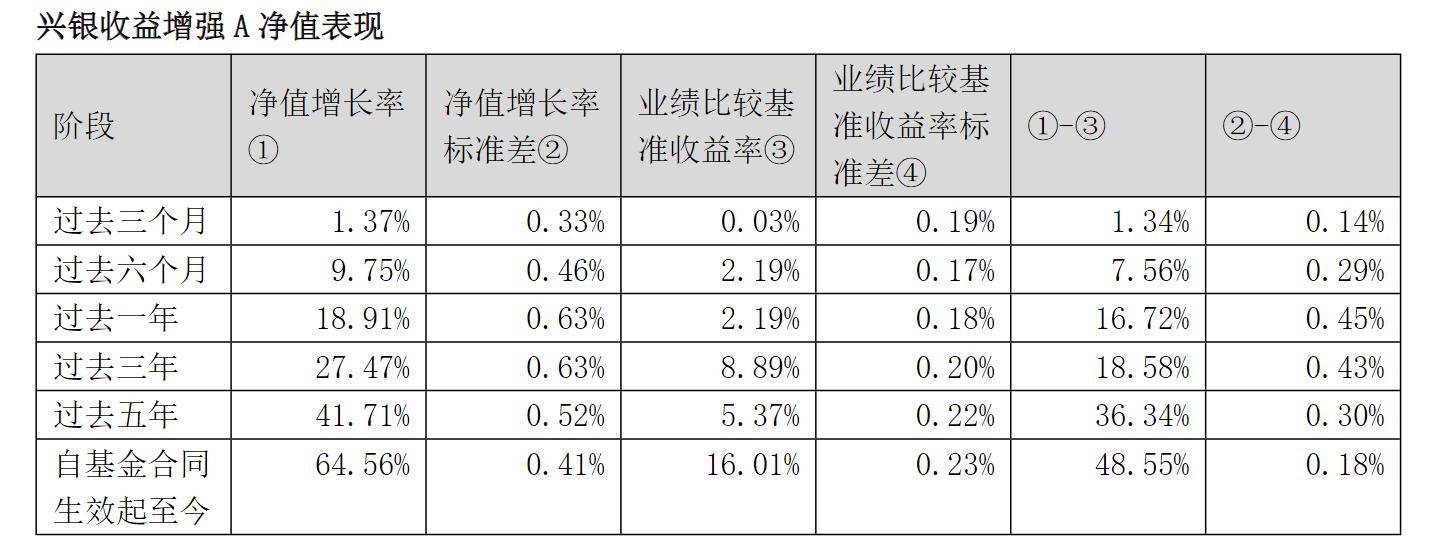
Core Viewpoint - The article highlights the strong performance of the Xingyin Enhanced Income A fund (003628), which has achieved a historical net value high and significant returns over various time frames, indicating its competitive position in the market [1][2]. Performance Summary - As of February 25, the latest net value of Xingyin Enhanced Income A is 1.3789 yuan, with a daily increase of 0.20%, marking a new historical high [1]. - The fund has delivered a return of 45.39% over the past five years, ranking 25th out of 576 similar funds [1]. - According to the fourth-quarter rating results from Jinan Jinxin Fund Evaluation Center, Xingyin Enhanced Income A is among 46 secondary bond funds that received a five-star rating [1]. - The fund's performance metrics include: - 1-year return: 18.91%, exceeding the benchmark return of 16.72% [1][2] - 5-year return: 41.71%, surpassing the benchmark return of 5.37% [2] - Since inception return: 64.56%, exceeding the benchmark return of 16.01% [2]. Asset Allocation - The fund's asset allocation as of the latest quarterly report shows: - Equity assets account for 16.11% of the portfolio, while bond assets make up 81.17% [2]. - Within the bond allocation, government bonds constitute 54.33% of the net value, a decrease of 17.58% from the previous period, while convertible bonds represent 26.78%, an increase of 16.84% [2]. - The primary industry allocation for equities is in manufacturing, which accounts for 14.06%, a decrease of 1.38% from the previous period [2]. Manager Insights - The fund managers express optimism for the upcoming year, noting that both PPI and inventory levels are low, which may benefit cyclical sectors [3]. - They highlight that the consumer sector, after years of decline, is now at a reasonable valuation, with potential for strong companies to emerge across various consumption categories [3]. - The managers also emphasize the competitive strength of Chinese companies as they expand into high-end overseas markets, enhancing confidence in growth potential [3].
重稀土价格显著上涨!有色金属 ETF 天弘(159157)标的指数涨超4.6%,连续7日吸金,近10日资金净流入超10.67亿元
Ge Long Hui A P P· 2026-02-25 02:53
Group 1 - The cyclical sectors in A-shares continue to strengthen, with Xiyie Co. hitting the daily limit, and rare earth permanent magnet concepts rising, leading to Northern Rare Earth increasing by over 9% and China Rare Earth by over 5% [1] - The Tianhong ETF (159157) focused on non-ferrous metals has seen continuous net inflows, accumulating over 1.067 billion yuan in the last 10 days, with a current scale of 2.159 billion yuan [1] - The Tianhong ETF primarily targets industrial metals, with copper, aluminum, and rare earths making up nearly 70% of its portfolio, including leading companies like Luoyang Molybdenum, Northern Rare Earth, and China Aluminum [1] Group 2 - Heavy rare earth prices have significantly increased, with Yttrium reaching 850 USD/kg and Dysprosium at 1100 USD/kg, marking the highest levels since 2015 due to ongoing supply concerns [1] - London base metals saw a broad increase, with Citigroup optimistic about copper prices, predicting they will reach 14,000 USD per ton in the next three months, while JPMorgan forecasts an average aluminum price of 3,200 USD per ton by Q2 2026 [1]


金融市场流动性与监管动态周报:历史上两会前后A股风格如何演绎?-20260224
CMS· 2026-02-24 14:31
Market Performance - Historically, A-shares tend to perform well in the two weeks leading up to the National People's Congress (NPC), with a probability of over 50% for indices like the CSI 1000 and CSI 500 to rise, averaging over 3% returns in the two weeks prior [9][18] - After the NPC, the probability of market increases rises significantly, with indices like the CSI 1000 and CSI 500 showing a 64% probability of rising in the weeks following the congress [9][18] Style Performance - There is a calendar effect observed in A-shares around the NPC, where small-cap stocks generally outperform both before and after the congress, driven by expectations of stable growth policies and active financing [12][18] - The small-cap growth and value styles are expected to dominate during the NPC period, while large-cap styles may gain traction in the month following the congress [12][18] Industry Performance - Industries such as basic chemicals, non-ferrous metals, and construction materials show strong performance before and after the NPC, with over 50% probability of rising in the weeks leading up to the congress [14][18] - Post-NPC, industries like real estate, construction materials, and consumer goods are expected to see higher probabilities of increases as stable growth policies are implemented [16][18] Liquidity and Funding - The liquidity indicators show a net outflow of financing funds amounting to 830.2 billion yuan, with a significant drop in ETF inflows [30][36] - The issuance of public funds increased by 340.3 million units, indicating a rise in demand for equity investments despite the overall net outflow [30][36] Market Sentiment - Market sentiment has shown a decrease in trading activity, with the proportion of financing transactions in A-share trading falling to 8.6% [44] - The VIX index has decreased, indicating improved risk appetite in the market, with the Nasdaq and S&P 500 indices also showing positive performance [46][48]