个人互联网消费贷款

Search documents
冰与火之歌:2025,消费金融的“生存”与“进化”
21世纪经济报道· 2025-12-28 23:14
Core Viewpoint - The consumer finance industry, having developed for 15 years since the first pilot companies were approved in 2010, is entering a transformative phase as it approaches 2025, characterized by strong regulatory pressures and the integration of AI technologies to enhance operational efficiency [1][2]. Group 1: Industry Challenges - The consumer finance sector is experiencing a significant market reshuffle due to stringent regulations, including the new lending rules and restrictions on cross-regional operations by banks, leading to a deep restructuring of products and business models [2][3]. - The introduction of a "white list" for licensed financial institutions in lending partnerships has intensified competition, concentrating market resources among leading players while pushing out weaker institutions [2][3]. - The new regulations have particularly impacted "suboptimal customers" with poor credit quality, as the cap on comprehensive loan interest rates at 24% has restricted their access to financing, leading to a contraction in available credit [2][3]. Group 2: Market Dynamics - The consumer finance industry is facing short-term "growing pains" due to increased competition, shrinking profit margins, and pressure on asset quality, particularly affecting smaller financial institutions [3][4]. - The competitive landscape is further complicated by the lower funding costs enjoyed by commercial banks, which allows them to offer more attractive rates to higher-quality borrowers, thereby squeezing the market for consumer finance companies [4][5]. - Consumer finance companies are in a precarious position, needing to balance their service offerings between high-risk, high-return clients and more stable, lower-risk customers to align with regulatory expectations [4][5]. Group 3: Technological Integration - To achieve high-quality development, consumer finance companies must enhance their self-operated channels, accumulate data assets, and establish independent risk control systems, thereby creating a digital ecosystem [5][6]. - Technology is becoming a crucial component for consumer finance companies, with leading firms investing significantly in tech development to improve their operational capabilities and customer service [5][6]. - For instance, a prominent player in the market has invested over 4 billion yuan in technology research and development since its inception, focusing on creating a comprehensive system for risk management throughout the lending process [5][6]. Group 4: Future Directions - The consumer finance industry is moving towards a new phase of high-quality development, emphasizing inclusivity, digital intelligence, and quality service [6][7]. - Companies are encouraged to integrate their strengths with those of licensed financial institutions to enhance operational efficiency and ensure compliance, thereby achieving synergistic benefits [7]. - As the industry approaches maturity, there is a recognition that growth must not only focus on scale but also on the quality of products and services, leveraging technology to build a competitive edge [7].


中小银行开始“切割”助贷业务
Jing Ji Guan Cha Wang· 2025-11-12 07:13
Core Viewpoint - Increasingly, small and medium-sized banks are distancing themselves from partnerships with lending platforms, primarily due to compliance risks associated with internet lending practices [1][2]. Group 1: Changes in Collaboration with Lending Platforms - Many small and medium-sized banks plan to significantly reduce the number of lending institutions they collaborate with, retaining only a few top-tier platforms [1]. - Some banks have already begun to "cut off" lending business, with Urumqi Bank announcing the cessation of cooperative personal internet consumer loans as of October 1 [1]. - The implementation of the new regulations on internet lending has prompted banks to reassess their partnerships, leading to a trend of "cutting" lending business to mitigate compliance risks [1][2]. Group 2: Compliance Risks and Regulatory Environment - The new regulations have revealed that some lending platforms continue to offer loans with annual interest rates between 24% and 36%, raising concerns among banks about potential regulatory penalties [2]. - Banks are increasingly worried about compliance risks associated with lending platforms, leading them to wait for existing contracts to expire before discontinuing partnerships [2][3]. - Regulatory scrutiny has intensified, with banks facing detailed checks on compliance processes, including potential violations related to bundled services and hidden fees [3]. Group 3: Impact on Lending Business - The decision to cut lending partnerships has resulted in a significant drop in business volume for lending institutions, with reports indicating a decrease of over 20% in October [4]. - The success rate of loan collection efforts has also declined, with the M1 collection success rate dropping to 70%, leading to an increase in potential bad debt rates [4]. - As a result of these challenges, lending institutions are restructuring their risk management systems to focus on borrower repayment capabilities and intentions [4][5].
洪偌馨:中小银行,「断尾」助贷
Xin Lang Cai Jing· 2025-11-10 00:53
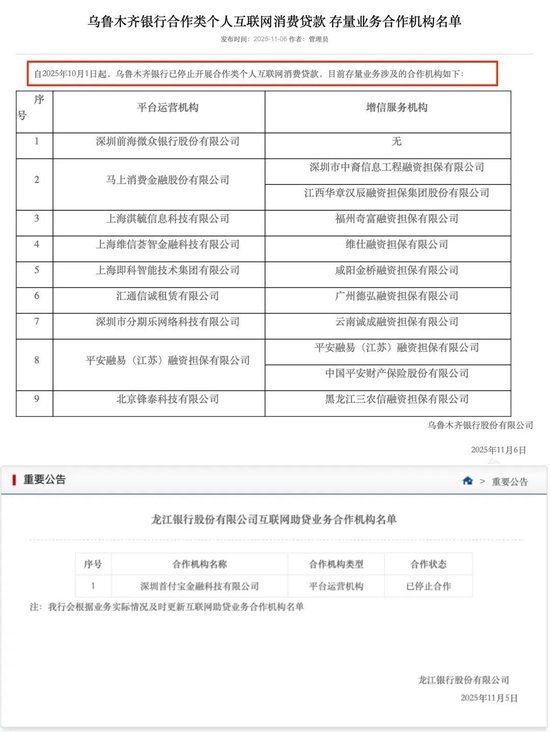
Core Viewpoint - An increasing number of small and medium-sized banks are withdrawing from the internet lending market due to regulatory pressures and diminishing profitability of such operations [1][5]. Group 1: Bank Actions - Urumqi Bank announced the cessation of cooperative personal internet consumer loans effective October 1, 2025 [2][3]. - Guizhou Bank stated that it has completed its cooperation with internet banks and is focusing on managing existing business rather than expanding into new internet platform collaborations [2]. - Longjiang Bank has only one cooperative institution listed, which has also ceased collaboration, indicating a significant reduction in internet lending activities [2]. Group 2: Market Dynamics - The profitability of internet lending has decreased, leading many small banks to reduce their involvement in this sector, as personal consumer loans represent a minimal portion of their overall loan balances (less than 3% for Urumqi Bank and around 4% for Longjiang Bank) [6]. - Guizhou Bank reported a more than 70% increase in its personal comprehensive consumer loans (excluding credit cards) in Q3 2025, indicating a shift towards developing in-house digital credit capabilities [6]. Group 3: Regulatory Impact - The implementation of the "9th Document" has prompted banks to reassess their internet lending strategies, as it imposes stricter compliance requirements and limits on interest rates and fees [5][9]. - The document requires banks to consider all potential service fees and costs in their pricing, which has made it challenging for many lending platforms to maintain profitability [9]. Group 4: Industry Trends - The market for internet lending is becoming increasingly competitive, with major players like Ant Group and ByteDance dominating the landscape, holding a 76% share of the market by 2024 [9]. - The shift in focus towards compliance and risk management has led to a contraction in the number of cooperative platforms available to smaller banks, which may struggle to adapt to the new regulatory environment [12][15]. Group 5: Future Outlook - The future for small and medium-sized banks appears challenging, as they will need to rely on their own capabilities rather than partnerships with larger platforms to remain competitive [16].
金融“彩云”促消费 建行云南省分行推出多项创新举措
Zhong Guo Jin Rong Xin Xi Wang· 2025-10-27 02:44
Core Viewpoint - The Construction Bank of Yunnan Province has implemented innovative measures to support the expansion of commodity consumption, service consumption, and the cultivation of new consumption patterns, achieving significant results in the tourism and cultural sectors of Yunnan Province [1][2]. Group 1: Support for Commodity Consumption - The Construction Bank of Yunnan Province has increased the credit limit for personal internet consumption loans from 200,000 yuan to 300,000 yuan and for self-payment amounts from 300,000 yuan to 500,000 yuan [2]. - The bank has actively leveraged the "old-for-new" policy, collaborating with major merchants and shopping centers, resulting in credit card transactions of nearly 445 million yuan and supporting over 20,000 consumers in "old-for-new" purchases [2]. - As of the end of September, the bank's car installment transaction volume reached 2.65 billion yuan, with the proportion of new energy vehicles steadily increasing to 822 million yuan, effectively promoting green consumption [2]. Group 2: Support for Service Consumption - The bank has conducted 2,500 joint marketing activities with merchants this year, focusing on the unique cultural and tourism resources of Yunnan [3]. - The "You Yunnan" tourism scene was launched, creating channels for "Yunnan Gifts" and "Flower Markets," with a total transaction volume of nearly 45,000 transactions and coverage of over 80% of local specialty consumption scenes [3]. Group 3: Cultivation of New Consumption - The bank has enhanced the ecosystem of the "Construction Bank Life" platform, introducing a "zero commission" model to attract merchants and drive customer traffic [3]. - The "Shopping Festival" activities at over 230 bank outlets have generated more than 1 million yuan in transaction volume and served over 50,000 customers [3]. Group 4: Innovative Financial Services - The "One Mobile Phone to Tour the Business District" platform was launched in collaboration with the Yunnan Provincial Department of Commerce, providing free services to merchants and facilitating the issuance of over 48 million yuan in government consumption vouchers [4]. - The platform has attracted 228 business districts and over 270,000 merchants, creating 493 new convenient living circles in cities [4]. Group 5: Support for Agricultural Consumption - The bank has provided 4.5 million yuan in funding support to one-third of the merchants in Xiaowan Village, which has transitioned to develop the tourism industry [4]. - The "Homestay Loan" product, a key financial offering, has been instrumental in supporting tourism consumption, with a current interest rate of only 3.05% [4]. Group 6: Addressing New Consumer Demands - The bank has supported the cultivation of off-season blueberries in Yuxi City, providing over 17 million yuan in credit loans to more than 40 farmers [6]. - The bank's proactive approach to financial innovation is reflected in its commitment to understanding consumer needs and industry dynamics through regular grassroots engagement [6].

重庆:鼓励金融机构在风险可控的前提下加大个人消费贷款投放力度
news flash· 2025-07-18 12:04
Group 1 - The core viewpoint of the article emphasizes the encouragement of financial institutions in Chongqing to increase personal consumption loan issuance under controllable risk conditions [1] - The measures allow for a temporary increase in the upper limit of personal consumption loans and personal internet consumption loans to 500,000 yuan for clients with good credit and significant consumption needs [1] - Financial institutions are encouraged to provide relief to borrowers with good credit who are temporarily facing difficulties through methods such as no-repayment renewals and reasonable adjustments to loan repayment terms [1] Group 2 - The government aims to utilize policy tools like relending to enhance support for consumer credit [1]
助贷平台跟进消费贷提额至30万元
Bei Jing Shang Bao· 2025-04-21 16:20
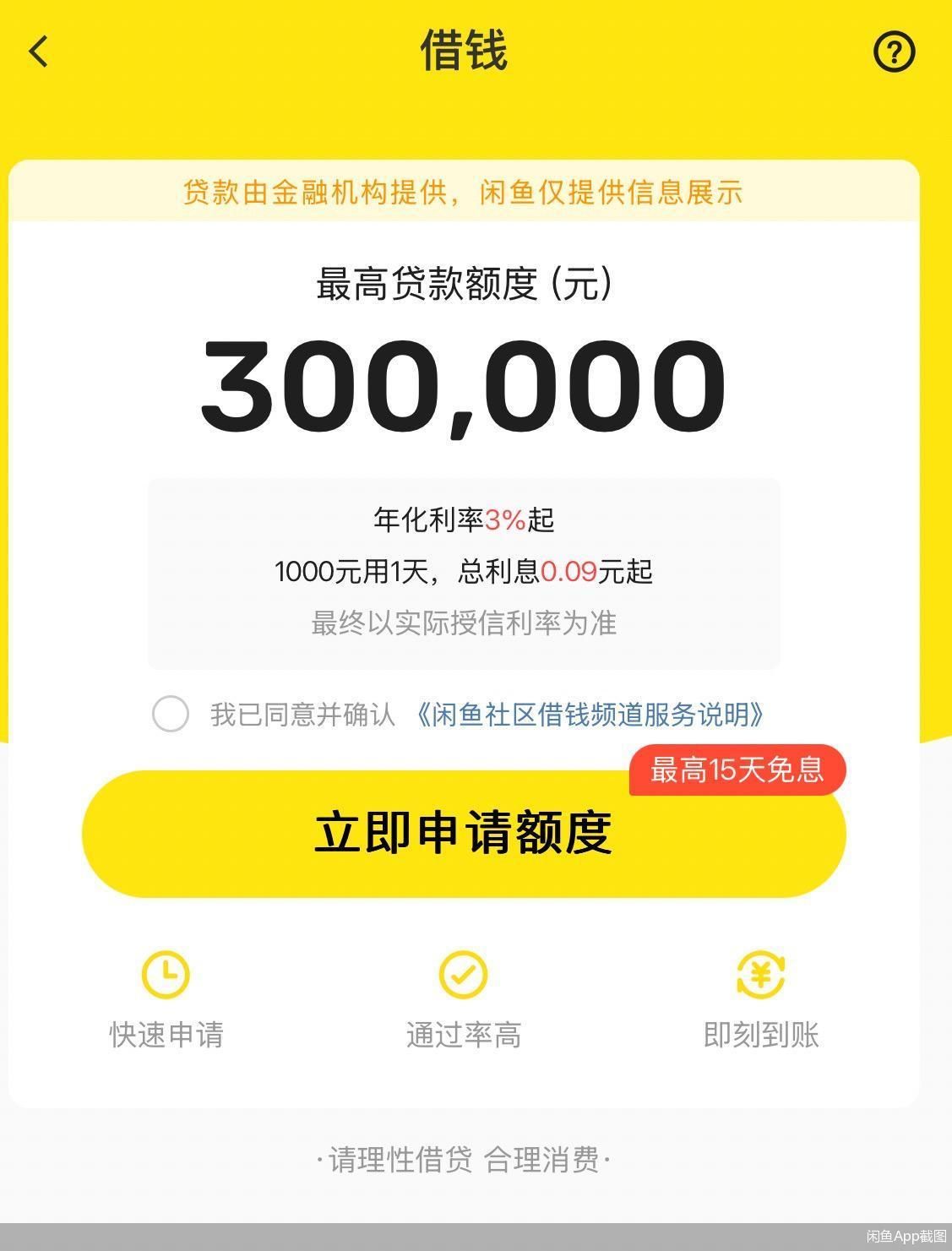
Core Viewpoint - The consumer finance market is undergoing structural adjustments driven by policy changes, with the upper limit for personal internet consumer loans raised from 200,000 yuan to 300,000 yuan, prompting banks and lending platforms to increase their loan limits accordingly [1][2]. Group 1: Loan Limit Adjustments - Major platforms such as Ele.me and Xianyu have raised their maximum personal loan limits to 300,000 yuan, with annual interest rates starting from 3% [1][2]. - Other lending products like JD Finance and Du Xiaoman have also increased their loan limits to 300,000 yuan on third-party channels, although some self-operated products still maintain a limit of 200,000 yuan [2][3]. - The increase in loan limits is seen as a way to stimulate consumer spending, but it also presents new challenges in risk management for financial institutions [1][3]. Group 2: Differentiation Among Platforms - There is a noticeable "cross-platform differentiation" in loan limits, where some platforms offer higher limits for certain products while others do not, reflecting the varying risk assessment standards and funding sources among different financial institutions [2][4]. - Platforms primarily act as marketing channels for licensed financial institutions, showcasing their loan products and limits, which can lead to discrepancies in the actual loan amounts available to consumers [3][4]. Group 3: Future Outlook - Although many platforms are currently taking a wait-and-see approach, there is an expectation that more platforms will follow suit in raising their loan limits in the near future [5].
从20万到30万,助贷平台跟上,意义有多大
Bei Jing Shang Bao· 2025-04-21 13:45
Core Insights - The consumer finance market is undergoing structural adjustments driven by policy changes, specifically the increase of personal internet consumer loan limits from 200,000 yuan to 300,000 yuan [1] - Various banks and lending platforms have responded by raising their loan limits, with notable platforms like Ele.me and Xianyu increasing their maximum loan amounts to 300,000 yuan [2][5] - The increase in loan limits aims to stimulate consumer spending but also presents new risk management challenges for financial institutions [1][11] Group 1: Loan Limit Adjustments - Multiple lending platforms have adjusted their maximum loan limits to 300,000 yuan, with annual interest rates starting at 3% [2][7] - Xianyu and Ele.me have both raised their loan limits, although some third-party products still reflect the previous limit of 200,000 yuan [5][7] - The adjustments are seen as a marketing strategy to attract users and enhance loan volume, with banks responding to policy changes to increase their lending capacity [9][10] Group 2: Risk Management and Operational Challenges - The increase in loan limits is not a panacea for growth, as it introduces higher credit risk exposure, necessitating robust risk management frameworks [11][12] - Analysts suggest that while higher limits can lead to increased revenue from interest and fees, they also heighten the risk of defaults and necessitate more stringent credit assessments [11][12] - The differentiation in loan limits across platforms is attributed to varying funding sources and risk assessment standards among financial institutions [10] Group 3: Future Trends and Recommendations - The industry is expected to see more platforms follow suit in raising loan limits, driven by competitive pressures and favorable policy environments [13][14] - Companies are advised to enhance their risk management capabilities and utilize technology for better credit evaluation and monitoring [13][14] - There is a call for platforms to focus on refined operations and differentiated product offerings to meet diverse customer needs while adhering to regulatory frameworks [14]