丰田卡罗拉Cross

Search documents
销量跳水、利润大跌、拒做纯电,三菱退出中国后日子不好过
Xin Lang Cai Jing· 2026-01-29 12:13
Core Viewpoint - Mitsubishi has officially exited the Chinese market, ceasing production of its brand vehicles, while struggling in other markets, particularly the U.S., where sales have significantly declined [1][4][20]. Group 1: Company Performance - In 2025, Mitsubishi's annual sales in the U.S. reached 94,800 units, a year-on-year decline of 13.7%, which is lower than the sales of the Toyota Corolla Cross in the same period [4][20]. - For the first half of the 2025 fiscal year (April-September 2025), Mitsubishi reported a net loss of 9.2 billion yen, marking its first half-year loss in five years [6][22]. - The company anticipates a drastic 76% reduction in net profit for the entire 2025 fiscal year (April 2025 - March 2026) [6][22]. Group 2: Electric Vehicle Strategy - Mitsubishi has adopted a conservative approach to electrification, having canceled its plans for developing pure electric vehicles independently and instead focusing on plug-in hybrid technology [7][24]. - The company has decided to collaborate with Nissan and Honda for the development of pure electric vehicles, indicating a shift in its strategic priorities [7][24]. Group 3: Market Competition - Despite exiting China, Mitsubishi faces increasing competition from Chinese automakers in Southeast Asia and the Middle East, where it has shifted its focus [13][29]. - In Thailand, Chinese brands occupy five of the top ten sales positions, with BYD and MG selling 41,000 and 22,700 units respectively, surpassing Mitsubishi's 22,400 units [13][29]. - Mitsubishi plans to revive the Pajero model in its Thai factory, highlighting its commitment to the Southeast Asian market, which is also a key area for Chinese automakers [15][31].


日系“铁壁”被攻破,“中国车首次登顶印尼”
Guan Cha Zhe Wang· 2025-11-21 08:53
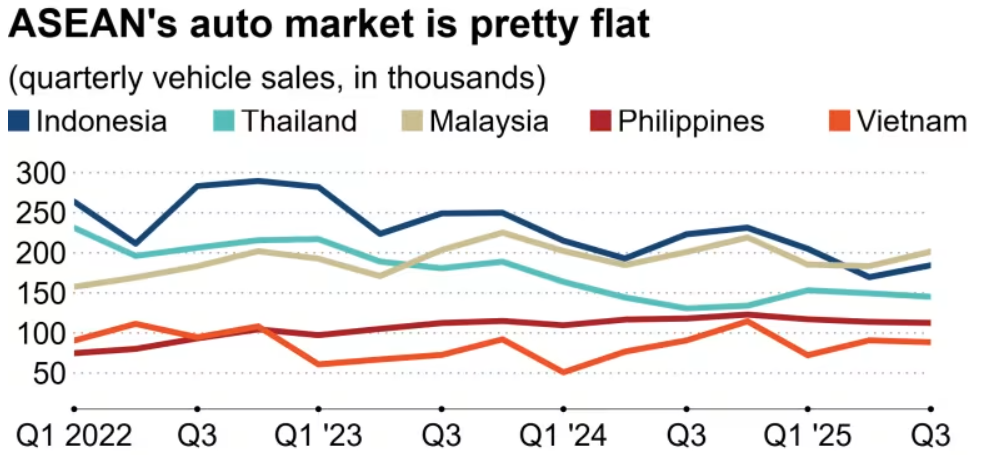
Core Insights - The long-standing dominance of Japanese automakers in Southeast Asia's automotive market is being challenged as demand shifts towards electric vehicles, with Chinese brands like BYD gaining significant traction [1][4] Group 1: Market Overview - In Q3 2023, total automotive sales in the five major Southeast Asian markets reached 731,900 units, a year-on-year decline of 4% but a quarter-on-quarter increase of 4% [4] - Indonesia's automotive sales fell by 17% year-on-year to 184,403 units, marking a 26% drop compared to two years ago, significantly impacting Japanese manufacturers who hold 90% market share [4] - Toyota remains the market leader in Indonesia with a 33.4% market share, but its Q3 sales dropped by 26%, while Daihatsu's sales fell by 24% [4] Group 2: Brand Performance - BYD's Atto 1 electric vehicle surpassed Toyota's Innova and Avanza in sales for the first time in October, with 9,396 units sold [4] - Astra International, Indonesia's largest automotive dealer, reported a 20% year-on-year decline in sales to 34,888 units, with market share dropping from 54% in September to 47% [4] - In Malaysia, automotive sales increased by 3% year-on-year to 201,588 units, supported by a 5.2% GDP growth [5] Group 3: Competitive Landscape - Chinese automakers are reshaping the Malaysian market, with Chery's sales reaching 25,631 units in the first ten months of the year, a 78.2% increase year-on-year, while BYD's electric vehicle sales grew by 56.5% [5] - Chery's growth began in Q3 2023, and it has surpassed Mitsubishi in sales for the first time in Q1 2024, and is on track to overtake Mazda in Q3 2024 [8] - The shift in consumer preference from sedans to SUVs is evident, with Chery's competitively priced models attracting buyers who previously considered Japanese sedans [8]