乾坤系列

Search documents
2025年度商用车品牌影响力指数:龙头格局稳健,电动化转型开启新征程
Zhong Guo Qi Che Bao Wang· 2026-01-26 07:50
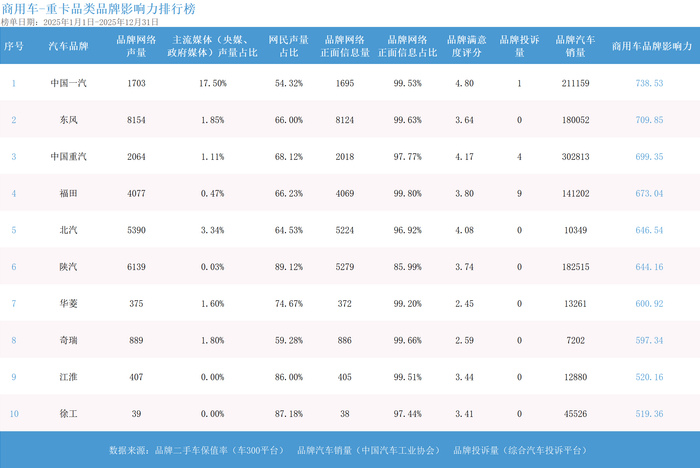
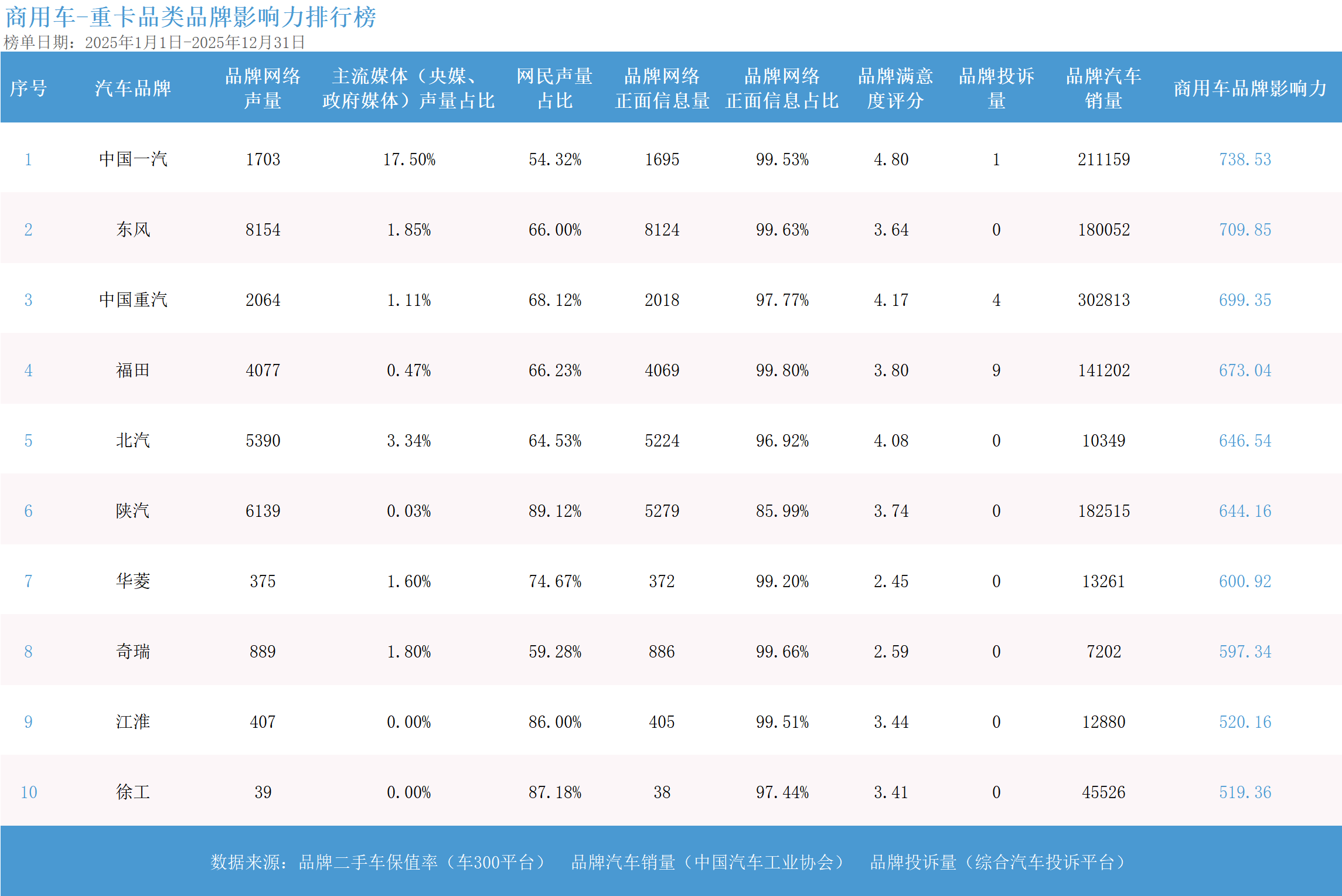
Core Insights - The China Commercial Vehicle Brand Influence Index Report for 2025 was released by the China-Europe Association for Intelligent Connected Vehicles, utilizing data from the China Association of Automobile Manufacturers and a differentiated scientific evaluation model for a comprehensive analysis of the heavy-duty truck, pickup, light truck, and light passenger vehicle segments [1] Group 1: Heavy-Duty Truck Market - The heavy-duty truck market is characterized by a triad of leading companies, with China FAW ranking first with a score of 738.53, showcasing a media presence of 17.50% and a user satisfaction score of 4.80 [2][3] - Dongfeng and China National Heavy Duty Truck Group follow in second and third place with scores of 709.85 and 699.35 respectively, demonstrating strong market influence and quality control [2][3] - These leading companies are advancing towards more fuel-efficient, reliable, and intelligent products, responding to the logistics industry's demand for cost reduction and efficiency [4] Group 2: Other Commercial Vehicle Segments - In the pickup market, Great Wall Motors leads with a score of 714.11, achieving annual sales of over 181,700 units and maintaining a 28-year streak as the domestic sales champion [5][6] - Dongfeng ranks first in the light truck segment with a score of 702.67, focusing on high-end logistics market strategies [7] - Jiangling Motors leads the light passenger vehicle market with a score of 698.11, emphasizing reliability and low operating costs, with annual sales nearing 100,000 units [8] Group 3: Electrification and Market Dynamics - The year 2025 is pivotal for the electrification of commercial vehicles, transitioning from policy-driven to market-driven dynamics, with new entrants like Radar Automotive gaining attention in the pickup segment [10] - Traditional brands are responding to the challenge posed by new players by launching new electric platforms and products, aiming to transform from vehicle manufacturers to comprehensive smart logistics solution providers [10] - The competition between traditional and new energy brands remains intense, with market restructuring still in progress [11]






2025年度商用车品牌影响力指数发布:龙头格局稳健 电动化转型开启新征程
Zheng Quan Ri Bao Zhi Sheng· 2026-01-25 13:35
Core Insights - The 2025 China Commercial Vehicle Brand Influence Index Report highlights a stable structure in the commercial vehicle market, led by traditional giants like FAW, Dongfeng, and JMC, which have established strong competitive barriers through product reliability and brand trust [1][2] - The report indicates a significant acceleration in the electrification, intelligence, and efficiency transformation of commercial vehicles, driven by the dual goals of the national "dual carbon" strategy and the logistics industry's need for cost reduction and efficiency [1][10] Group 1: Heavy Truck Market - The heavy truck market is characterized by a triad of leading companies, with FAW achieving the highest influence score of 738.53, supported by a media presence of 17.50% and a user satisfaction score of 4.80 [2][3] - Dongfeng and China National Heavy Duty Truck Group follow with scores of 709.85 and 699.35, respectively, showcasing their strong market presence and quality control [3][4] Group 2: Other Commercial Vehicle Segments - In the pickup truck segment, Great Wall Motors leads with a score of 714.11, demonstrating a robust market presence with over 181,000 units sold and a strong brand reputation built over 28 years [6][7] - Dongfeng tops the light truck segment with a score of 702.67, focusing on high-end logistics solutions, while Foton and JMC maintain their positions through extensive distribution networks and proven product durability [8][9] Group 3: Electrification and New Entrants - The year 2025 marks a pivotal shift towards market-driven electrification in commercial vehicles, with new entrants like Radar Automotive gaining attention in the pickup segment [10][11] - Traditional brands are responding to new competitors by launching dedicated electric platforms and comprehensive logistics solutions, aiming to transition from vehicle manufacturers to integrated smart logistics providers [10][11]