
二氧化碳加氢制甲醇催化剂

Search documents
吉利创新中心甲醇制备技术达国际卓越水平,实现核心催化剂国产化量产破局
Zhong Guo Qi Che Bao Wang· 2025-12-09 13:46
Core Insights - Geely Innovation Center's carbon dioxide hydrogenation to methanol technology has passed authoritative evaluation, achieving international advanced levels, particularly in catalyst performance which reached exceptional standards [2] Group 1: Technology Development - The technology development focused on overcoming key technical bottlenecks in carbon dioxide hydrogenation to methanol through innovative strategies, including the creation of a complete catalyst preparation process that enhances mechanical strength and water resistance [2] - The catalyst achieved over 99% total conversion rate of CO2 and H2, as well as over 99% total selectivity for methanol [2] Group 2: Pilot Projects and Feasibility - A pilot project for carbon dioxide hydrogenation to methanol has been completed, demonstrating 2000 hours of continuous stable operation without catalyst performance degradation, confirming the engineering feasibility of the technology [4] - The pilot project successfully passed a 72-hour continuous on-site assessment, with core indicators exceeding expectations and impurity levels in crude methanol significantly lower than industry standards [4] Group 3: Commercialization and Market Impact - The catalyst is now capable of mass production and commercial sales, meeting domestic chemical companies' demand for low-carbon methanol production technology and breaking the market monopoly of foreign catalysts [6] - Geely Innovation Center plans to accelerate the industrialization and market promotion of this technology, contributing to the global carbon dioxide resource utilization industry upgrade and supporting the green low-carbon transition [6]



吉利创新中心甲醇催化剂性能达国际领先水平
Zhong Guo Xin Wen Wang· 2025-12-09 07:08
Core Viewpoint - Geely Innovation Center has successfully developed a high-efficiency carbon dioxide hydrogenation to methanol catalyst, achieving international advanced levels in technology evaluation by the China Petroleum and Chemical Industry Federation [2][6]. Group 1: Technological Breakthroughs - After three years of research and development, Geely has overcome key technical bottlenecks in the industry, focusing on two main dimensions: the creation of a complete catalyst preparation process that significantly enhances mechanical strength and water resistance, achieving over 99% total conversion rate of CO2 and H2, and total selectivity for methanol [4]. - The team has completed the large-scale preparation of ton-level catalysts and developed a process package for 100,000 tons of carbon dioxide hydrogenation to methanol, clearing the obstacles for technological scaling [4]. Group 2: Pilot Project Achievements - The pilot project for carbon dioxide hydrogenation to methanol has achieved 2,000 hours of continuous stable operation with no performance degradation, confirming the engineering feasibility of the technology [6]. - The pilot project successfully passed a 72-hour continuous on-site assessment, with results indicating reliable process flow and stable operating conditions, exceeding expectations in core indicators such as total conversion rates and selectivity [6]. Group 3: Commercialization and Future Plans - The catalyst developed by Geely Innovation Center is now capable of mass production and commercial sales, meeting domestic chemical companies' demand for low-carbon methanol production technology and enabling the localization of key materials [8]. - Geely plans to leverage its methanol circular economy ecosystem to accelerate the industrialization and market promotion of this technology, contributing to the global upgrade of carbon dioxide resource utilization and supporting the transition to a green low-carbon economy [8].
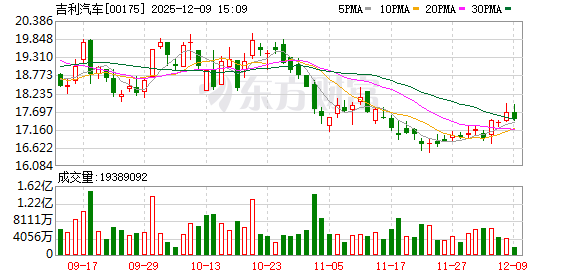
吉利创新中心实现甲醇催化剂国产化技术突破
Xin Hua Cai Jing· 2025-12-09 06:23
Core Insights - Geely Innovation Center has developed an efficient carbon dioxide hydrogenation to methanol catalyst, which has successfully passed the evaluation by the China Petroleum and Chemical Industry Federation [1][2] - The technology overcomes key technical bottlenecks in the industry, achieving over 99% total conversion rate of CO2 and H2, and over 99% total selectivity for methanol [1] Group 1 - The catalyst preparation process includes innovative strategies such as integrated carrier pre-synthesis, active component deposition, hydrophobic functional layer construction, and in-situ self-driven pore formation, significantly enhancing the catalyst's mechanical strength and water resistance [1] - The technology team has completed the scale-up preparation of ton-level catalysts and developed a process package for 100,000 tons of carbon dioxide hydrogenation to methanol, clearing the obstacles for large-scale application [1] Group 2 - The pilot project for carbon dioxide hydrogenation to methanol has achieved 2,000 hours of continuous stable operation with no degradation in catalyst performance, confirming the engineering feasibility of the technology [2] - The pilot project successfully passed a 72-hour continuous on-site assessment, with results indicating reliable process flow and stable operating conditions, exceeding expectations for core indicators such as CO2 and H2 total conversion rates and methanol selectivity [2]
吉利创新中心甲醇制备技术达国际领先水平 实现核心催化剂国产化量产突破
Zheng Quan Ri Bao Wang· 2025-12-08 14:00
Core Viewpoint - Geely Innovation Center's self-developed carbon dioxide hydrogenation to methanol technology has passed authoritative evaluation, achieving international advanced level, with catalyst performance recognized as leading globally [1][2] Group 1: Technological Breakthroughs - The technology has overcome key technical bottlenecks in the industry through innovative strategies, resulting in a catalyst preparation process that significantly enhances mechanical strength and water resistance, achieving over 99% total conversion rate of CO2 and H2, and over 99% total selectivity for methanol [1] - The team has completed the scale-up preparation of ton-level catalysts and developed a 100,000-ton-level process package for carbon dioxide hydrogenation to methanol, clearing obstacles for large-scale application [1] Group 2: Pilot Project and Commercialization - The pilot project for carbon dioxide hydrogenation to methanol has achieved 2,000 hours of continuous stable operation with no degradation in catalyst performance, confirming the engineering feasibility of the technology [2] - The pilot project successfully passed a 72-hour continuous on-site assessment, with core indicators exceeding expectations, and impurity levels in crude methanol significantly lower than industry standards [2] - The catalyst is now capable of mass production and commercial sales, meeting domestic chemical enterprises' demand for low-carbon methanol production technology and breaking the market monopoly of overseas catalysts [2] Group 3: Future Plans - Geely Innovation Center plans to leverage its methanol circular economy ecosystem to accelerate the industrialization and market promotion of this technology, contributing to the global carbon dioxide resource utilization industry upgrade and supporting the green low-carbon transition [2]
吉利CO 加氢制甲醇催化剂中试项目开车
Zhong Guo Hua Gong Bao· 2025-08-22 02:36
Core Viewpoint - Geely's carbon dioxide hydrogenation to methanol pilot project marks a significant advancement in the self-iteration and upgrade of core technologies, laying the foundation for industrial application of this technology [1] Group 1: Technology Development - The carbon dioxide hydrogenation to methanol technology effectively utilizes high-concentration CO2 emissions from industries such as coking, steel, and thermal power to produce methanol, which can replace imported crude oil [1] - The catalyst preparation is crucial as it directly affects reaction efficiency and the feasibility of industrialization [1] - The new generation of catalysts developed by Geely achieves over 99% total CO2 conversion rate and methanol selectivity, with a more than 20% increase in methanol space-time yield and a catalyst lifespan of over 3 years [2] Group 2: Economic Impact - The new process technology reduces the comprehensive energy consumption for methanol production by 10% and lowers the cost per ton of methanol by 6% [2] - The pilot project aims to validate the performance improvements of the new generation catalyst and gather critical data for large-scale industrial application [2] Group 3: Environmental Goals - This technology is a key component in Geely's construction of a green methanol circular economy, integrating methanol preparation, transportation, refueling, and CO2 capture [3] - The technology can couple with high-carbon industries such as coal chemical, steel, and power plants, creating a circular economy model of "carbon waste—resource utilization—recycling" to support China's dual carbon goals [3]
吉利CO₂加氢制甲醇催化剂中试项目开车
Zhong Guo Hua Gong Bao· 2025-08-22 02:30
Core Viewpoint - Geely's CO₂ hydrogenation to methanol pilot project marks a significant advancement in the self-iteration and upgrade of catalyst and process technology, laying the groundwork for industrial application [1] Group 1: Technology Development - The CO₂ hydrogenation to methanol technology effectively utilizes high-concentration CO₂ emissions from industries such as coking, steel, and thermal power to produce methanol, which can replace imported crude oil [1] - The catalyst preparation is crucial as it directly affects reaction efficiency and the feasibility of industrialization [1] - The new generation of CO₂ hydrogenation to methanol catalyst developed by Geely has a CO₂ total conversion rate and methanol total selectivity exceeding 99%, with a methanol space-time yield improvement of over 20% and a catalyst lifespan of over 3 years [2] Group 2: Economic Impact - The new process technology can reduce the comprehensive energy consumption for methanol production by 10% and lower the cost per ton of methanol by 6% [2] - The pilot project aims to comprehensively verify the performance enhancement of the new catalyst, focusing on key indicators such as catalytic activity, selectivity, and conversion rate, while also assessing long-term stability [2] Group 3: Environmental and Economic Integration - The technology is a key component in Geely's construction of a green methanol circular economy, integrating methanol preparation, transportation, refueling, and CO₂ capture into a cohesive ecological chain [3] - The technology can couple with high-carbon industries such as coal chemical, steel, and power plants, creating a "carbon waste—resource—reutilization" circular economy model, providing critical technical support for achieving China's "dual carbon" goals [3]