云帆AI大模型

Search documents
从一家企业的AI转型,看中国制造的“新铠甲”
Zhong Guo Xin Wen Wang· 2025-12-26 11:55
Core Viewpoint - In 2025, China's manufacturing sector is undergoing a significant transformation driven by emerging technologies like artificial intelligence, which are enhancing industrial upgrades and shifting the focus from scale advantages to quality and system advantages [1][2][3]. Group 1: Transformation of Manufacturing - The transformation is characterized by the emergence of 17,600 national "little giant" enterprises leading innovation, 140,000 specialized and innovative small and medium-sized enterprises laying the foundation for the industrial ecosystem, and 600,000 technology and innovation-oriented SMEs growing rapidly [3]. - The shift from "manufacturing" to "intelligent manufacturing" is evident, with companies like Changhong enhancing their AI strategies, resulting in a rise in their global brand rankings [3][5]. - Changhong's comprehensive AI strategy includes "AI + manufacturing, AI + products, and AI + operations," which has led to the development of smart appliances that understand consumer needs [5][6]. Group 2: Systemic Empowerment - The new development momentum is leading to a change in the path of industrial upgrades, moving from single product breakthroughs to systemic empowerment through platforms and ecosystems [8]. - Changhong's establishment of the first national "dual-cross" industrial internet platform in Sichuan exemplifies this systemic approach, enabling data-driven operations and enhancing collaboration among enterprises [9][10]. - The platform facilitates data sharing and operational integration for nearly 3,000 SMEs, significantly improving efficiency and reducing barriers to digital transformation [10]. Group 3: Technological Self-Reliance - The core strength of China's manufacturing transformation lies in the strategy of technological self-reliance, focusing on overcoming key technological challenges and nurturing "invisible champions" [11]. - Changhong has achieved significant milestones, such as being the global leader in compressor production and developing advanced technologies in various sectors, including rail and aviation [11][12]. - The dual-driven innovation system, combining internal and external collaboration, is crucial for breaking through technological barriers and fostering a robust industrial foundation [12].


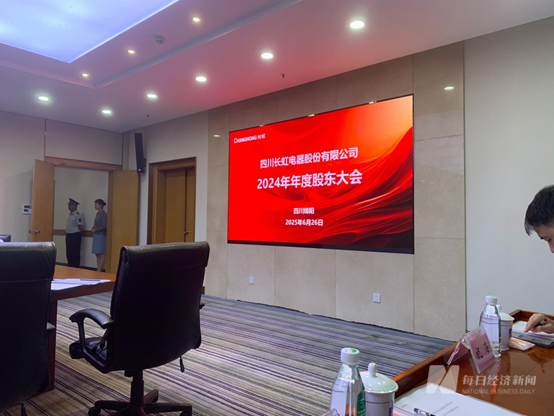
直击股东大会 | 四川长虹称将正视复杂的外部宏观环境及高度“内卷”的市场竞争态势
Mei Ri Jing Ji Xin Wen· 2025-06-26 12:03
Core Viewpoint - Sichuan Changhong's 2024 annual shareholder meeting highlighted the company's strategic focus on enhancing competitiveness through product optimization, brand strengthening, and channel expansion in response to a complex external environment and intense market competition [1][3][5]. Financial Performance - In 2024, Sichuan Changhong's revenue surpassed 100 billion yuan for the first time, reaching 103.69 billion yuan, representing a year-on-year growth of 6.40% [1]. - The net profit attributable to shareholders for 2024 was 704 million yuan, showing a year-on-year increase of 2.30%, which has raised concerns regarding the company's profitability [1][6]. - The company reported a total revenue of 26.84 billion yuan in Q1 2024, marking a year-on-year growth of 12.89%, with a net profit of 345 million yuan, up 96.68% [6]. Business Strategy - The company aims to leverage domestic policies such as the "old-for-new" replacement program and embrace AI technology to enhance product, market, and service capabilities [5]. - Sichuan Changhong's home appliance segment accounted for 43.49% of total revenue in 2024, generating 45.09 billion yuan, with a notable growth rate of 15.29% [5]. - The television business achieved approximately 16.04 billion yuan in revenue in 2024, reflecting a year-on-year growth of about 10.27% [5]. Shareholder Returns - The company approved a cash dividend of 0.50 yuan per 10 shares, leading to a total cash dividend of 462 million yuan for the year, which constitutes 65.62% of the annual net profit attributable to shareholders [6]. - Sichuan Changhong announced a share buyback plan of 250 million to 500 million yuan, marking its first buyback since 2006, reflecting confidence in the company's future prospects [6].