互联网娱乐

Search documents
华谊兄弟王忠军所持7000万股拟被司法拍卖
Shen Zhen Shang Bao· 2026-02-09 12:15
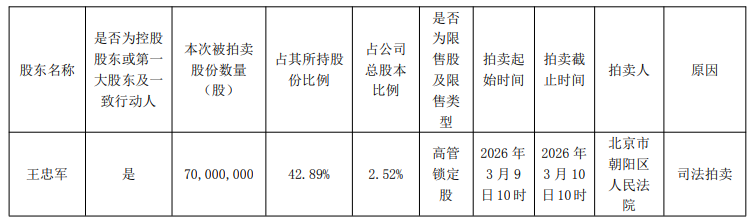
Core Viewpoint - The controlling shareholder of Huayi Brothers, Wang Zhongjun, is set to auction 70 million shares, representing 42.89% of his holdings and 2.52% of the company's total shares, with the auction scheduled for March 9-10, 2026 [1][2]. Shareholder Information - Wang Zhongjun's shareholding will decrease from 11.43% to 5.88% following the auction, while the combined holding of Wang Zhongjun and his associate Wang Zhonglei will drop from 13.81% to 8.26% [4]. - If the auction is successful, the controlling shareholders will still hold 5.74% of the total shares, maintaining their status as the largest shareholder [2]. Legal and Financial Issues - As of the announcement date, Wang Zhongjun and Wang Zhonglei's shares have been frozen, totaling 229 million shares, which is 100% of their holdings and 8.26% of the company's total shares [3]. - Huayi Brothers has faced significant financial losses, with cumulative losses exceeding 8.2 billion yuan from 2018 to 2024, and an expected net loss of 289 million to 407 million yuan for 2025 [6][7]. Financial Forecast - The company anticipates a net asset value of between -94 million and 63 million yuan by the end of 2025, which could trigger delisting risk warnings if the audited net assets are negative [8]. - The expected net profit for 2025 is projected to be a loss of 289 million to 407 million yuan, compared to a loss of 284.61 million yuan in the same period last year [7]. Market Performance - As of February 9, the stock price of Huayi Brothers increased by 6.15% to 2.07 yuan per share, with a total market capitalization of approximately 5.743 billion yuan, despite a 20% decline in stock price over the past year [9].


新消费:当情绪价值成为“刚需”
淡水泉投资· 2025-06-12 00:16
Core Viewpoint - The article discusses the evolution of consumer behavior in China, emphasizing the shift from basic survival needs to emotional and experiential consumption, driven by economic development and demographic changes [4][5][15]. Group 1: New Consumption Trends - The concept of "new consumption" has gained traction, with examples like a rising cosmetics brand achieving a valuation exceeding $10 billion within four years of its establishment [3]. - Consumers are increasingly focused on emotional satisfaction and self-fulfillment, moving beyond mere product functionality [4]. - The 95 post-90s generation has become a significant consumer force, with annual spending reaching approximately 8-9 trillion yuan, accounting for nearly 50% of sales during major shopping events [5]. Group 2: Emotional Consumption Drivers - The transition to an "atomized" social structure has led to the rise of emotional consumption and the single economy, as traditional social ties weaken [5]. - The COVID-19 pandemic and geopolitical uncertainties have heightened the demand for emotional consumption, with the market for concerts expected to grow from 12 billion yuan in 2019 to 45 billion yuan by 2024 [15]. - Emotional consumption has shifted from being optional to essential, as consumers seek to maintain psychological well-being in uncertain times [15]. Group 3: Brand Power and Market Dynamics - The success of a consumption model relies on the ability of companies to manage brand power, which is increasingly influenced by product quality and distribution channels [10]. - The shift from traffic dividends to content dividends means that strong product quality is essential for gaining market share in a fragmented channel environment [12]. - The capital market views assets that can be priced based on emotional value as scarce growth opportunities, less affected by economic cycles and geopolitical risks [18]. Group 4: Challenges and Future Outlook - The core driver of new consumption is consumer passion, which translates into strong purchasing intent and high repurchase rates [19]. - However, sustaining this passion is challenging; only brands that can elevate their products to art and cultivate a loyal customer base will thrive in the long term [19].