亚洲科技股ETF

Search documents
2026年全球资本大迁徙深度分析:抛售美国背后,黄金、亚洲科技股谁是真避险?
Sou Hu Cai Jing· 2026-02-06 14:00
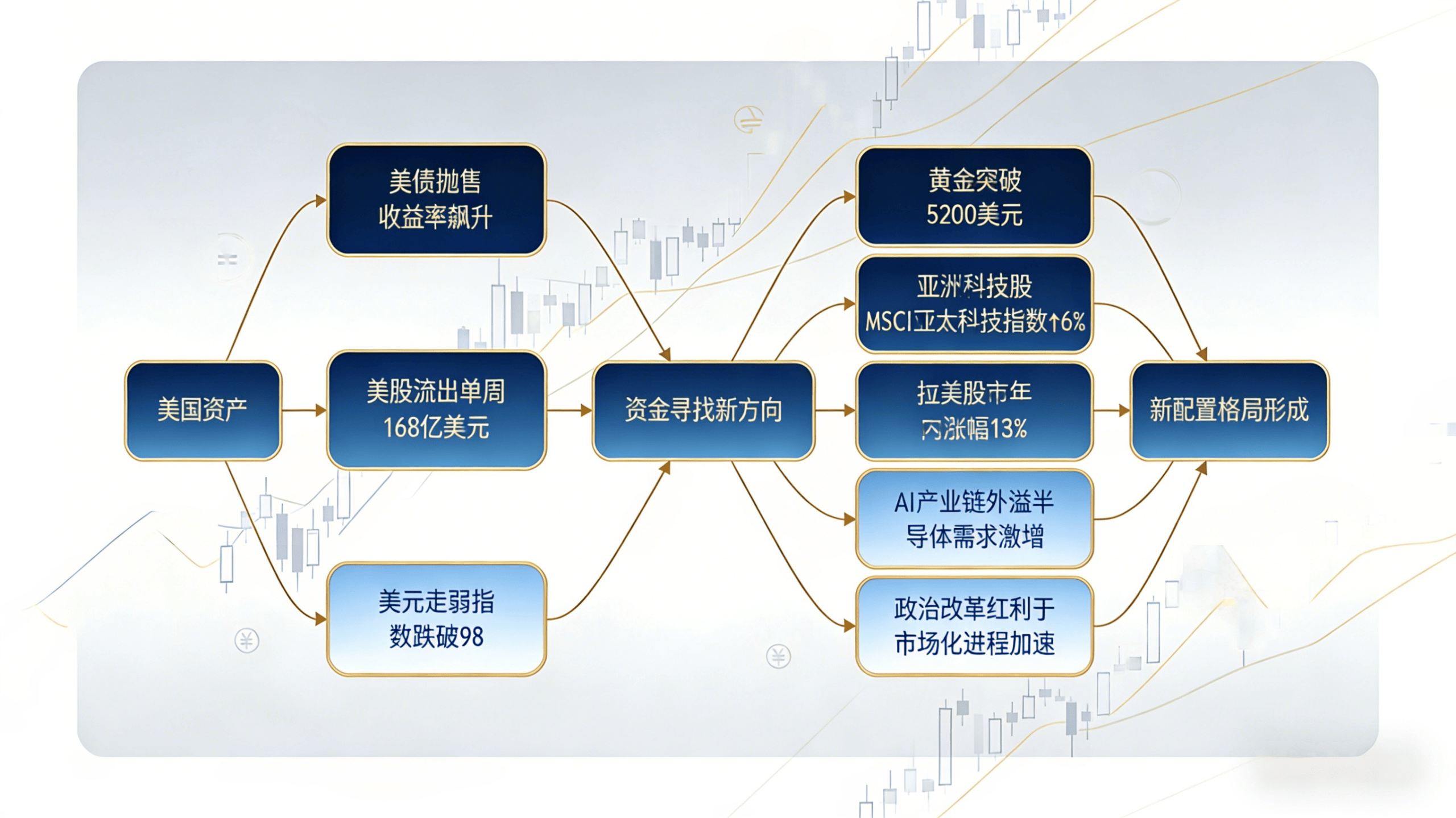
Core Insights - A significant capital migration is occurring globally, with investors reassessing traditional safe-haven assets like U.S. Treasuries and exploring alternatives such as gold and Asian tech stocks [1][4][16] - The recent volatility in gold prices, which peaked at $5,234 per ounce, reflects growing concerns over the credit risk associated with the U.S. dollar [1][4] - Institutional investors are increasingly reducing their holdings in U.S. Treasuries, indicating a shift in confidence regarding U.S. creditworthiness [1][3][4] Capital Flow Signals - U.S. Treasuries are experiencing historic sell-offs, with significant reductions in holdings by major investors like Denmark's AkademikerPension and the Reserve Bank of India [1][4] - U.S. stock funds have seen record outflows, with a net withdrawal of $16.8 billion in a single week, marking one of the largest capital exits in history [1][4] - Emerging markets, particularly in Latin America, are attracting investment, with the MSCI Latin America stock index reaching a new high since 2018, up 13% year-to-date [1][4] Structural Reasons for Capital Migration - The perception of the U.S. dollar is shifting from a "safe haven" to a "risk asset," influenced by geopolitical tensions and concerns over the weaponization of financial assets [3][4] - The dollar's share in global foreign exchange reserves has fallen below 60%, the lowest in decades, prompting investors to seek traditional safe-haven assets like gold [4] - The unsustainable nature of U.S. fiscal policy is becoming evident, with federal debt surpassing $38 trillion and significant refinancing pressures looming [5][6] Valuation Discrepancies - Asian tech stocks are seen as undervalued compared to U.S. counterparts, with the MSCI Asia Pacific Information Technology Index trading at a forward P/E ratio of 16.3, significantly lower than the Nasdaq 100's 25 [4][6] - Earnings growth potential for Asian tech firms is robust, with expected EPS growth rates of 79% and 36% for South Korean and Taiwanese stocks, respectively, outpacing Nasdaq's 28% [4][6] Investment Strategies - A conservative investment strategy suggests a 50% allocation to gold ETFs or physical gold, with a focus on preserving capital and moderate growth [7][8] - A balanced approach recommends a mix of gold, high-dividend Hong Kong stocks, and cash, aiming for a 10-12% annualized return [8] - An aggressive strategy emphasizes high-growth Asian tech stocks, with a significant allocation to emerging market bonds and gold as a hedge [9][10]