人参软糖

Search documents
2025年中国即食滋补品行业发展历程、市场政策、产业链图谱、市场规模、竞争格局及发展趋势分析:产品形态日益丰富[图]
Chan Ye Xin Xi Wang· 2025-12-11 01:34
Overview - The aging population in China is driving the rapid rise of the "silver economy," with a strong demand for easy-to-swallow, low-sugar ready-to-eat health products among the elderly, creating a stable consumer group [1] - The health awareness of the general public is increasing, leading to a shift in health maintenance from being exclusive to the elderly to being integrated into the daily lives of younger generations, who are adopting a "light nourishment" concept [1][11] - The ready-to-eat health product market in China is projected to reach a market size of 217.1 billion yuan in 2024, with a year-on-year growth of 10.5% [1][11] Market Characteristics - Common ready-to-eat health products include ready-to-eat donkey-hide gelatin, fresh stewed bird's nest, ready-to-eat ginseng, and others, each targeting different consumer demographics [3][4] - The consumer base for these products has expanded beyond the elderly to include young professionals and health-conscious individuals [7] Development History - Prior to 2000, the market primarily consisted of traditional health ingredients, with the introduction of initial ready-to-eat products occurring in response to consumer demand for convenience [3] - The concept of ready-to-eat health products has evolved significantly since 2016, expanding to include a variety of products that emphasize freshness and natural ingredients [3][4] Market Policies - Recent policies in China emphasize food safety and quality control, requiring strict compliance from ready-to-eat health product manufacturers, thereby promoting industry standardization and high-quality development [6][7] Industry Chain - The industry chain includes suppliers of raw materials, production, and packaging, with a growing focus on meeting the needs of younger consumers and adapting marketing strategies accordingly [7][9] Sales Channels - The online sales channel for ready-to-eat health products is expected to account for 52.8% of the market by 2024, surpassing traditional offline channels [9][10] Competitive Landscape - The market exhibits a varied competitive landscape, with certain segments like ready-to-eat donkey-hide gelatin and fresh stewed bird's nest showing oligopolistic characteristics, while other segments remain fragmented with opportunities for smaller brands [12][13] Future Trends - The industry is expected to continue evolving towards snack-like, convenient forms, with an emphasis on innovative combinations of ingredients to meet specific health needs [14]


研判2025!中国人参类保健食品行业市场政策、产业链、发展现状、竞争格局及发展趋势分析:市场竞争日趋激烈[图]
Chan Ye Xin Xi Wang· 2025-08-25 01:34
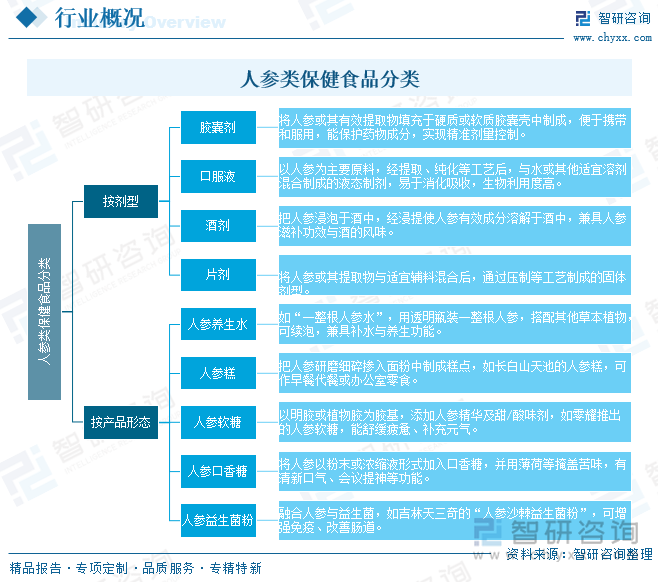
Overview - The demand for health food, particularly ginseng-based products, is increasing due to rising living standards and health awareness among consumers. Ginseng is recognized for its various health benefits, making it increasingly popular among consumers [1][13] - The aging population, referred to as the "silver economy," is driving demand for health products, with ginseng health foods meeting their wellness needs. Additionally, younger consumers are showing interest in ginseng products, such as ginseng gummies and coffee, contributing to market growth. The demand for ginseng health foods in China is projected to reach 17,548.8 million boxes/bottles/cans by 2024, with a market size of 12.593 billion yuan [1][13] Market Policies - The Chinese government has implemented various policies to support the development of the health food industry, including ginseng products. These policies aim to encourage and regulate the industry, creating a favorable environment for growth [4][6] Industry Chain - The ginseng health food industry consists of an upstream segment that includes ginseng, auxiliary materials, production equipment, and packaging materials. The midstream involves research and production, while the downstream encompasses sales channels such as supermarkets, pharmacies, and e-commerce platforms [7][9] Development Status - The market for ginseng health foods is expanding, driven by increased consumer interest and the aging population. The demand is expected to grow significantly, with a projected market size of 12.593 billion yuan by 2024 [1][13] Competitive Landscape - The number of companies in the ginseng health food sector is rapidly increasing, leading to heightened competition. As of August 2025, there are 1,129 approved ginseng health food products, with 1,089 from domestic companies and 40 from imports [15] - Key players in the industry include Yisheng Pharmaceutical, Tongrentang, and Jilin Aodong, among others. Yisheng Pharmaceutical has diversified its operations across the ginseng industry chain, while Jilin Aodong has developed a comprehensive health product portfolio [17][20] Future Trends - The ginseng health food market is expected to see increased product diversification, with new consumption methods and snack-like products emerging. Brands will focus on enhancing their image and marketing strategies to stand out in a competitive landscape [22]