
人工智能税务规划工具

Search documents
美股财富管理类股掀抛售潮美企推出AI税务规划工具
Xin Lang Cai Jing· 2026-02-11 10:13
Core Insights - The launch of Altruist's AI tax planning tool has raised concerns within the financial industry, particularly regarding its potential to disrupt traditional wealth management services [1] - Following the announcement, wealth management stocks in the U.S. experienced significant declines, with Charles Schwab down over 7%, Raymond James down over 8%, and Morgan Stanley down over 2% [1] - Analysts suggest that the sell-off reflects a market reassessment of AI tools' ability to replace human advisory services in wealth management [1] Company Impact - Altruist's introduction of AI technology directly targets the core business of traditional wealth management firms [1] - The immediate market reaction indicates a loss of confidence in established financial institutions' ability to compete with emerging AI solutions [1] Industry Trends - The financial sector is witnessing a shift as AI tools are increasingly viewed as potential replacements for human advisors, prompting a reevaluation of business models in wealth management [1] - The sell-off in wealth management stocks may signal broader market concerns about the sustainability of traditional financial advisory roles in the face of technological advancements [1]


道指续创新高,嘉信理财重挫7.4%,人工智能忧虑波及券商股
Di Yi Cai Jing· 2026-02-10 23:16
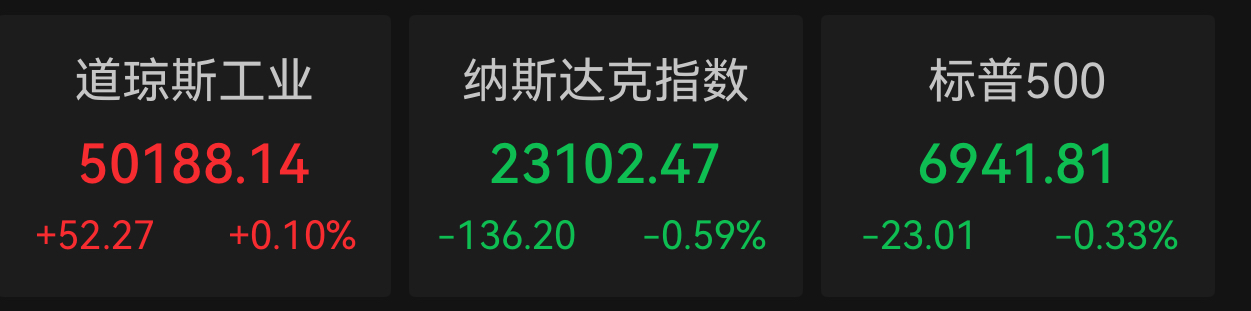
Core Viewpoint - US retail sales unexpectedly stagnated in December, raising concerns about slowing consumer momentum, while high capital expenditures by major tech companies in the race for AI dominance continue to exert valuation pressure [1][2]. Market Overview - The US stock market showed mixed performance, with the Dow Jones Industrial Average reaching a new all-time high, while the S&P 500 and Nasdaq indices declined [2]. - The Dow Jones increased by 52.27 points, or 0.10%, closing at 50,188.14 points. The S&P 500 fell by 23.01 points, or 0.33%, to 6,941.81 points, and the Nasdaq dropped by 136.20 points, or 0.59%, to 23,102.47 points [2]. Retail Sales Data - The US Commerce Department reported that retail sales remained flat in December after a 0.6% increase in November. Core retail sales, excluding auto dealers and gas stations, also showed no change [6]. - Among 13 major retail categories, 8 experienced declines, including clothing and furniture stores, while spending at building materials and sporting goods retailers saw slight growth [6]. Employment and Economic Indicators - The upcoming US non-farm payroll report is anticipated to provide insights into the labor market, with previous estimates of job growth being revised down by approximately 911,000 positions [6][7]. - The Employment Cost Index for Q4 increased by 0.7%, below the market expectation of 0.8% [7]. Technology Sector Performance - Major tech stocks mostly declined, with Alphabet's announcement of a $20 billion bond issuance intensifying concerns over capital expenditure levels [4]. - Companies like Amazon, Alphabet, Meta, and Microsoft are expected to invest a cumulative total of around $650 billion in AI by 2026 [4]. Bond Market Reaction - The yield on the US 10-year Treasury bond fell by 5.1 basis points to 4.147%, marking a significant decline over four consecutive trading days [8]. - Market expectations for a potential interest rate cut by the Federal Reserve have increased, with June being viewed as the first month where the probability exceeds 50% [7][8].

道指续创新高,嘉信理财重挫7.4%,人工智能忧虑波及券商股
第一财经· 2026-02-10 23:16
Core Viewpoint - The article discusses the mixed performance of the US stock market, highlighting the divergence between the Dow Jones reaching a new historical high and the declines in the S&P 500 and Nasdaq indices, driven by investor reactions to corporate earnings and retail sales data [3]. Market Overview - The Dow Jones Industrial Average rose by 52.27 points, or 0.10%, closing at 50,188.14 points. In contrast, the S&P 500 fell by 23.01 points, or 0.33%, to 6,941.81 points, while the Nasdaq Composite dropped by 136.20 points, or 0.59%, to 23,102.47 points [3]. - Major technology stocks mostly declined, with Tesla increasing by 1.89%, while Google, Meta, Amazon, Nvidia, Apple, and Microsoft saw declines ranging from 0.08% to 6.19%. Oracle rose by 2.11%, and Micron Technology fell by 2.67% [5][6]. - Alphabet announced a bond issuance of $20 billion, raising concerns about capital expenditure among large tech companies. The combined investment in AI by Amazon, Alphabet, Meta, and Microsoft is estimated to reach approximately $650 billion by 2026 [5]. Economic Data - The US retail sales data showed a stagnation in December, with a 0.6% increase in November followed by no change in December. Core retail sales, excluding auto dealers and gas stations, also remained flat [9]. - Among 13 major retail categories, 8 experienced declines, indicating a slowdown in consumer spending as the holiday season ended. This trend reflects consumer caution in a high-inflation environment [9]. - The upcoming US non-farm payroll report is anticipated to provide insights into employment trends, with previous estimates suggesting an overestimation of job growth by approximately 911,000 positions [9][10]. Federal Reserve and Market Sentiment - The Federal Reserve officials are signaling caution, emphasizing the importance of returning inflation to the 2% target before making further rate adjustments. Market sentiment remains optimistic despite weak retail sales data, which suggests a potential cooling of economic growth [10][11]. - Following the retail sales report, expectations for a rate cut by the Federal Reserve in June have increased, with the probability exceeding 50% according to market tools [10]. Sector Performance - The financial sector faced pressure, with concerns about increased competition in financial services following the launch of a new AI tax planning tool by Altruist. LPL Financial and Charles Schwab saw significant stock declines [11]. - Disney and Home Depot stocks rose over 2%, providing support to the Dow, while Coca-Cola's stock fell by 1.5% due to disappointing fourth-quarter revenue [11].

道指续创新高 嘉信理财重挫7.4% 人工智能忧虑波及券商股
Di Yi Cai Jing· 2026-02-10 23:13
Core Viewpoint - Concerns over artificial intelligence capital expenditures are impacting the technology and software sectors, leading to a mixed performance in the U.S. stock market, with the Dow Jones reaching a new historical high while the S&P 500 and Nasdaq declined [1] Group 1: Market Performance - The Dow Jones Industrial Average rose by 52.27 points, or 0.10%, closing at 50,188.14 points [1] - The S&P 500 index fell by 23.01 points, or 0.33%, to close at 6,941.81 points [1] - The Nasdaq Composite index decreased by 136.20 points, or 0.59%, ending at 23,102.47 points [1] Group 2: Technology Sector Performance - Major tech stocks mostly declined, with Tesla up by 1.89% and Alphabet down by 1.77% [3] - Concerns about capital expenditures were heightened by Alphabet's announcement of a $20 billion bond issuance [3] - The combined investment in AI by Amazon, Alphabet, Meta, and Microsoft is projected to reach approximately $650 billion by 2026 [3] Group 3: Economic Data - U.S. retail sales were flat in December, following a 0.6% increase in November, indicating a slowdown in consumer spending [5] - Eight out of thirteen major retail categories saw declines, reflecting consumer caution in a high-inflation environment [5] - The upcoming U.S. non-farm payroll report is expected to provide insights into the labor market, with prior estimates of job growth being revised down by approximately 911,000 [5][6] Group 4: Bond Market and Federal Reserve - The U.S. 10-year Treasury yield fell by 5.1 basis points to 4.147%, marking a significant decline over four consecutive trading days [7] - Federal Reserve officials are signaling caution, emphasizing the importance of returning inflation to the 2% target before making further rate adjustments [7] Group 5: Individual Stock Movements - Disney and Home Depot stocks rose over 2%, supporting the Dow, while Coca-Cola fell by 1.5% due to disappointing Q4 revenue [8] - S&P Global's stock plummeted by 9.7%, becoming the worst performer in the S&P 500 due to lower-than-expected 2026 earnings guidance [8] - Financial sector stocks faced pressure as competition in financial services intensified, with LPL Financial and Charles Schwab experiencing declines of 8.3% and 7.4%, respectively [8]