人民币计价的债券

Search documents
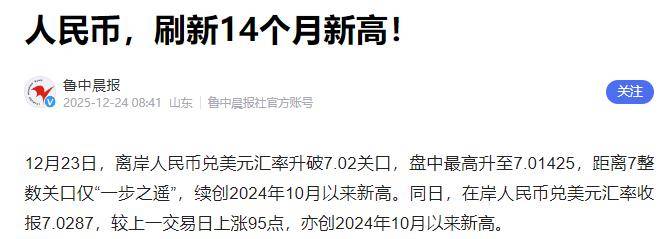
人民币国际化提速,创14个月新高 升值势头强,普通人如何抓住机会
Sou Hu Cai Jing· 2025-12-25 13:56
Core Viewpoint - The article discusses the evolving role of the Chinese yuan (RMB) in the global financial system, highlighting its increasing significance as a currency for trade and reserves, as the dominance of the US dollar shows signs of weakening [1]. Group 1: RMB in Trade - The shift in trade practices is evident, with countries like Brazil and China moving towards direct currency settlements, reducing reliance on the US dollar [3]. - In 2023, the share of RMB in Brazil's foreign exchange transactions rose to 5.1%, indicating a growing trend of using RMB for trade settlements [5]. - A landmark event occurred in March 2023 when China National Offshore Oil Corporation completed its first LNG purchase settled in RMB, marking a significant breakthrough in the energy sector [5]. Group 2: RMB as a Reserve Currency - The RMB is transitioning from being a settlement currency to a reserve currency, with its share in global allocated foreign exchange reserves reaching 2.13% by the end of Q3 2024, making it the fifth-largest reserve currency globally [9]. - The increasing trust in RMB is reflected in its growing inclusion in the foreign exchange reserves of central banks and financial institutions [11]. - The establishment of the Cross-Border Interbank Payment System (CIPS) facilitates RMB transactions globally, with 1,482 participants covering 186 countries and regions [11]. Group 3: Impact on Individuals - The internationalization of the RMB affects everyday life, particularly for businesses engaged in foreign trade, allowing them to mitigate exchange rate risks by quoting prices in RMB [16]. - Importers benefit from the strengthened purchasing power of the RMB, leading to lower costs for imported goods and enhancing the consumer experience [18]. - New financial products and services, such as the "Cross-Border Wealth Management Connect," enable residents to invest directly in overseas assets, simplifying the process of cross-border transactions [20].