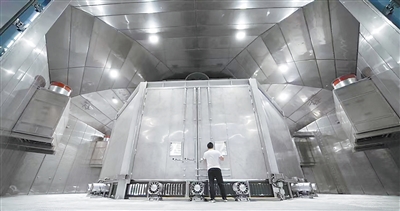
低空三维多物理场耦合引导风洞

Search documents
广东深圳落地投用全球首个低空风洞 低空飞行器在这里“极限测试”(探一线)
Ren Min Ri Bao· 2025-11-21 22:26
Core Insights - The establishment of the world's first low-altitude three-dimensional multi-physical field coupled wind tunnel in Shenzhen marks a significant advancement in testing low-altitude flying vehicles, addressing the challenges posed by complex wind environments below 1000 meters [1][2] Group 1: Low-Altitude Wind Tunnel - The newly developed wind tunnel can simulate urban wind environments and extreme weather conditions, providing essential data for the safety and performance of low-altitude flying vehicles [2] - The wind tunnel features an outer diameter of 18 meters and an inner diameter of 10 meters, capable of supporting aircraft with a wingspan of up to 4 meters, with wind speeds reaching 60 meters per second [2] - Since its launch, the wind tunnel has already provided testing services for several low-altitude enterprises focusing on small flying vehicles [2] Group 2: Future of Low-Altitude Economy - The low-altitude economy is not just about individual technologies but requires collaboration across the entire industrial chain, with a need for original research and the establishment of a self-sufficient research and industrial system [3] - Plans are underway to construct a larger wind tunnel with an outer diameter of 65 meters and an inner diameter of 45 meters, aimed at testing larger low-altitude flying vehicles and drone swarms [3] - The vision for the future includes point-to-point commuting, where individuals can take off from rooftops, transforming urban transportation [2]
低空飞行器在这里“极限测试”(探一线)
Ren Min Ri Bao· 2025-11-21 22:12
Core Insights - The establishment of the world's first low-altitude three-dimensional multi-physical field coupled guiding wind tunnel in Shenzhen marks a significant advancement in testing low-altitude flying vehicles, addressing the challenges posed by complex wind environments below 1000 meters [2][3]. Group 1: Technological Advancements - The guiding wind tunnel, developed by the Deep Thinking Laboratory, features 81 high-power fans and can simulate extreme weather conditions, providing a critical testing ground for low-altitude flying vehicles [2][3]. - The wind tunnel can replicate urban wind fields and extreme weather phenomena, such as urban canyon winds and downbursts, which are essential for ensuring the safety and performance of flying vehicles [3]. Group 2: Industry Implications - The low-altitude economy is not just about individual technologies but requires collaboration across the entire industrial chain, with a focus on establishing a self-sufficient research and industrial system in the low-altitude sector [4]. - The laboratory plans to construct a larger wind tunnel to accommodate larger flying vehicles and drone swarms, further enhancing research capabilities in low-altitude flight [4].