低醇葡萄酒

Search documents
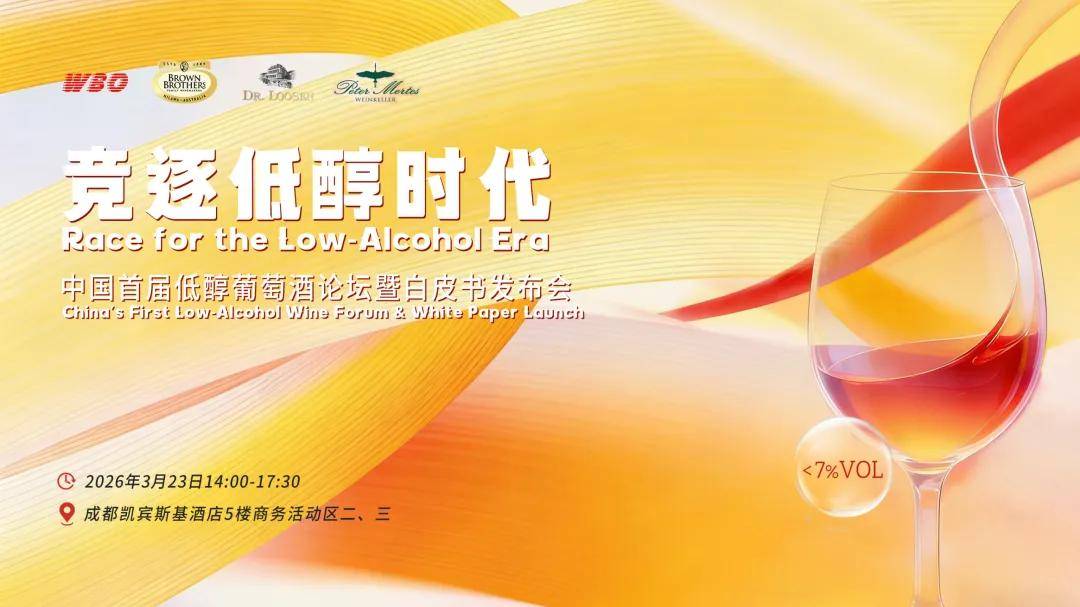
竞逐低醇时代,中国首届低醇葡萄酒论坛将重磅启幕
Sou Hu Cai Jing· 2026-02-25 10:45
Core Insights - The low-alcohol wine market is rapidly gaining attention, with the global market expected to reach $43 billion by 2027, nearly doubling from $22 billion in 2022 [1] - China is projected to surpass 8 billion RMB in market size during the same period, becoming one of the fastest-growing segments globally [1] Industry Event - WBO will host the "Low-Alcohol Era - China's First Low-Alcohol Wine Forum and White Paper Release" on March 23, 2026, in Chengdu [1] - The forum aims to systematically review the development status, competitive landscape, and consumption trends of low-alcohol wine in China, gathering insights from the industry [1] Expert Participation - The forum will feature prominent speakers, including Wang Zuming, Secretary-General of the China Alcoholic Drinks Circulation Association, who will discuss industry regulations and policy directions [3] - Wang Xuwei, Secretary-General of the China Food and Animal Products Import and Export Chamber of Commerce, will provide the latest import and export data analysis [3] - Yang Zhengjian, Editor-in-Chief of WBO, will share market success stories and channel innovation models [3] Roundtable Discussion - A roundtable discussion will include representatives from mainstream channels like 1919 and Jiu Xiaoyi, facilitating direct communication about consumer feedback and demand insights [9] - This dialogue aims to foster a systematic conversation and ecological co-construction within the low-alcohol segment of the Chinese wine industry [9] White Paper Release - The "2026 China Low-Alcohol Wine Market White Paper" will be the first comprehensive research report, integrating global trends and local data to present a realistic picture of the low-alcohol segment [10] - The white paper will analyze market size, regional distribution, consumer demographics, and the strategies of major brands, addressing challenges and breakthroughs in production and marketing [10] Market Trends - The rise of low-alcohol wine reflects significant trends in the Chinese wine market, including health consciousness, youth engagement, and segmentation of consumption scenarios [10] - Low-alcohol wine serves as a strong complement to the traditional wine market while establishing its own independent segment [10]

【深度】中国葡萄酒市场深度研究(下):消费主权觉醒与市场重构
Sou Hu Cai Jing· 2025-12-18 09:03
Core Insights - The Chinese wine market is experiencing a fundamental shift in consumer psychology, moving from "pleasing others" to "pleasing oneself," indicating a deep restructuring of consumption logic towards value matching rather than brand premium chasing [1][21] - The market is entering a "three rationality era," where consumer behavior, purchasing decisions, and category preferences are becoming more rational, with a notable increase in the demand for products that offer better quality-to-price ratios [1][21] Consumer Behavior Changes - The sales proportion of wines priced between 100-300 RMB has increased from 35% in 2020 to 52% by 2025, while the share of high-end wines priced over 1000 RMB has decreased by nearly 30% [1][21] - The younger generation, particularly Gen Z, is shifting focus towards personalized experiences and emotional resonance, moving away from traditional "face consumption" to "self-pleasing consumption" [1][21] Health and Quality Trends - Health consciousness is becoming a new driving force in consumption, with 76% of consumers prioritizing "zero pesticide residues" when selecting organic wines, significantly higher than traditional factors like taste (58%) and brand (49%) [2] - The average selling price of domestic wines has risen from over 30 RMB per liter (2015-2019) to 46 RMB per liter in 2022, reflecting a quality-driven value return [4] Market Structure Adjustments - The competition landscape between imported and domestic wines is undergoing significant changes, with domestic wine market share dropping from 54.89% in 2020 to 46.91% in the first half of 2023, while imported wines have increased to 53.09% [3] - In 2024, domestic wine production is expected to exceed imports, with a total production of 300,000 kiloliters, marking a 3% year-on-year growth [3] Diversification of Consumer Demand - The low-alcohol wine market has seen explosive growth, reaching 28.5 billion RMB in 2023, with internet brands contributing about 18% of sales [5] - The organic wine market is also growing rapidly, with a 62% repurchase rate among high-income consumers aged 25-45 in first-tier and new first-tier cities [2] Channel Innovations and Digital Transformation - New retail channels have increased their contribution from 19% in 2021 to 42% in 2024, with platforms like Hema showing a 53% repurchase rate for wine, significantly higher than traditional supermarkets [6] - Live-streaming e-commerce has emerged as a new growth point, exemplified by significant sales figures from live broadcasts [6] Quality and Brand Development - Product innovation and brand building are crucial strategies for the Chinese wine industry, with a focus on high cost-performance products becoming mainstream [14] - The market for high-end products is expected to grow significantly, with the share of products priced above 300 RMB projected to rise from 22% in 2024 to 35% by 2030 [16] Local Development and Policy Support - The integration of wine with cultural tourism is becoming a key path for local development, with successful projects like the Tulanduo Town attracting over 100,000 visitors annually [17] - Policy support, such as the Ningxia government's development plan for the wine industry, aims to enhance the sector's growth and sustainability [19]

财报解读|前三季度国产、进口葡萄酒调整仍未见底,无醇化能否破局?
Di Yi Cai Jing· 2025-11-03 06:13
Core Viewpoint - The domestic wine industry in China is experiencing a significant downturn, with both domestic and imported wine markets showing declining trends, while non-alcoholic wine imports are witnessing double-digit growth, potentially offering a new growth avenue for the industry [1][6]. Group 1: Domestic Wine Market Performance - In the first three quarters of the year, major domestic wine companies reported a decline in performance, with Zhangyu's revenue at 2.12 billion yuan, down 3.7% year-on-year, and a net profit of 191.7 million yuan, down 31% [2]. - Other companies like Weilang and CITIC Nia also reported significant revenue declines of 17.4% and 2.2%, respectively, indicating a broader trend of financial struggles within the industry [2][5]. - The overall market for bottled wine under 2 liters saw a 15% decrease in import value, amounting to 1 billion USD, and a 3.4% drop in import volume [5]. Group 2: Changes in Consumer Behavior - The decline in wine consumption is attributed to changing consumer preferences, with a notable shift towards social drinking rather than home consumption, which has not kept pace with market demands [6]. - The economic environment has impacted wine consumption, as it is considered a non-essential product, leading to a long-term decline in consumption scenarios [5][6]. Group 3: Opportunities in Non-Alcoholic Wine - The import of low-alcohol and non-alcoholic products is on the rise, with low-alcohol beverage imports increasing by 31.4% and non-alcoholic beverage imports by 23.1% in the first eight months of 2025 [6][8]. - Industry experts believe that the growth of non-alcoholic wine is not a short-term trend but a structural long-term opportunity driven by health-conscious consumer behavior [8]. - The market for non-alcoholic wine is expected to face challenges such as consumer awareness, brand fragmentation, and technical barriers, with widespread acceptance anticipated by 2030 [8].