充气玩具

Search documents
政策速递|玩具产品质量标准更严格
Ren Min Ri Bao· 2025-12-11 07:59
Core Viewpoint - The recent revision of mandatory national standards for toy safety in China aims to enhance product quality and consumer safety, addressing concerns over harmful substances in toys and ensuring compliance with stricter safety regulations [1][2]. Group 1: Industry Overview - China is a major player in the toy industry, both as a producer and consumer, with projected retail sales exceeding 100 billion yuan by 2025 [1]. - The toy industry is experiencing growth in scale and product variety, but the presence of substandard toys poses risks to consumers [1]. Group 2: Changes in Mandatory Standards - The revised standards introduce new limits on ten harmful substances, including formaldehyde and volatile organic compounds, significantly expanding the scope of chemical safety [2][3]. - New technical requirements for specific toy categories, such as flame-retardant properties for masks and other headwear, have been added to enhance physical safety [2]. - The standards now require stricter limits on phthalates and boron content in toys, particularly for popular items like "squishy" toys and "crystal mud" [3]. Group 3: Regulatory Actions - The National Market Supervision Administration plans to strengthen oversight of emerging toy products, focusing on areas with high consumer concern, such as magnetic beads and "blind box" toys [3]. - Continuous efforts will be made to improve the safety of children's and students' products through a three-year action plan [3].
玩具安全强制国标迎修订 新增10类有害物质限量要求
Zheng Quan Shi Bao· 2025-11-19 17:54
Core Viewpoint - The Ministry of Industry and Information Technology has introduced a revised mandatory national standard GB6675 for toy safety, enhancing regulations to ensure the safety of children's toys and promoting high-quality development in the toy industry [1][2]. Group 1: Chemical Safety - The new standard adds limits for ten harmful substances, including formaldehyde and boron, significantly increasing the coverage of chemical hazards in toys [1]. - The revised standard aims to address health risks associated with toys that children may put in their mouths or that could cause skin irritation [1]. Group 2: Mechanical and Physical Safety - New technical requirements have been introduced for products such as flame devices and food-shaped toys, optimizing specific requirements for categories like yo-yos and inflatable toys [2]. - The standard enhances the applicability of technical requirements for the physical safety of toys, ensuring a higher safety threshold [2]. Group 3: Fire Safety - The revised standard includes new flammability performance requirements for headwear toys and improves testing methods for various toy categories, ensuring fire safety [2]. - The standard's rigor has been compared to raising the passing score from 60 to 90, indicating a significant increase in safety expectations [2]. Group 4: Transition Period - A dual transition period has been established to mitigate the impact of the new standards on the industry, allowing 12 months for production adjustments followed by another 12 months for sales [2]. Group 5: AI Toys Development - The Ministry plans to promote high-quality development in the AI toy sector through policy support, product innovation, and regulatory development [3]. - AI toys are characterized by stronger integration with technology, redefining their roles to include educational and emotional support functions, and appealing to a broad user demographic [3]. - The Ministry will collaborate with relevant departments to create implementation plans that encourage the integration of AI technology in toy production, fostering new market demands [3].
研判2025!中国充气玩具行业产业链、市场规模、竞争格局、发展趋势分析:行业应用场景广泛,市场规模增长至84.81亿元[图]
Chan Ye Xin Xi Wang· 2025-08-07 01:09
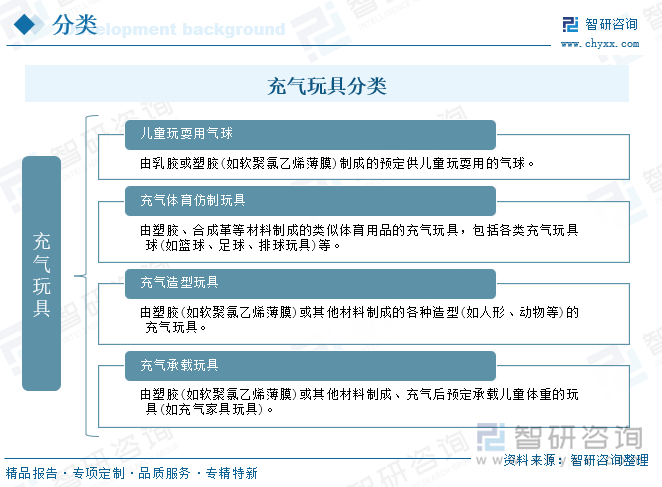
Core Viewpoint - The inflatable toy market, as a segment of the plastic toy industry, is experiencing steady growth due to its lightweight, durable, and versatile characteristics, with the market size projected to increase from 6.704 billion yuan in 2015 to 8.481 billion yuan in 2024, reflecting a compound annual growth rate (CAGR) of 2.6% [1][16]. Industry Overview - Inflatable toys are made from materials like latex or plastic, filled with air or inert gases, and include various types such as balloons, inflatable sports toys, and furniture [3]. - The inflatable toy market in China is expected to grow steadily, driven by the increasing demand for lightweight and portable toys suitable for outdoor activities and travel [1][16]. Market Size and Growth - The inflatable toy market in China reached a size of 6.704 billion yuan in 2015 and is projected to grow to 8.481 billion yuan by 2024, with a CAGR of 2.6% [1][16]. - The overall plastic toy market in China is also expanding, with the market size expected to reach 84.808 billion yuan in 2024, showing a year-on-year increase of 4.03% [14]. Competitive Landscape - The inflatable toy industry is characterized by intense competition, with major players like Gaole Co., Aofei Entertainment, and Hai Xin Group leveraging brand strength, supply chain integration, and diverse sales channels to maintain market share [18][19]. - Companies are facing challenges such as product homogenization and shrinking profit margins, prompting a need for differentiation and innovation [18]. Policy and Regulation - Recent government policies aim to enhance regulation and provide guidance for the toy industry, including measures to address marketing practices harmful to minors and ensure product quality [5][7]. - The 2023-2025 action plan emphasizes the need for improved mental health protections for children, impacting the marketing and safety standards for toys [5]. Industry Trends - There is a growing emphasis on environmental sustainability and safety in the inflatable toy industry, with a shift towards recyclable or biodegradable materials [23]. - The industry is witnessing increased concentration, with leading companies expanding through IP integration and technology, while smaller firms either specialize or face consolidation [24]. - Sales channels are diversifying, with a significant rise in e-commerce and cross-border sales, enhancing market reach and brand visibility [26].