光伏产业链

Search documents
赋能可持续 | 内蒙古清洁能源产业协会会长张楠:融合国际经验与本土创新 共筑清洁能源转型新生态
Sou Hu Cai Jing· 2025-11-24 07:16
Core Insights - The fourth forum on sustainable development for listed companies highlighted the importance of building a competitive clean energy development path through consensus and system thinking [1][4] Group 1: Leadership and Ecosystem Coordination - The key leadership quality for activating and coordinating a large ecosystem is the ability to build consensus and create shared value among diverse stakeholders [3] - The role of a leader includes being a "translator" and "connector" to facilitate effective communication and collaboration among government, industry, academia, and financial institutions [3][4] Group 2: International Experience and Local Adaptation - Successful integration of international advanced concepts and technologies into local practices is crucial, emphasizing that while technology can be imported, business models must be localized [5] - The "system optimization" concept has proven effective in Inner Mongolia, focusing on maximizing the efficiency of the entire energy system rather than individual equipment [5][6] Group 3: China's Competitive Advantages in Clean Energy - China possesses a complete and cost-competitive photovoltaic manufacturing supply chain, along with advanced ultra-high voltage transmission technology, which addresses the global challenge of clean energy transmission [6] - The exploration of large-scale "photovoltaic+" applications demonstrates China's unique advantages in combining energy projects with ecological restoration and industrial collaboration [6][7]


白皮书:中国气候科技产业“超级并购周期”即将到来
Di Yi Cai Jing· 2025-06-07 04:20
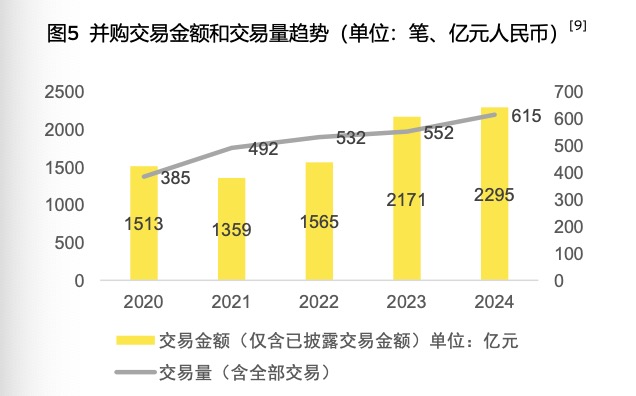
Core Insights - The Chinese climate technology industry is entering a "super merger cycle" led by industry leaders, transitioning from a technological and industrial revolution to a valuation and profit revolution [1][10] - A white paper released at the Shanghai International Carbon Expo indicates a significant wave of mergers and acquisitions (M&A) reshaping the competitive landscape and accelerating the global green industry transition [1][10] M&A Activity Trends - M&A activities in the Chinese climate technology sector are primarily concentrated in the photovoltaic industry chain, infrastructure, energy storage, and lithium battery sectors, maintaining a stable transaction volume share of over 75% [5][8] - From 2020 to 2024, the number of investment and M&A transactions in the renewable energy sector increased from 385 to 615, reflecting an upward trend [2] - The disclosed M&A transaction value reached a low of 135.9 billion yuan in 2021, rebounding to 229.5 billion yuan in 2024 [2] Strategic Focus - The focus of M&A activities has shifted from mere scale expansion to acquiring key technologies, improving supply chains, and expanding market channels [1][5] - The proportion of cross-border M&A is increasing, with Chinese companies actively seeking advanced technologies and management experiences through international acquisitions [1][5] Investment Dynamics - The primary investors in the climate technology sector are industrial capital, which has increased from 76.2% in 2020 to 86.8% in 2023, slightly decreasing to 80% in 2024 [4] - Control-oriented transactions dominate, accounting for 66.9% of M&A activities in 2024 [4] Sector-Specific Insights - The photovoltaic industry chain, infrastructure, energy storage, and lithium battery sectors accounted for 39%, 19%, 13%, and 9% of transaction volumes in 2024, respectively, totaling 80% [5] - The enthusiasm for the lithium battery sector has decreased due to slowing downstream demand and price fluctuations, with transaction values remaining above 60 billion yuan [8] - The infrastructure sector saw significant growth, with transaction values nearly quadrupling compared to 2023 [8] Future Outlook - The current M&A wave is expected to focus more on cutting-edge technology areas such as hydrogen energy, energy storage, and carbon management, with a diversification of M&A models [8][10] - The integration of technology resources through M&A is seen as essential for industry upgrades, with a need for companies to effectively incorporate acquired technologies into their innovation systems [9][10] - The ongoing M&A activities are positioned as a core driver for accelerating technological breakthroughs and market consolidation in the climate technology sector, enhancing China's global influence and market share [10]