光伏发电装置

Search documents
金字塔脚下的光与电
中国能源报· 2025-11-10 00:34
Core Viewpoint - The Grand Egyptian Museum (GEM) represents a significant advancement in integrating modern energy systems with cultural heritage, showcasing a commitment to sustainability through innovative energy supply strategies and low-carbon design principles [4][14]. Energy Supply System - GEM has developed a new energy supply system that incorporates various designs to address low-carbon challenges, ensuring stable environmental conditions for artifact preservation while minimizing carbon emissions and enhancing energy efficiency [4][12]. - The museum's solar energy system is expected to generate approximately 2.24 GWh annually, making it one of the first large museums in Africa and the Middle East to rely significantly on solar power [5][14]. Localized Solar Power Strategy - The solar panels installed on the museum's roof and parking area follow a "localized" approach, optimizing land use and blending with the museum's architecture [7]. - The solar power system is designed to prioritize energy for lighting, air conditioning, and exhibit control, with excess energy either fed back into the grid or stored for peak load management [7][14]. Continuous Power Supply - GEM employs a robust power distribution and automation system to ensure uninterrupted power supply, crucial for protecting valuable artifacts from potential damage due to power outages [10]. - The museum is equipped with uninterruptible power supplies (UPS) and high-capacity backup generators, providing a multi-layered power supply strategy that is standard for large international museums [10][11]. Energy Efficiency and Water Conservation - The museum has achieved over 60% energy savings through passive and active energy design strategies, and it has reduced water usage by approximately 34% [12][13]. - Specific measures include high-sealing display cases, LED lighting with sensors, and efficient HVAC systems, all contributing to reduced energy consumption and enhanced artifact preservation [12][13]. Sustainable Operations - GEM promotes low-carbon transportation options, such as electric vehicle charging stations, and implements green procurement and waste management practices, creating a sustainable operational framework [13][14]. - The museum has been recognized as one of the first advanced green museums in Africa and the Middle East, reflecting both technological achievements and collaborative governance efforts [13][14]. Future Challenges - Despite its advancements, GEM faces ongoing challenges, including the need for energy storage solutions to balance solar power intermittency and further reduce operational carbon emissions [14].


研判2025!中国化工行业碳中和技术行业产业链、相关政策及行业现状分析:政策引领转型,技术突破助力低碳未来[图]
Chan Ye Xin Xi Wang· 2025-05-12 01:29
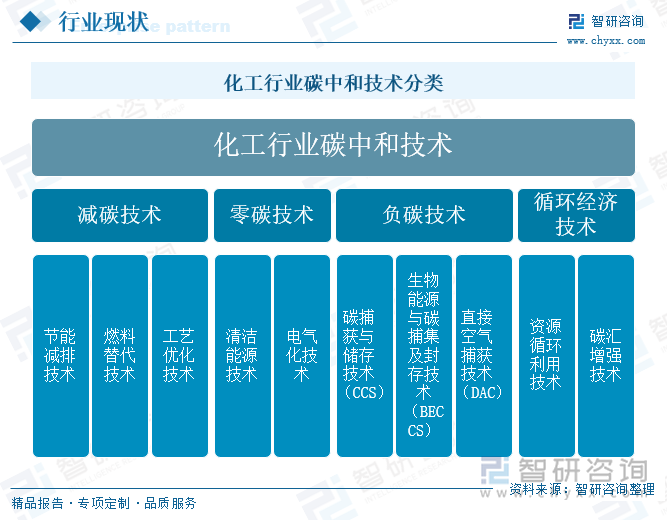
Core Viewpoint - In 2024, China's chemical industry carbon emissions are projected to be approximately 1.58 billion tons, reflecting a year-on-year increase of 1.28%, with a deceleration in growth rate compared to 2023 [1][12] Industry Overview - Carbon neutrality technology in the chemical industry aims to reduce CO2 emissions during production or achieve net-zero emissions through carbon capture, utilization, and storage (CCUS) [2] - The carbon neutrality technologies can be categorized into carbon reduction, zero-carbon, negative carbon, and circular economy technologies [2] Industry Development History - The development of carbon neutrality technology in China's chemical industry has progressed through three stages: introduction and exploration (before 2015), planning (2015-2020), and implementation and promotion (2021-present) [4] - Since 2021, significant advancements have been made in energy consumption and carbon emission control, with major companies like Sinopec actively participating in carbon neutrality initiatives [4] Industry Chain - The upstream of the carbon neutrality technology industry chain includes raw materials, equipment, and technical services, while the midstream involves the implementation of carbon neutrality technologies [6] - Key equipment includes carbon capture devices, low-carbon energy utilization devices, and high-efficiency energy-saving devices [6] Current Industry Status - In 2024, China's total CO2 emissions are expected to be 12.6 billion tons, remaining stable compared to 2023, with GDP growth of 5.0% and a decrease in carbon emission intensity by 3.4% [10] - The increase in non-fossil energy consumption and the growth of clean energy generation are contributing to the transition away from fossil fuels [10] Key Enterprises - Major companies in the sector include China National Chemical Corporation, Wanhua Chemical, and Zhongcai Energy, focusing on carbon capture and low-carbon technologies [18][20] - Wanhua Chemical has made significant strides in carbon neutrality technology, expanding into new materials and renewable energy sectors [18] Industry Development Trends - The chemical industry is expected to accelerate technological innovation and green transformation, with a focus on replacing traditional fossil materials with bio-based and renewable resources [22] - Integration of the industry chain and collaborative development will be emphasized, with companies extending their operations from raw materials to downstream fine chemical products [23] - The market landscape will shift significantly under carbon neutrality policies, with increased attention on new energy materials and carbon capture technologies [24]