光伏ETF招商(516230)

Search documents
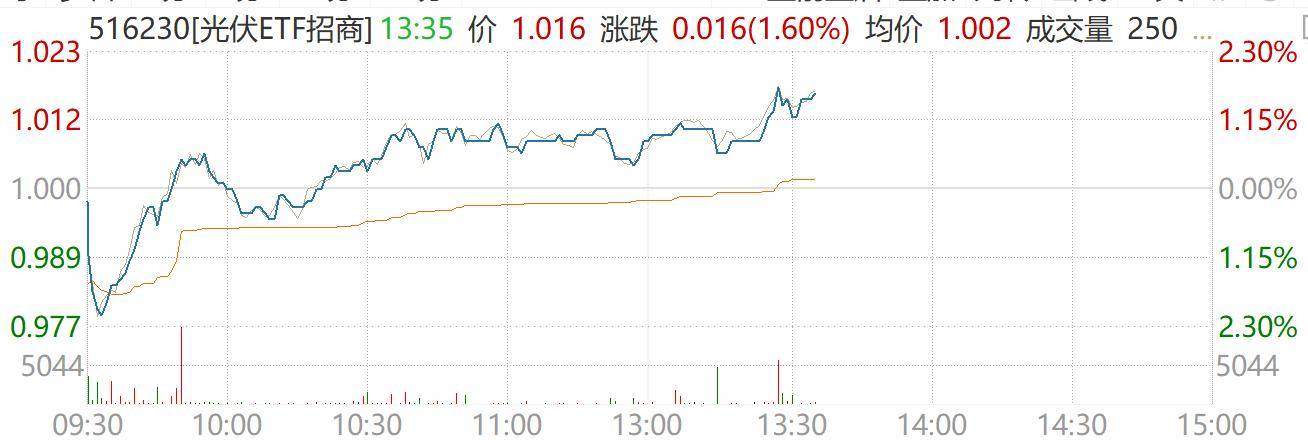
产业盈利触底回升,太空需求打开新蓝海,光伏ETF招商(516230)午后放量拉升
Sou Hu Cai Jing· 2026-02-06 05:58
Core Insights - The photovoltaic sector continues to show strong performance, with significant stock price increases among key companies [1][3] - The market's heightened focus on industry trends, particularly "space photovoltaics," is driving this momentum [3][4] Group 1: Industry Performance - As of Q3 2025, the photovoltaic industry's profitability indicators are expected to stabilize, with a projected return to positive net profits for the year [4] - The overall revenue growth rate for the photovoltaic industry is anticipated to end its decline starting Q1 2025, indicating a potential shift towards high-quality development [4] Group 2: Technological Advancements - The demand for high-performance photovoltaic systems is being driven by global low-orbit communication constellations and space AI computing initiatives, leading to a new market for space photovoltaics [7] - The evaluation criteria for photovoltaic systems are shifting from cost-efficiency for ground stations to power, reliability, and manufacturability for space applications, raising technical barriers and product value [7] Group 3: Investment Opportunities - Companies leading in HJT equipment, perovskite technology research, and core material supply are experiencing stock price increases, reflecting market revaluation of technological leadership and new growth areas [8] - The emerging demand for space photovoltaics, although in its early stages, indicates a strategic direction for the photovoltaic industry to upgrade its value amidst cyclical challenges [8]

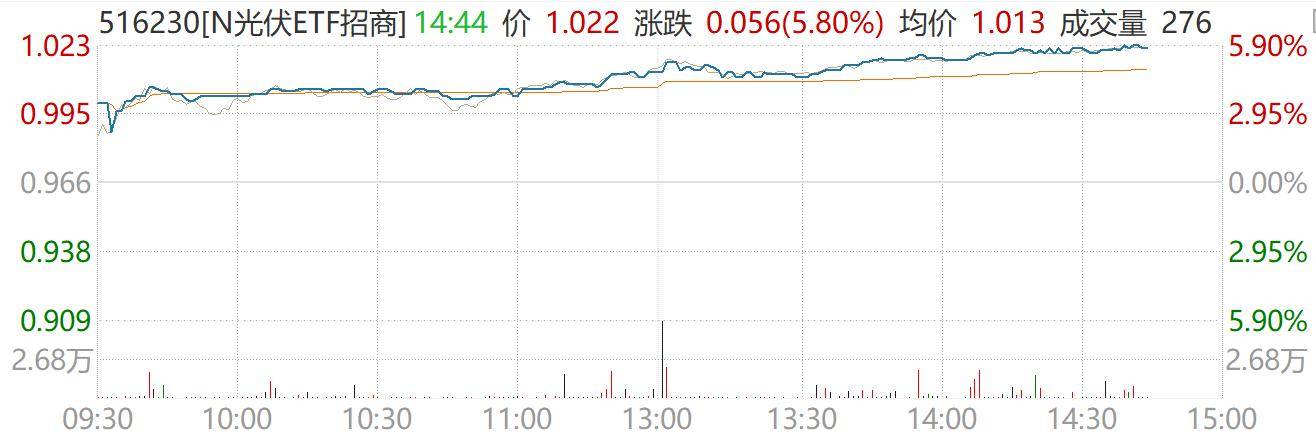
罗博特科、迈为股份涨停!光伏ETF招商(516230)上市首日涨近6%,算力卫星引领太空光伏新蓝海
Sou Hu Cai Jing· 2026-02-03 07:06
Group 1 - SpaceX has officially acquired its AI subsidiary xAI, with a combined entity valuation reaching $1.25 trillion, aiming to leverage SpaceX's launch capabilities to deploy AI data centers in space, marking a transition from concept to practical implementation in the space AI data center plan [2] - The concept of space photovoltaics involves deploying photovoltaic systems in space, which can overcome the inherent limitations of ground-based solar power, potentially becoming the optimal energy solution for space [3] Group 2 - Space photovoltaics can achieve a capacity factor improvement of 45% compared to ground-based solar power due to the absence of atmospheric interference, and peak power generation can be at least 40% higher [4][5] - The estimated cost of deploying a 40MW data center in space is approximately $0.002 per kWh, which is 22 times lower than the typical wholesale electricity cost in the U.S. of $0.045 per kWh [6] Group 3 - A major commercial rocket company plans to launch over 1 million satellites to create the world's first "orbital data center system," aiming to provide reasoning and edge computing services to billions of users over a 9-year deployment period [9] - The rise of space photovoltaics coincides with the challenges faced by the Chinese photovoltaic industry, such as overcapacity and price competition, presenting a new opportunity for value chain restructuring and upgrading [13] Group 4 - The technology roadmap for space photovoltaics is expected to evolve from gallium arsenide to P-type HJT and perovskite tandem batteries, with perovskite expected to become the next mainstream technology due to its high efficiency and lightweight characteristics [10] - The emergence of space photovoltaics is anticipated to catalyze high-value export opportunities for China's photovoltaic industry, as global demand for space energy surges [13] Group 5 - The photovoltaic industry is witnessing a shift in evaluation criteria from ground-based "levelized cost of electricity" to space-based metrics such as "power, reliability, and manufacturability," indicating a change in competitive barriers [13] - The photovoltaic ETF launched on February 3, 2026, aims to capture the overall trends in the photovoltaic industry, including the advancements in space photovoltaics and the acceleration of overseas expansion [15]