光速写作

Search documents
AI解题出海,“做题家”成全球“AI教师”
Xin Lang Cai Jing· 2025-12-02 11:44
Core Insights - The article discusses the rise of AI educational apps, particularly Gauth, which is gaining popularity among students in North America for its photo-based problem-solving capabilities [1][3][4]. Group 1: AI Educational Apps Overview - Gauth, developed by ByteDance, is an AI learning app that allows students to take pictures of problems and receive detailed solutions and explanations [3][4]. - Other notable apps include Question AI from Zuoyebang and Uknow.AI from Yuanfudao, which also focus on photo-based problem-solving [4][32]. - Gauth has achieved significant success, topping the North American App Store's education category for two consecutive months in late 2025, surpassing established apps like Duolingo and Google Classroom [4][32]. Group 2: Competitive Landscape - The AI educational app market is competitive, with established players like Quizlet and Photomath already having a foothold before the entry of Chinese apps [11][41]. - Gauth's success is attributed to its effective use of TikTok for marketing, where students discover the app through shared experiences [11][44]. - The app has been downloaded over 39 million times globally, with significant growth in Southeast Asian markets, indicating a strong international presence [14][44]. Group 3: Technological Advancements - The evolution of AI educational apps has shifted from merely providing answers to offering comprehensive explanations and teaching methodologies, resembling a tutoring experience [10][40]. - Gauth and similar apps are now expanding their capabilities beyond mathematics to include subjects like statistics, physics, and literature [10][40]. - The integration of advanced AI models has improved the apps' ability to provide personalized learning experiences, enhancing user engagement [18][48]. Group 4: Market Dynamics - The AI education market is projected to grow significantly, with estimates suggesting it could reach 1.6 trillion yuan by 2027 and nearly 1.8 trillion yuan by 2030 [18][48]. - The competitive structure of the market is characterized by a three-tier funnel, with tech giants at the top, educational companies in the middle, and niche startups at the bottom [19][49]. - The strategies of internet giants focus on user acquisition through free features, while educational companies often rely on subscription models to monetize their offerings [19][50]. Group 5: Challenges and Future Directions - Despite the rapid growth, AI educational apps face challenges such as the "hallucination problem" where AI may provide incorrect answers, impacting user trust [27][57]. - The lack of standardized evaluation metrics in the industry complicates the assessment of app effectiveness, leading to potential user dissatisfaction [27][57]. - The future of AI in education will likely focus on balancing technological advancements with ethical considerations, aiming to enhance learning outcomes while maintaining academic integrity [28].


“AI家教”火了,哪家大厂领跑?
Tai Mei Ti A P P· 2025-10-16 02:33
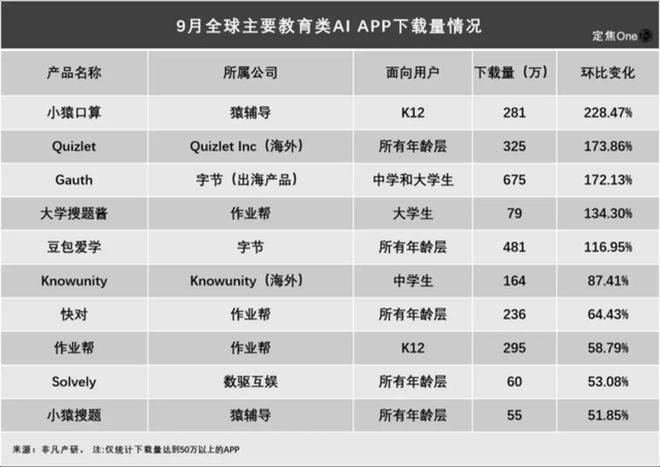
Core Insights - The article highlights the rapid rise of AI applications in the education sector, driven by increased user engagement and downloads, particularly during the back-to-school season [1][2][3] Group 1: Market Trends - Education AI applications are experiencing significant growth, with some products seeing download increases close to 1000% [1] - Notable examples include "光速写作" with a 926.59% increase in downloads and "E听说中学" with a 162.37% increase in monthly active users [1] - The surge in AI education applications is attributed to heightened demand for homework assistance and problem-solving tools among students [1][2] Group 2: Key Players - Major players in the market include internet giants like ByteDance and Alibaba, educational companies like Yuanfudao and Xueersi, and emerging startups like Answer AI [2] - The competition is characterized by a mix of established educational firms and tech companies, each leveraging their unique strengths [11][18] Group 3: Performance Metrics - Download volume and monthly active users (MAU) are critical metrics for assessing the success of AI education applications [4] - In September, several apps surpassed 200 million MAU, with ByteDance's "Gauth" leading in growth [8][10] - The top educational AI apps by download volume include "小猿口算" and "Quizlet," both showing substantial month-over-month growth [6][7] Group 4: Business Models - Educational companies primarily adopt a membership model, charging around 30 yuan per month, while internet companies often provide free access to attract users [12][13] - The focus for educational firms is on monetization through premium features, while internet firms aim to build user engagement and data accumulation [12][13] Group 5: Challenges and Opportunities - Despite the growth, the industry faces challenges such as low user willingness to pay and the accuracy of AI solutions [21][23] - Marketing strategies heavily influence the success of educational AI applications, with many relying on social media for user acquisition [24]