
作业帮

Search documents
月活破1.2亿!AI教育频繁出错,学生被错误答案误导谁来负责?
Sou Hu Cai Jing· 2026-02-13 10:53
Core Insights - The education sector is experiencing renewed interest from major tech companies, with ByteDance and Alibaba launching AI-driven educational tools to capture market share [1][2] - The AI education market in China has seen significant growth, with monthly active users of AI education apps surpassing 120 million, a 340% year-on-year increase as of Q3 2025 [1] - The competition is primarily between tech giants leveraging their existing user bases and traditional education companies with established research capabilities [2] Group 1: Market Dynamics - The AI education landscape is dominated by three main players: tech giants like ByteDance and Alibaba focusing on rapid iteration and user acquisition, traditional education firms like Yuanfudao and Zuoyebang enhancing their services with AI, and smaller startups targeting niche markets [2] - Major companies are pursuing three business lines: AI problem-solving tools, AI teaching assistants for schools, and AI-driven personalized learning, with varying degrees of market maturity and profitability [3][4] Group 2: Competitive Advantages - Major tech companies benefit from the reuse of large model technologies, existing user traffic, and lower development costs due to economies of scale [4] - However, their fast-paced, traffic-driven strategies may conflict with the slower, more methodical nature of the education sector, potentially hindering long-term success [4] Group 3: Product Differentiation - There are notable differences in user experience among AI education products, with tech giants offering integrated AI assistants that streamline user interaction, while traditional education apps maintain a more segmented approach [6][7] - The interaction styles of AI explanations vary significantly, with tech companies focusing on real-time analysis and engagement, contrasting with traditional firms that rely on pre-existing content and less interactive formats [10][12] Group 4: Challenges and Future Outlook - Major tech companies face challenges in educational content development due to a lack of deep educational research compared to traditional players, which may affect the quality and trustworthiness of their offerings [14] - The sustainability of the business model for tech giants remains uncertain, as they currently offer AI features for free without clear monetization strategies, raising questions about long-term profitability [15][16] - Future opportunities may lie in targeting specific segments such as B2B solutions for schools and adult education, where demand is stable and user willingness to pay is higher [16]



2026,巨头大战AI教育
3 6 Ke· 2026-02-10 01:14
Core Insights - The education sector is experiencing renewed interest from major tech companies, with ByteDance and Alibaba launching AI-driven educational tools to capture market share [1][2] - The AI education market in China has seen significant growth, with monthly active users of AI education applications surpassing 120 million, a 340% year-on-year increase [1] - The competition is primarily between tech giants leveraging their traffic and technology and traditional education players focusing on content and educational services [1][2] Group 1: Market Dynamics - Major tech companies are entering the education market due to clear demand and vast market potential, utilizing large model technology to reduce development costs and time [5][6] - The AI education landscape is divided into three main factions: tech giants focusing on rapid iteration and scenario validation, traditional education companies enhancing content with AI, and small startups targeting niche markets [1][2] - The monetization paths in the education market vary, with AI problem-solving tools being a low-barrier entry point for attracting users [2] Group 2: Business Models - The AI teaching assistant model for B-end clients is clearer in terms of commercial pathways, but its implementation is slower than expected [4] - The primary focus of major companies is on AI teaching, which requires a deep integration of technology and educational research, yet conversion rates and willingness to pay remain challenges [4][6] - The profitability of AI education products from major tech companies is uncertain, as they often prioritize data and traffic over direct revenue generation [6][20] Group 3: Product Differentiation - There are significant differences in the AI capabilities of various educational applications, with major tech companies offering integrated AI assistants while traditional players maintain a more segmented approach [7][14] - User experience varies greatly, with tech giants emphasizing seamless interaction and traditional companies relying on established educational methodologies [7][14] - The core functionalities of leading applications are similar, but the underlying technology and user engagement strategies differ significantly [6][7] Group 4: Challenges and Opportunities - Major tech companies face challenges in educational research, as their data often lacks the systematic organization and validation found in traditional education firms [17] - The phenomenon of "AI hallucination," where AI provides incorrect answers, poses a risk to user trust and product reliability [18][20] - The future of the education sector may lie in niche markets such as B/G-end solutions for schools and adult education, where demand is stable and payment structures are clearer [21][22]

来自华强北的AI硬件,成了外国学生口中的“作弊神器”?
3 6 Ke· 2025-12-10 00:18
Core Insights - The demand for AI-assisted problem-solving tools in education is rapidly increasing, with 26% of U.S. teens aged 13-17 using ChatGPT for homework, a twofold increase from 2023 [1] - The introduction of dedicated devices like the Youdao AI Answering Pen in China shows strong consumer willingness to pay for independent learning tools, with over 200,000 units sold [2][5] - In contrast, overseas markets are seeing a rise in similar devices, such as the "AI Smart Pen," which has gained popularity on platforms like TikTok, despite concerns about their effectiveness and potential misuse [4][7][10] Market Trends - The availability of problem-solving apps is widespread, but the actual market for dedicated hardware remains robust, driven by different consumer behaviors in domestic and international markets [2] - The Youdao AI Answering Pen's success indicates a strong demand for standalone educational tools among Chinese parents, contrasting with the overseas market where traditional devices like tablets and laptops dominate [12][16] Product Performance - The "AI Smart Pen" has been marketed as a tool for exam assistance but has faced criticism for its poor functionality and lack of localization, leading to low effectiveness in real-world applications [18][20] - User feedback on TikTok reflects a mix of skepticism and curiosity, highlighting the generational divide in attitudes towards educational technology [9][10] Consumer Behavior - In China, parents are willing to invest in tools that enhance learning efficiency, while overseas students are drawn to devices that offer a perceived advantage in restrictive testing environments [23] - The rapid spread of the "AI Smart Pen" on social media suggests a strong curiosity-driven market, although the actual educational value of such products remains questionable [12][23]


千问App上新了免费“AI家教”,作业帮们该接招了
Xin Lang Cai Jing· 2025-12-03 13:20
Core Insights - Qianwen App has launched a significant product update on December 3, introducing the Qwen3-Learning model and core features like photo-based Q&A and homework correction, marking its full entry into the education sector as an "AI tutor" [1][4][11] - The app aims to differentiate itself by focusing on "process presentation" in its Q&A feature, providing step-by-step explanations and breaking down core knowledge points, which enhances the learning experience [2][7] - The app's homework correction accuracy for objective questions is nearing 100%, while it has developed a dynamic scoring system for subjective questions, collaborating with teachers to provide detailed feedback and class performance reports [8][10] Market Positioning - The education AI market is competitive, with existing products like ShuaShuaTi and others transitioning from traditional question-matching to AI-driven solutions, often requiring subscription fees for advanced features [3][9] - Qianwen App plans to adopt a "free forever" model for its services, aiming to make educational AI accessible to all, particularly in under-resourced areas, which could help it surpass traditional user growth limitations [4][10] - The app's initial launch saw over 10 million downloads in its first week, setting a record for the fastest-growing AI application globally, indicating strong market interest [11] User Engagement Strategy - The app targets the K12 education segment but plans to expand its offerings to cover a broader range of educational needs, from elementary to university courses, and various examinations [10][11] - With competitors like Doubao and DeepSeek already achieving around 100 million monthly active users, Qianwen App's success in the education vertical is crucial for increasing its user base [5][11] - The focus on education as a critical need that spans both home and school environments positions Qianwen App to leverage its technology across multiple verticals once it establishes a foothold in the education sector [5][11]
AI家教赛道升温,互联网大厂与教育巨头开启攻防战
3 6 Ke· 2025-11-03 04:57
Core Insights - The education AI application market is experiencing unprecedented growth, with monthly active users and download numbers reaching record highs, driven by the "double reduction" policy and the increasing demand for efficient home education tools [1][3][5] - Major internet companies and traditional education giants are heavily investing in this sector, leading to a competitive landscape that reflects differing development strategies and user needs [3][6][12] Group 1: Market Dynamics - The surge in education AI applications is a result of both demand and supply factors, with a 50% increase in registered users reported during the back-to-school season [5][41] - The global education AI market is projected to grow from approximately $5.88 billion in 2024 to $32.27 billion by 2030, with a compound annual growth rate (CAGR) of 31.2% [6][41] - ByteDance's products lead in downloads, with Gauth at 6.75 million and Doubao Aixue at 4.81 million, both showing over 100% growth [6][9] Group 2: User Engagement - Monthly active users (MAU) are considered more critical than download numbers in the education AI sector, with five apps exceeding 20 million MAU in September [9][10] - The highest MAU is reported for Homework Help at 98.63 million, despite a 1.94% decline, while Yuanfudao's products also show significant growth [10][12] Group 3: Product Differentiation - Internet giants focus on user experience and rapid user acquisition, while traditional education companies emphasize teaching effectiveness and user retention [12][37] - The product design and user experience differ significantly between internet companies and education firms, with the former prioritizing efficiency and the latter focusing on educational outcomes [12][38] Group 4: Challenges and Opportunities - Despite the high potential for monetization in the education sector, actual revenue generation remains low, with top products earning only hundreds of thousands to millions monthly [41][42] - User skepticism regarding the effectiveness of AI tutoring products, combined with the prevalence of free offerings, hampers the willingness to pay [42][45] - The industry faces challenges such as product homogeneity and a lack of standardized evaluation metrics, which complicate user decision-making [45][47]

教育类 AI App 集体爆发:9月MAU增长贡献超30%|2025年9月AI百强榜
Xin Lang Cai Jing· 2025-10-28 05:14
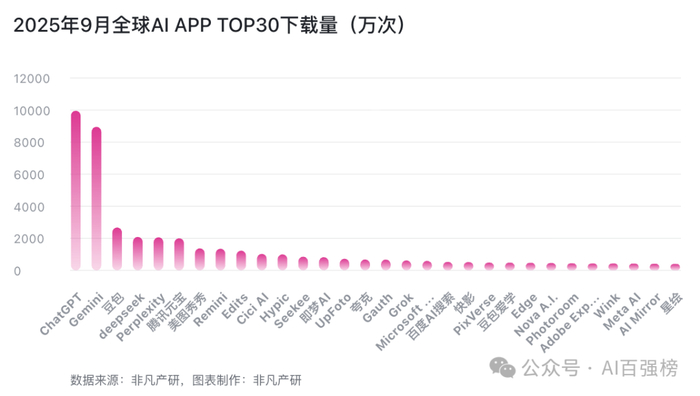
Global Overview - In September, the AI app market experienced a dual trend of rising interest with new products like Gemini and AI Mirror gaining traction, while established apps like ChatGPT and Baidu AI Search saw a decline in downloads but maintained an increase in active users [1][2][3] - The top 100 AI apps globally accumulated approximately 557 million downloads, with 75.4% from overseas and 24.6% from China, while the top 10 apps accounted for 58.8% of total downloads [2] Active User Metrics - The top 100 apps had a combined monthly active user (MAU) count of about 3.768 billion, with the top 10 apps representing 66.1% of this figure, indicating a higher concentration of active users compared to downloads [3] - Active users were more evenly distributed geographically, with 58.1% from overseas and 41.9% from China, suggesting stronger retention in the domestic market compared to new user acquisition [3] Category Structure - In terms of downloads, chatbots led with 48.1%, followed by image editing (11.4%), personal assistants (7.4%), smart search (7.4%), and video editing (7.3%), indicating that "dialogue + imagery" remains the dominant theme for new user acquisition [6] - For active users, chatbots accounted for 43.3%, smart search for 19.5%, image editing for 11.4%, and education for 9.8%, with education showing stable performance reflecting its cyclical and frequent usage advantages [6] User Acquisition and Retention - Gemini saw a remarkable increase in downloads, with a month-on-month growth of 462%, contributing approximately 73.62 million downloads [8] - ChatGPT, despite a 13.3% decline in downloads, added 188 million MAUs, showcasing its strong retention and penetration capabilities [10][11] - Other notable contributors to active user growth included Photomath, Cici AI, and Gauth, particularly in the education and image categories [12] Domestic Market Insights - In China, the total downloads reached 144.97 million, with the top 10 apps accounting for 80% of this figure [18] - The leading categories in downloads were chatbots (34.8%), image editing (14.3%), personal assistants (14.1%), education (10.7%), and smart search (9.1%) [19] - Major players in the domestic market included ByteDance (30.3%), Meitu (15.0%), DeepSeek (14.4%), and Tencent (13.8%) [19] Product Performance Signals - ChatGPT's decline in downloads alongside a strong increase in MAUs indicates a maturation phase where new user acquisition is stabilizing while existing users engage more deeply [27] - Gemini's explosive download growth suggests effective channel and brand strategies, although its MAU growth remains lower than its download increase, indicating potential for improved retention [27] - Perplexity demonstrated positive growth in both downloads and active users, highlighting its effective positioning in the "question and answer search" segment [28]
“AI家教”火了,哪家大厂领跑?
Tai Mei Ti A P P· 2025-10-16 02:33
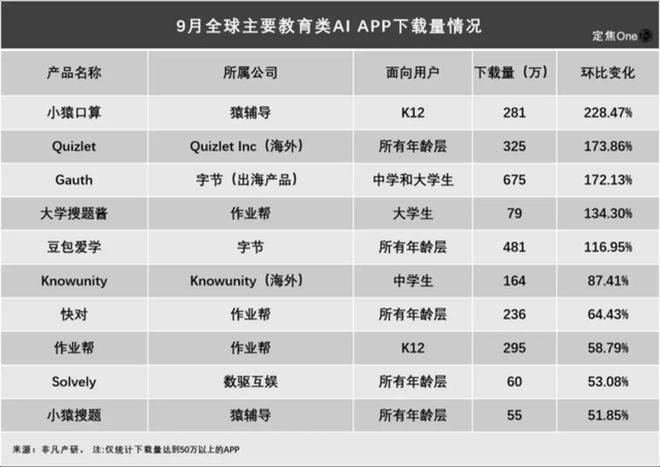
Core Insights - The article highlights the rapid rise of AI applications in the education sector, driven by increased user engagement and downloads, particularly during the back-to-school season [1][2][3] Group 1: Market Trends - Education AI applications are experiencing significant growth, with some products seeing download increases close to 1000% [1] - Notable examples include "光速写作" with a 926.59% increase in downloads and "E听说中学" with a 162.37% increase in monthly active users [1] - The surge in AI education applications is attributed to heightened demand for homework assistance and problem-solving tools among students [1][2] Group 2: Key Players - Major players in the market include internet giants like ByteDance and Alibaba, educational companies like Yuanfudao and Xueersi, and emerging startups like Answer AI [2] - The competition is characterized by a mix of established educational firms and tech companies, each leveraging their unique strengths [11][18] Group 3: Performance Metrics - Download volume and monthly active users (MAU) are critical metrics for assessing the success of AI education applications [4] - In September, several apps surpassed 200 million MAU, with ByteDance's "Gauth" leading in growth [8][10] - The top educational AI apps by download volume include "小猿口算" and "Quizlet," both showing substantial month-over-month growth [6][7] Group 4: Business Models - Educational companies primarily adopt a membership model, charging around 30 yuan per month, while internet companies often provide free access to attract users [12][13] - The focus for educational firms is on monetization through premium features, while internet firms aim to build user engagement and data accumulation [12][13] Group 5: Challenges and Opportunities - Despite the growth, the industry faces challenges such as low user willingness to pay and the accuracy of AI solutions [21][23] - Marketing strategies heavily influence the success of educational AI applications, with many relying on social media for user acquisition [24]
AI教育洞察:「Gauth」收入翻番,AI笔记刷新品类最好成绩
3 6 Ke· 2025-05-13 00:21
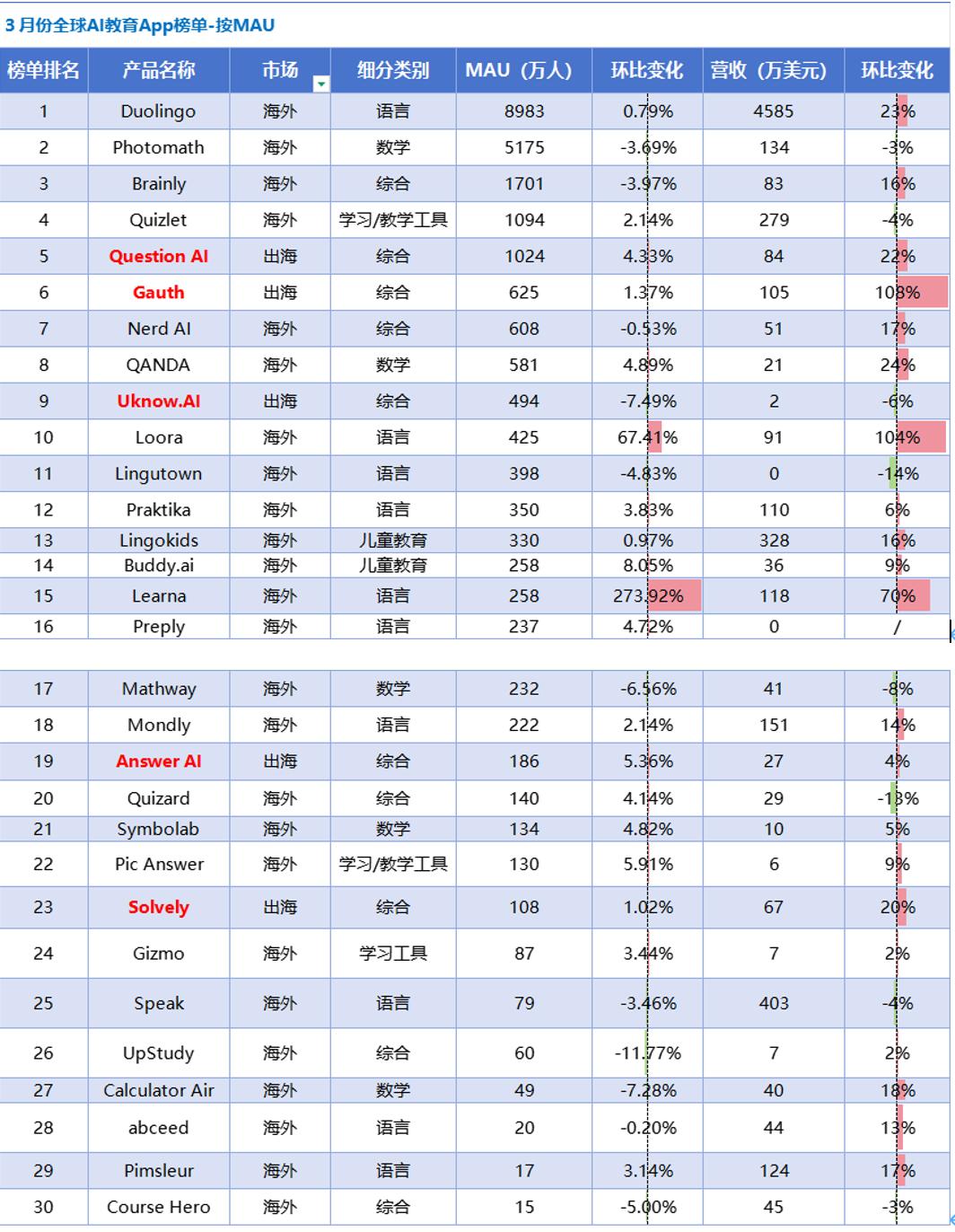
Core Insights - The report highlights the performance of global AI education products, focusing on K12, language learning, and children's enlightenment sectors, with a total of 30 apps listed based on MAU (Monthly Active Users) and revenue growth [2][3][4]. Group 1: Global AI Education Apps - The global AI education app rankings include 30 products, with a threshold of 100,000 MAU for inclusion [3][4]. - Overall, the MAU for global AI education apps remained stable in March, with some products showing significant growth; 7 apps experienced a revenue increase of 20% or more [4][5]. - "Duolingo" leads the global app rankings with 89.83 million MAU, showing a slight increase of 0.79% and a revenue growth of 23% [5][6]. - "Gauth" achieved the highest revenue growth at 108%, following its return and successful marketing campaigns targeting university students [7][10]. - "Loora" and "Learna," both language learning apps, also reported substantial MAU growth of 67.41% and 274%, respectively, due to new features and subscription model adjustments [10][12][11]. Group 2: Revenue and User Growth - The report indicates that 5 products from Chinese teams are included in the global rankings, with 4 of them showing both MAU and revenue growth [5][6]. - "Calculator Air" and "Symbolab," both math-focused apps, have been noted for their high ARPU (Average Revenue Per User), with "Calculator Air" achieving an ARPU of 0.81, significantly higher than its competitors [13][14][15]. - The revenue performance of domestic AI education apps in China shows a recovery, with 6 out of 8 products reporting revenue growth, particularly "TalkAI" which saw a staggering 6010% increase in revenue [29][31]. Group 3: Web-Based AI Education Products - The web-based AI education product rankings feature 27 products, with "Q-Chat" leading in traffic with 9.845 million visits, followed by "Duolingo" with 6.807 million [19][20]. - "Chegg" has introduced new AI features to enhance its offerings, including AI flashcards and solution comparison tools, in response to competitive pressures [22][23]. - "Turbolearn ai" has shown remarkable growth in the AI note-taking segment, achieving a monthly visit increase of 42.03%, marking a record for AI note-taking products [24][26].
QuestMobile 2024年度中国移动互联网实力价值榜
QuestMobile· 2025-03-04 01:59
1、TOP5 0赛道用户规模NO. 1APP | 序号 | 行业分类 | No.1 ADD 名称 | 2024年Q4平均MAU(万) | | --- | --- | --- | --- | | 1 | 即时语讲 | 6 微信 | 107,803.99 | | 2 | 综合电商 | 淘 淘宝 | 95,688.45 | | 3 | 短视频 | ct | 84,048.59 | | 4 | 地图导航 | ◀ 高德地图 | 83,970.16 | | 5 | 支付结算 | ま 支付宝 | 92,452.36 | | б | 输入法 | S 搜狗输入法 | 61,091.90 | | 7 | 在线视频 | D 腾讯视频 | 38,023.10 | | 8 | 终端天气 | C 华为天气 | 22.370.24 | | 9 | 浏览器 | △ QQ浏览器 | 43,039.14 | | 10 | 搜索引擎 | 総 百度 | 66,625.07 | | 1 I | 在线音乐 | (K) 酷狗音乐 | 22,799.73 | | 12 | 综合资讯 | 紧 今日头条 | 34,246.65 | | 13 | 手机银行 | ...