
小猿搜题

Search documents
“十五五”规划纲要计算机行业解读:智能经济启航,AI Agent主导未来五年AI叙事
Zhong Guo Yin He Zheng Quan· 2026-03-15 03:24
Investment Rating - The report maintains a "Buy" rating for the computer industry [4] Core Insights - The "14th Five-Year Plan" emphasizes the core strategic position of artificial intelligence (AI) in national development, with the term "artificial intelligence" appearing 30 times, compared to only 6 times in the previous plan [6][8] - The next five years will see AI Agents as the driving force for economic transformation, with a focus on high-value AI Agent growth leading to significant value creation [6][10] - The demand for intelligent computing power is expected to rise significantly, with projections indicating that by 2028, intelligent computing power will account for over 95% of total computing power in China [6][12] - The report highlights the emergence of "Token inflation" due to the rapid growth in AI model usage, with a projected annual Token consumption increase from 0.0005 PetaTokens in 2025 to 152,667 PetaTokens by 2030, reflecting a CAGR of 3418% [6][24] - Investment opportunities are identified in AI-native application companies, edge AI technologies, domestic computing power chain replacements, and collaborative infrastructure for computing and electricity [6][38] Summary by Sections Section 1: The "14th Five-Year Plan" as a Key Period for Intelligent Economy - The plan introduces the concept of "intelligent native," suggesting AI may become a new production factor [11] - The intelligent economy will drive the reconstruction of AI factor value [13] Section 2: Outlook for the "14th Five-Year Plan" - The intelligent economy is set to initiate a rapid explosion in Token usage, with AI Agents transitioning from cost centers to profit centers [17][38] - The report anticipates a significant increase in the number of active AI Agents, from approximately 28.6 million in 2025 to 2.216 billion by 2030, with a compound annual growth rate (CAGR) of 139% [24] Section 3: Comprehensive Upgrade of AI Factors During the "14th Five-Year Plan" - The report emphasizes the importance of high-quality data sets as a core barrier for building irreplaceable AI Agents [16] - The demand for high-quality, proprietary data sets is expected to surge, with a focus on transforming data resources into valuable assets [16] Section 4: Investment Recommendations - The report suggests focusing on AI-native application companies capable of generating scalable revenue, as well as companies that integrate AI Agents with vertical industry know-how [6][38] - Specific companies to watch include Horizon Robotics, JingTai Holdings, Meitu, and others [6]


千问App上新了免费“AI家教”,作业帮们该接招了
Xin Lang Cai Jing· 2025-12-03 13:20
Core Insights - Qianwen App has launched a significant product update on December 3, introducing the Qwen3-Learning model and core features like photo-based Q&A and homework correction, marking its full entry into the education sector as an "AI tutor" [1][4][11] - The app aims to differentiate itself by focusing on "process presentation" in its Q&A feature, providing step-by-step explanations and breaking down core knowledge points, which enhances the learning experience [2][7] - The app's homework correction accuracy for objective questions is nearing 100%, while it has developed a dynamic scoring system for subjective questions, collaborating with teachers to provide detailed feedback and class performance reports [8][10] Market Positioning - The education AI market is competitive, with existing products like ShuaShuaTi and others transitioning from traditional question-matching to AI-driven solutions, often requiring subscription fees for advanced features [3][9] - Qianwen App plans to adopt a "free forever" model for its services, aiming to make educational AI accessible to all, particularly in under-resourced areas, which could help it surpass traditional user growth limitations [4][10] - The app's initial launch saw over 10 million downloads in its first week, setting a record for the fastest-growing AI application globally, indicating strong market interest [11] User Engagement Strategy - The app targets the K12 education segment but plans to expand its offerings to cover a broader range of educational needs, from elementary to university courses, and various examinations [10][11] - With competitors like Doubao and DeepSeek already achieving around 100 million monthly active users, Qianwen App's success in the education vertical is crucial for increasing its user base [5][11] - The focus on education as a critical need that spans both home and school environments positions Qianwen App to leverage its technology across multiple verticals once it establishes a foothold in the education sector [5][11]
AI家教赛道升温,互联网大厂与教育巨头开启攻防战
3 6 Ke· 2025-11-03 04:57
Core Insights - The education AI application market is experiencing unprecedented growth, with monthly active users and download numbers reaching record highs, driven by the "double reduction" policy and the increasing demand for efficient home education tools [1][3][5] - Major internet companies and traditional education giants are heavily investing in this sector, leading to a competitive landscape that reflects differing development strategies and user needs [3][6][12] Group 1: Market Dynamics - The surge in education AI applications is a result of both demand and supply factors, with a 50% increase in registered users reported during the back-to-school season [5][41] - The global education AI market is projected to grow from approximately $5.88 billion in 2024 to $32.27 billion by 2030, with a compound annual growth rate (CAGR) of 31.2% [6][41] - ByteDance's products lead in downloads, with Gauth at 6.75 million and Doubao Aixue at 4.81 million, both showing over 100% growth [6][9] Group 2: User Engagement - Monthly active users (MAU) are considered more critical than download numbers in the education AI sector, with five apps exceeding 20 million MAU in September [9][10] - The highest MAU is reported for Homework Help at 98.63 million, despite a 1.94% decline, while Yuanfudao's products also show significant growth [10][12] Group 3: Product Differentiation - Internet giants focus on user experience and rapid user acquisition, while traditional education companies emphasize teaching effectiveness and user retention [12][37] - The product design and user experience differ significantly between internet companies and education firms, with the former prioritizing efficiency and the latter focusing on educational outcomes [12][38] Group 4: Challenges and Opportunities - Despite the high potential for monetization in the education sector, actual revenue generation remains low, with top products earning only hundreds of thousands to millions monthly [41][42] - User skepticism regarding the effectiveness of AI tutoring products, combined with the prevalence of free offerings, hampers the willingness to pay [42][45] - The industry faces challenges such as product homogeneity and a lack of standardized evaluation metrics, which complicate user decision-making [45][47]


“AI家教”火了,哪家大厂领跑?
Tai Mei Ti A P P· 2025-10-16 02:33
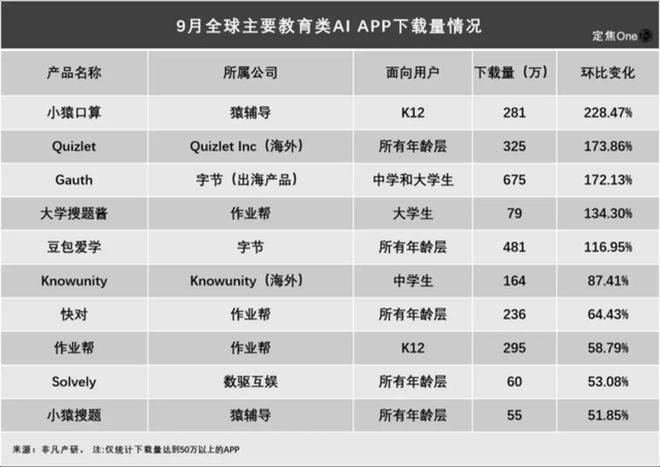
Core Insights - The article highlights the rapid rise of AI applications in the education sector, driven by increased user engagement and downloads, particularly during the back-to-school season [1][2][3] Group 1: Market Trends - Education AI applications are experiencing significant growth, with some products seeing download increases close to 1000% [1] - Notable examples include "光速写作" with a 926.59% increase in downloads and "E听说中学" with a 162.37% increase in monthly active users [1] - The surge in AI education applications is attributed to heightened demand for homework assistance and problem-solving tools among students [1][2] Group 2: Key Players - Major players in the market include internet giants like ByteDance and Alibaba, educational companies like Yuanfudao and Xueersi, and emerging startups like Answer AI [2] - The competition is characterized by a mix of established educational firms and tech companies, each leveraging their unique strengths [11][18] Group 3: Performance Metrics - Download volume and monthly active users (MAU) are critical metrics for assessing the success of AI education applications [4] - In September, several apps surpassed 200 million MAU, with ByteDance's "Gauth" leading in growth [8][10] - The top educational AI apps by download volume include "小猿口算" and "Quizlet," both showing substantial month-over-month growth [6][7] Group 4: Business Models - Educational companies primarily adopt a membership model, charging around 30 yuan per month, while internet companies often provide free access to attract users [12][13] - The focus for educational firms is on monetization through premium features, while internet firms aim to build user engagement and data accumulation [12][13] Group 5: Challenges and Opportunities - Despite the growth, the industry faces challenges such as low user willingness to pay and the accuracy of AI solutions [21][23] - Marketing strategies heavily influence the success of educational AI applications, with many relying on social media for user acquisition [24]
当大模型 “吞噬” 垂类应用,教育 AI 如何成为例外?
晚点LatePost· 2025-04-16 15:37
通用大模型难以满足教育的复杂需求,给了教育 AI 落地的机会。今年 3 月国外知名投资机构 A16Z 发布了全球最赚钱的前 50 个 AI 应用收入,数学解题、语言学习的应用贡献了前 50 总收入的 8%。 这些学习类 AI 的底层依然是通用大模型,但它们找到了刚需场景,提供了比通用大模型更好的解决 方案。当底层模型趋同时,安全专业的服务、对垂直场景的深度理解,才是留存用户的关键。 抢滩教育 AI,猿辅导这次赌对了吗? AI 正以迅猛的速度追赶人类智力。当大模型在越来越多垂直领域上持续进步,创业公司们还有生存空 间吗? AI 应用创业公司最近一次感到恐慌,来自 GPT-4o 文生图功能的更新,其生成的吉卜力风格图片刷爆 社交媒体,效果超过 Midjourney、Stable Diffusion、Gemini 等对手。"复杂工程化注定会被模型碾 碎",资深产品设计师 "歸藏" 说,"如今都被一个简单对话界面所取代。" 在猿辅导集团副总裁王向东看来,大模型吞噬垂类应用的事情,在教育行业不会发生。 他认为文生图的需求简单、标准化,而教育需求极度复杂且非标。中小学生的需求包括作业检查、知 识讲解、错题总结、心理陪伴等 ...