光阻剂

Search documents
2025年湖南电动汽车出口首破10万辆 同比激增128.2%
Chang Sha Wan Bao· 2026-01-22 09:39
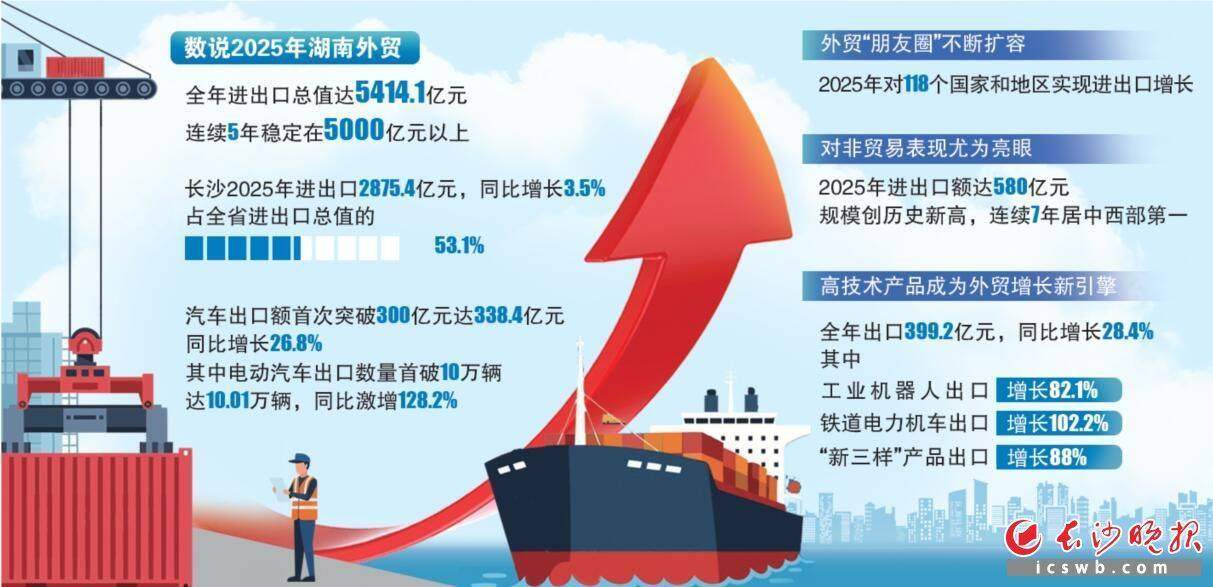
Core Insights - In 2025, Hunan's foreign trade demonstrated resilience, achieving a total import and export value of 541.41 billion yuan, maintaining stability above 500 billion yuan for five consecutive years, and contributing significantly to the province's economic goals during the 14th Five-Year Plan [2] Group 1: Trade Performance - Hunan's foreign trade showed steady growth, with a quarter-on-quarter increase of 7.7% in Q4 and a year-on-year increase of 5.7% in December, marking a strong finish for the year [3] - The automotive export value reached 33.84 billion yuan, a 26.8% increase year-on-year, with electric vehicle exports exceeding 100,000 units, a staggering increase of 128.2% [3] - The number of enterprises engaged in import and export activities surpassed 9,000 for the first time, reaching 9,113, with export enterprises increasing by 9.6% and import enterprises by 10.4% [3] Group 2: Key Contributions from Changsha - Changsha accounted for 287.54 billion yuan in import and export value, representing 53.1% of the province's total, and contributed significantly to high-tech product exports and machinery imports [4] - The city played a crucial role in stabilizing Hunan's foreign trade landscape, contributing over three-quarters of the province's high-tech product exports and machinery imports [4] Group 3: Trade Expansion and New Markets - Hunan's trade network expanded to cover 118 countries and regions, with imports and exports to Belt and Road countries reaching 320.08 billion yuan, accounting for 59.1% of the province's total [5] - Exports to Africa reached a record high of 58 billion yuan, growing by 5.8% year-on-year, with significant increases in engineering machinery and "new three samples" products [5] - The province benefited from zero-tariff policies for least developed countries in Africa, leading to increased imports of African specialty products [5] Group 4: Export Structure Optimization - Hunan's exports totaled 320.76 billion yuan, with traditional industries maintaining stability and emerging industries showing strong growth, particularly in high-tech products [6] - High-tech product exports grew by 28.4%, with industrial robots and electric locomotives seeing significant increases of 82.1% and 102.2%, respectively [6] - The customs department implemented measures to support high-tech enterprises, significantly improving the efficiency of material flow for companies requiring timely imports [6] Group 5: Logistics Improvements - The construction of international logistics channels has strengthened Hunan's foreign trade, with new international air routes and increased container throughput at ports [8] - The "Xiangyuefei" rail-sea intermodal transport reduced logistics costs by nearly 30% for enterprises [8] - Future plans include optimizing regulatory services and expanding innovative logistics models to further enhance Hunan's position in high-quality foreign trade development [8]


曝华为扶植中国本土半导体化学供应商!
国芯网· 2025-05-29 13:49
Core Viewpoint - Huawei is fostering a local semiconductor chemical company, Zhuhai Jishi Technology, to compete with global leaders and establish a self-sufficient domestic semiconductor supply chain [1]. Group 1: Company Development - Zhuhai Jishi Technology aims to become an "end-to-end" chemical materials supplier, competing with major international firms like Shin-Etsu Chemical, JSR, Merck, DuPont, and Dow [1]. - The company is not focused on developing just one or two types of chemical materials but aims to create a comprehensive "turnkey solution" that covers nearly all key materials required for chip manufacturing [1]. Group 2: Market Context - The high-end photoresist market has long been dominated by Japanese companies such as Shin-Etsu Chemical, JSR, and Tokyo Ohka Kogyo [2]. - The chemical mechanical polishing (CMP) slurry and polishing pad markets have been controlled for years by companies like Fujimi, Dow, and DuPont [2]. Group 3: Industry Motivation - There is a strong motivation for China to develop local chemical materials, as the country possesses a robust chemical industry but has not yet reached the high-end standards required for semiconductor manufacturing [3].