全球芯片LOF

Search documents
超10只QDII基金同日预警风险
21世纪经济报道· 2026-03-20 00:39
Core Viewpoint - The article highlights the increasing premium risk associated with cross-border ETFs and LOFs amid heightened volatility in international financial markets, urging investors to be cautious and monitor secondary market prices closely [1][2]. Group 1: Premium Risk Alerts - Multiple QDII funds, including the E Fund's crude oil LOF and various ETFs, have issued over ten announcements since early March regarding premium risks, indicating a growing trend of frequent alerts [1][3]. - As of March 18, the E Fund's crude oil LOF had a premium rate of approximately 15%, with its secondary market closing price significantly exceeding its net asset value [3][4]. - The frequency of premium risk alerts has increased, with some funds resorting to temporary trading halts to manage high premium rates [3][4]. Group 2: Factors Contributing to High Premiums - The high premium rates are attributed to concentrated demand for overseas assets, such as oil, U.S. stocks, and semiconductors, combined with exhausted QDII foreign exchange quotas, leading to a supply-demand imbalance [4][5]. - The misalignment of trading hours in cross-border markets and lengthy subscription cycles further exacerbates price deviations, resulting in sustained high premiums [4]. Group 3: Investment Recommendations - Investors are advised to focus on the premium rates of QDII funds, avoiding purchases during high premium periods to mitigate potential losses from price corrections [6][7]. - It is recommended to prioritize funds with good liquidity and low tracking errors, and to adopt a long-term investment strategy rather than short-term speculation [7][9]. - Awareness of external factors such as foreign exchange quotas, subscription rules, and market risks is crucial for informed investment decisions [8][9]. Group 4: Regulatory and Company Actions - To address high premium risks, regulatory bodies should consider increasing QDII foreign exchange quotas and improving allocation efficiency, while fund companies need to issue timely alerts and implement subscription limits [9]. - Enhanced investor education regarding the risks of price deviations from net asset values is essential to reduce impulsive buying during high premium periods [9].

高溢价基金还有谁?
Sou Hu Cai Jing· 2026-02-05 16:05
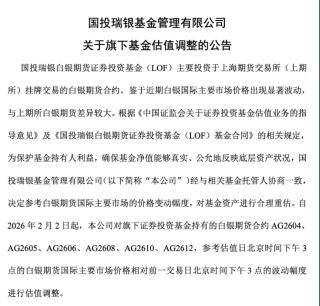
Core Insights - The only LOF fund tracking silver futures, Guotou Silver LOF, experienced significant price fluctuations, highlighting risks for investors chasing high premiums [1][3] - A major adjustment in the fund's valuation method was announced due to discrepancies between international silver prices and domestic futures prices, leading to a substantial drop in the fund's net asset value [1][3] Valuation Adjustment - The unit net value of Guotou Silver LOF dropped from 3.2838 yuan to 2.2494 yuan following the new valuation method [3] - The fund's management explained that domestic silver futures have a ±17% price limit, which can lead to overvaluation if international prices fall sharply [3] Premium Rates and Risks - As of February 5, the premium rate for Guotou Silver LOF was still at 37.13%, indicating significant losses for early investors who entered at high premiums [3] - The fund's premium rate previously surged to 109%, with over 20 risk alerts issued this year [3] - The case of Guotou Silver LOF illustrates three major risks associated with LOF fund investments: high premiums can erode principal, cross-market trading has inherent regulatory mismatches, and complex derivative structures may expose ordinary investors to unexpected volatility [3] Market Context - Other LOF funds, including Global Chip LOF and E Fund Oil LOF, also exhibit high premium rates, with over 16 products having premiums above 10%, some exceeding 40%, indicating potential value correction risks [3]