
华安日经225ETF

Search documents
超10只QDII基金同日预警风险
21世纪经济报道· 2026-03-20 00:39
Core Viewpoint - The article highlights the increasing premium risk associated with cross-border ETFs and LOFs amid heightened volatility in international financial markets, urging investors to be cautious and monitor secondary market prices closely [1][2]. Group 1: Premium Risk Alerts - Multiple QDII funds, including the E Fund's crude oil LOF and various ETFs, have issued over ten announcements since early March regarding premium risks, indicating a growing trend of frequent alerts [1][3]. - As of March 18, the E Fund's crude oil LOF had a premium rate of approximately 15%, with its secondary market closing price significantly exceeding its net asset value [3][4]. - The frequency of premium risk alerts has increased, with some funds resorting to temporary trading halts to manage high premium rates [3][4]. Group 2: Factors Contributing to High Premiums - The high premium rates are attributed to concentrated demand for overseas assets, such as oil, U.S. stocks, and semiconductors, combined with exhausted QDII foreign exchange quotas, leading to a supply-demand imbalance [4][5]. - The misalignment of trading hours in cross-border markets and lengthy subscription cycles further exacerbates price deviations, resulting in sustained high premiums [4]. Group 3: Investment Recommendations - Investors are advised to focus on the premium rates of QDII funds, avoiding purchases during high premium periods to mitigate potential losses from price corrections [6][7]. - It is recommended to prioritize funds with good liquidity and low tracking errors, and to adopt a long-term investment strategy rather than short-term speculation [7][9]. - Awareness of external factors such as foreign exchange quotas, subscription rules, and market risks is crucial for informed investment decisions [8][9]. Group 4: Regulatory and Company Actions - To address high premium risks, regulatory bodies should consider increasing QDII foreign exchange quotas and improving allocation efficiency, while fund companies need to issue timely alerts and implement subscription limits [9]. - Enhanced investor education regarding the risks of price deviations from net asset values is essential to reduce impulsive buying during high premium periods [9].

单日涨超4.8%,这只ETF逆袭
Zhong Guo Ji Jin Bao· 2026-02-11 11:54
Core Viewpoint - The cross-border ETFs, particularly rare metal ETFs, have shown strong performance, with significant increases in their values, indicating heightened market interest in these assets [1][5][6]. ETF Performance - On February 11, A-shares exhibited mixed trends, with small metals and oil and gas extraction sectors performing well, while the film and cinema sector experienced a pullback [2]. - A total of 640 stock ETFs (including cross-border) rose, with notable gains in rare metal ETFs, while 713 stock ETFs declined, particularly in the film and media sectors [3][4]. Cross-Border ETF Highlights - Cross-border ETFs performed exceptionally well, with the Huaxia Nikkei ETF surging by 4.85%, leading the market. Other Nikkei ETFs also saw significant increases, indicating growing interest in Japanese stock assets [6]. - The Huaxia Nikkei ETF and Huaxia Nikkei 225 ETF both exceeded 2 billion yuan in scale, while the E Fund Nikkei 225 ETF and ICBC Nikkei ETF surpassed 1.8 billion yuan and 1 billion yuan, respectively [6]. Rare Metal Sector - The rare metal sector experienced a comprehensive surge, with the Jiashi Rare Metal ETF rising by 3.86%, followed closely by ETFs from ICBC Credit Suisse, GF, and Huafu, which increased by 3.79%, 3.78%, and 3.53%, respectively [9]. - The Jiashi Rare Metal ETF is the largest in scale, exceeding 6.5 billion yuan, followed by GF Rare Metal ETF at over 5.1 billion yuan [9]. - Industry experts suggest that limited reserves and increasing demand from sectors like renewable energy and semiconductors may lead to a continued upward trend in rare metal prices [9]. Broader Metal Industry Trends - The non-ferrous metal industry chain also saw gains, with the Taikang Non-Ferrous ETF rising by 3.19%, and other ETFs in the sector showing similar upward trends [10]. Fund Flow Insights - On February 10, broad-based ETFs experienced a net outflow of over 10.6 billion yuan, with significant outflows from the CSI 300 Index and other major indices [11][12]. - The top sectors for fund inflows included media, rare earths, and robotics, while the largest outflows were from the CSI 300 Index and the ChiNext 50 Index [12].
10月份56%QDII正收益 易方达奥明日经225ETF涨12.5%
Zhong Guo Jing Ji Wang· 2025-11-05 23:08
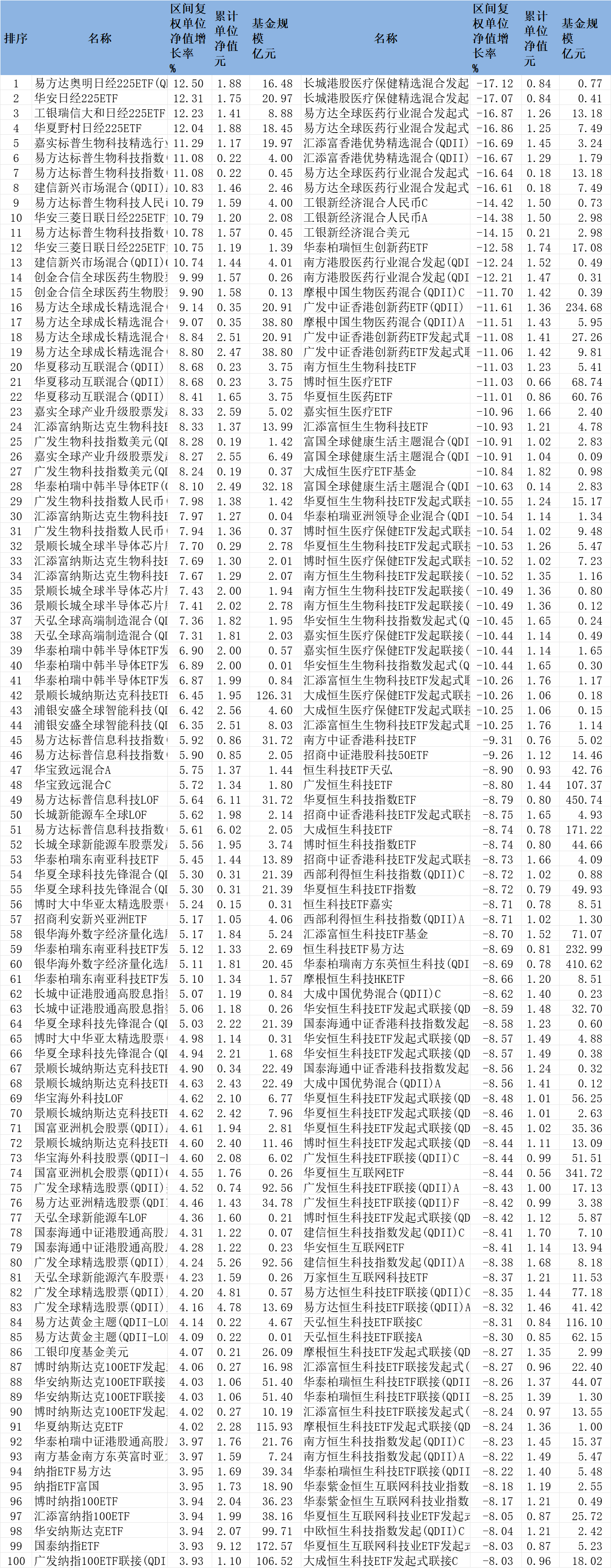
Core Insights - In October 2023, among 684 comparable QDII funds, 381 funds saw an increase in net value, representing 55.7% of the total, while 301 funds experienced a decline [1] - The top-performing QDII fund for October was the E Fund Nikkei 225 ETF, which achieved a return of 12.50% [1] - The E Fund Nikkei 225 ETF has a year-to-date return of 31.82% and an inception-to-date return of 87.95%, with a cumulative net value of 1.8795 yuan as of November 3, 2025 [1] Fund Performance - The Huaan Nikkei 225 ETF, with the largest scale of 2.097 billion yuan, recorded a 10-month increase of 12.31% [2] - The Huaan Nikkei 225 ETF has a year-to-date return of 32.23% and an inception-to-date return of 74.55%, with a cumulative net value of 1.7455 yuan as of November 3, 2025 [3] - The Hua Xia Nomura Nikkei 225 ETF and the Harvest S&P Biotechnology Select Industry ETF also performed well, with returns of 12.04% and 11.29% respectively in October [4] Fund Tracking and Holdings - The E Fund Nikkei 225 ETF tracks the Nikkei 225 Index and primarily invests in the Nikkei 225 ETF managed by Omin Asset Management [1] - The Hua Xia Nomura Nikkei 225 ETF also tracks the Nikkei 225 Index, achieving a year-to-date return of 31.34% and an inception-to-date return of 88.09% [4] - The Harvest S&P Biotechnology Select Industry ETF, established on December 26, 2023, has a year-to-date return of 22.26% and an inception-to-date return of 18.27% [4] Performance Summary - A total of 13 QDII funds had returns exceeding 10% in October, with the top five being: 1. E Fund Nikkei 225 ETF: 12.50% 2. Huaan Nikkei 225 ETF: 12.31% 3. ICBC Credit Suisse Nikkei 225 ETF: 12.23% 4. Hua Xia Nomura Nikkei 225 ETF: 12.04% 5. Harvest S&P Biotechnology Select Industry ETF: 11.29% [5][6]
大回血,股票型ETF一周猛增1000亿元!上周两明星产品遭“反噬”,但资金“越跌越买”
Mei Ri Jing Ji Xin Wen· 2025-10-26 05:53
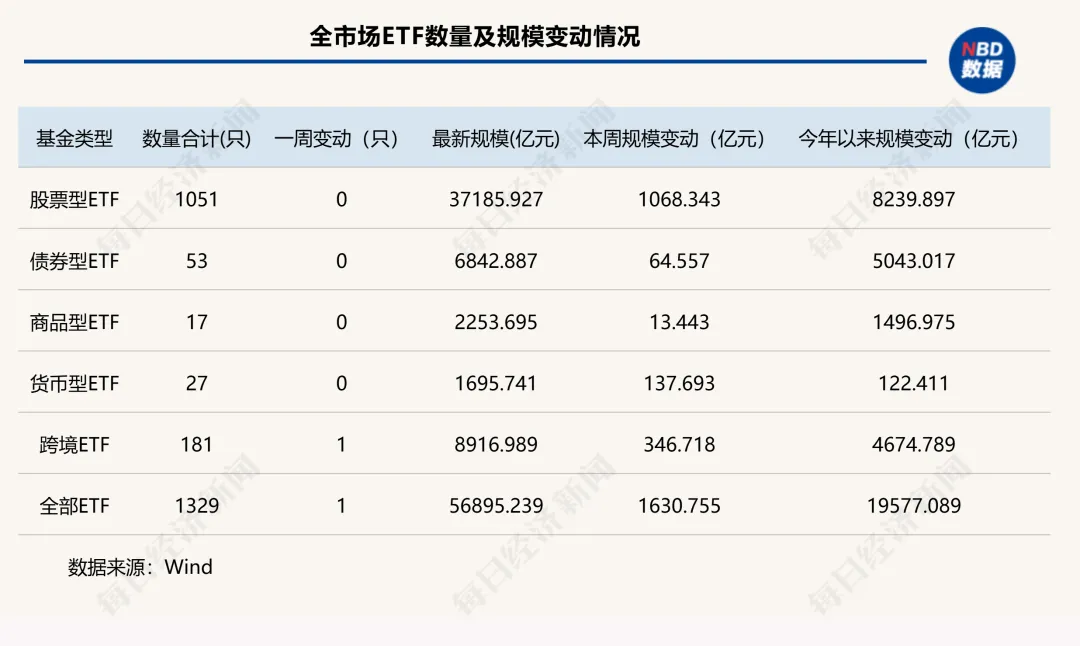
Market Overview - A-shares experienced a significant rebound from October 20 to October 24, with the CSI 300 index rising by 3.24%, and the ChiNext and STAR 50 indices increasing by 8.05% and 7.27% respectively [1][2] - The Hong Kong tech stocks also saw a rebound, with the Hang Seng Tech Index rising by 5.2% during the same period [1] ETF Market Performance - The ETF market saw a strong recovery, with a total increase of 1630.76 billion yuan, marking the highest weekly growth since September [2][3] - Stock ETFs led the growth, increasing by 1068 billion yuan, with broad-based ETFs contributing over 70% of this increase [2][3] - Cross-border ETFs also reversed their recent decline, with money market ETFs recovering from earlier losses [1][2] Key ETF Highlights - The CSI 300 index-linked ETFs were the main focus, with a weekly increase of 343 billion yuan, bringing the total scale to over 1.2 trillion yuan [1][4] - Major fund managers like Huaxia Fund and E Fund saw their ETF scales increase by over 300 billion yuan each, with Huaxia Fund's ETF management scale surpassing 900 billion yuan [1][7] Gold ETFs - Gold ETFs were among the products that saw a decrease in scale, but there was a notable trend of "buying the dip," with over 5 billion yuan net subscriptions for two prominent gold ETFs [1][11] ETF Scale and Growth - As of October 25, the total scale of all ETFs reached 56.9 trillion yuan, with stock ETFs accounting for 37.2 trillion yuan [3][4] - Year-to-date, the total increase in ETF scale has reached 1.96 trillion yuan, with stock ETFs contributing 823.99 billion yuan [3][4] Fund Management Rankings - The top 20 ETF management firms saw significant growth, with Huaxia Fund and E Fund leading the way, each increasing by over 300 billion yuan this week [7][9] - Notably, the performance of traditional fund managers like Huatai-PB and Jiashi Fund was also strong, with each increasing their ETF scales by over 100 billion yuan [7][9] ETF Index Performance - Among the top 20 indices linked to ETFs, only one index, the SGE Gold 9999 index, saw a decrease in scale, while others like the CSI 300 and Hang Seng Tech indices experienced significant recoveries [4][6] - The CSI 300 index-linked ETFs have seen a year-to-date growth of 218.69 billion yuan, while the Hang Seng Tech index-linked ETFs have increased by 96.51 billion yuan [7][6]
公募机构密集提示跨境ETF溢价风险
Zheng Quan Ri Bao· 2025-10-21 16:16
Core Insights - The Nikkei 225 index and the Korean Composite Index both reached historical highs on October 21, with increases of 0.27% and 0.24% respectively, closing at 49,316.06 points and 3,823.84 points [1] Group 1: High Premium Risks in Cross-Border ETFs - Multiple fund companies, including Huaxia Fund, Huaan Fund, and Invesco Great Wall Fund, issued risk warnings regarding high premium rates in their cross-border ETFs, indicating significant deviations from the fund's reference net asset value [2][3] - The Invesco Great Wall Nasdaq Technology ETF (QDII) reported a premium rate as high as 16.89% as of the date of the report [1] Group 2: Market Dynamics and Investor Behavior - The surge in the Japanese and U.S. stock markets has attracted substantial domestic capital into ETFs, while tight quotas for QDII funds have limited primary market subscriptions, pushing secondary market prices higher [3] - Investors' lack of familiarity with cross-border product rules has exacerbated premium fluctuations, leading to irrational trading behaviors [3] Group 3: Industry Response and Recommendations - As of October 21, 16 fund management companies have issued premium risk warnings for 25 products, with 10 of these being cross-border products primarily investing in the U.S. and Japan [4] - Fund managers have indicated that if premium rates do not decrease, they may take measures such as applying for temporary trading halts to warn the market of risks [4] - Experts suggest that high premiums indicate a significant departure from net asset values, posing multiple risks, and recommend that investors maintain rationality and control their positions to avoid potential losses [4]
突然飙升!单日暴涨2000点
Ge Long Hui· 2025-10-06 04:30
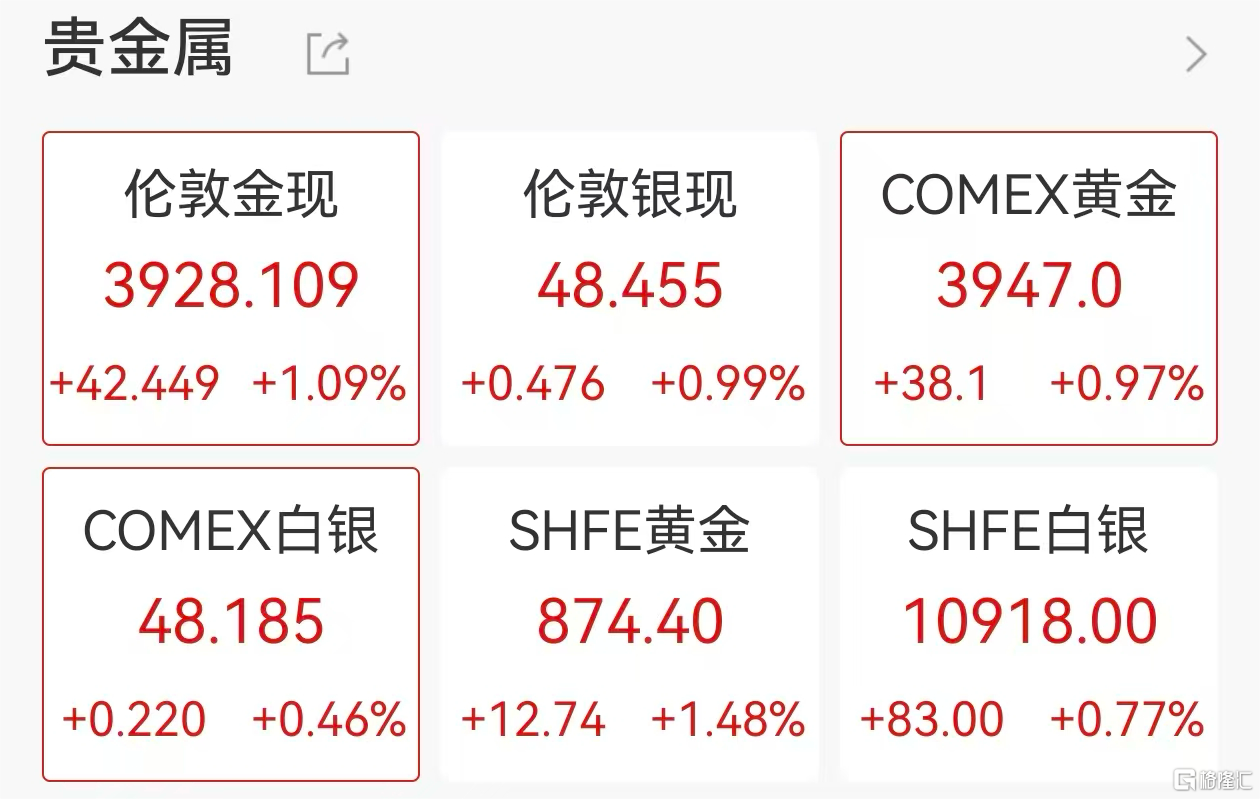
Group 1 - The core viewpoint of the articles highlights the contrasting market reactions to the U.S. government shutdown and employment data delays, with risk assets like U.S. stocks and Bitcoin reaching historical highs, while safe-haven assets like gold also surged, breaking the $3900 per ounce mark [1][3][4] - Gold prices have increased nearly 50% this year, driven by geopolitical risks, anticipated interest rate cuts by the Federal Reserve, a weakening dollar, and ongoing global central bank purchases of gold [3][4] - The U.S. government shutdown has entered its fifth day, delaying the release of significant economic data, including the September non-farm payroll report, which has contributed to market optimism despite the lack of concrete economic indicators [4][5] Group 2 - The Japanese stock market experienced a significant surge, with the Nikkei 225 index rising over 4% in a single day, gaining more than 2000 points and reaching a historical high above 47800 [5][7] - The bond and currency markets in Japan also showed volatility, with the 40-year Japanese government bond yield rising by 14 basis points to 3.52%, and the yen depreciating by 1.7% against the dollar, reaching a critical level of 150 [7][11] - The market's reaction is linked to the election of Sanae Takaichi as the new president of the ruling Liberal Democratic Party, who is expected to become Japan's first female prime minister, with her economic policies seen as a continuation of "Abenomics" but with a focus on fiscal expansion [11][12][13] Group 3 - Takaichi's economic policies include significant tax cuts and subsidies, as well as a shift away from strict fiscal discipline, allowing for increased government borrowing to stimulate the economy [13][14] - Analysts predict that Takaichi's fiscal stance will boost market confidence and positively impact the stock market, although there are concerns about the sustainability of this "Takaichi trade" and the need for clarity on policy specifics [14][15]
8/8财经夜宵:得知基金净值排名及选基策略,赶紧告知大家
Sou Hu Cai Jing· 2025-08-08 15:44
Group 1 - The article provides a ranking of open-end funds based on their net asset value growth as of August 8, 2025, highlighting the top 10 funds with significant increases [2][3] - The top-performing funds include Qianhai United Yonglong Mixed A, Qianhai United Yonglong Mixed C, and E Fund Nikkei Asset Management, with net values of 1.0820, 1.0606, and 1.5734 respectively [2] - The bottom-performing funds include Galaxy and Mei Life Mixed C and A, with net values of 1.3206 and 1.3465, showing declines of 0.09 [4] Group 2 - The Shanghai Composite Index experienced slight fluctuations, closing down, while the ChiNext Index opened low but later rebounded before closing with a small decline, with a total trading volume of 1.73 trillion [6] - The leading sectors included engineering machinery with a rise of over 2%, while software services, semiconductors, and internet sectors faced declines [6] - The fund with the fastest net value growth is Qianhai United Yonglong Mixed A, indicating strong performance in the market [6] Group 3 - The top holdings of Qianhai United Yonglong Mixed A include companies in the renewable energy sector, with a concentration of 60.76% in its top ten holdings [7] - Notable stocks in this fund include Sunshine Power and Hengtong Optic-Electric, which have shown significant price increases [7] - Conversely, the top holdings of Galaxy and Mei Life Mixed C are in the communication sector, with a concentration of 67.18%, and several stocks have experienced notable declines [7]

多只QDII基金恢复申购 助力投资者多元化资产配置
Zheng Quan Ri Bao· 2025-07-07 17:18
Group 1 - Multiple public fund institutions have resumed normal and large-scale subscription for QDII funds since July, indicating a trend of "opening the door" for investors [1][2] - Specific funds such as Huazhong Fund's Huazhong France CAC40 ETF and Huazhong Nikkei 225 ETF have resumed subscriptions after being suspended since March [2] - Some institutions have increased the upper limit for large subscriptions, with Penghua Fund raising the limit for certain fund accounts from 50,000 RMB to 100,000 RMB and from 10,000 USD to 20,000 USD [2] Group 2 - The resumption of QDII funds is driven by two main factors: the approval of an additional 30.8 billion USD in QDII investment quotas and the unique cross-border investment advantages of QDII funds [3] - The number of QDII funds has nearly doubled from 161 to 317 over the past five years, with total assets growing from 115.5 billion RMB to 654.3 billion RMB, representing a 466% increase [4] - QDII funds play a crucial role in asset allocation, providing investors with diverse asset choices and optimizing risk-return characteristics through global market exposure [4] Group 3 - Investors are advised to consider factors such as currency fluctuations and geopolitical risks when investing in QDII funds, and to assess their risk tolerance accordingly [5] - QDII funds focused on the Hong Kong stock market have outperformed their peers this year, with specific funds achieving top net value growth rates [5] - The Hong Kong market is expected to continue expanding with more quality listings, driven by supportive policies [5]
多元配置需求旺盛 部分QDII产品“开门迎客”
Zhong Guo Zheng Quan Bao· 2025-07-06 20:50
Core Viewpoint - Several public fund institutions have resumed normal subscription operations for QDII products and increased the upper limit for large subscriptions, supported by a total investment quota of $30.8 billion issued by the State Administration of Foreign Exchange [1][3]. Group 1: QDII Product Resumption - Multiple QDII products have resumed normal subscription operations, with significant adjustments to large subscription limits. For instance, Hua Bao's Nasdaq Select Stock Fund raised its limit from 5,000 yuan to 20,000 yuan, while other funds also saw similar increases [2]. - Hua An Fund and Huitianfu Fund have also announced the resumption of subscription services for their respective QDII products, indicating a broader trend among public funds to enhance investment accessibility [2]. Group 2: New Investment Quotas - The State Administration of Foreign Exchange has granted a total of $30.8 billion in new investment quotas to several qualified QDII institutions, with notable approvals for Hua An Fund, Southern Fund, and Huaxia Fund among others [3][4]. - As of the end of June, the total approved quota for securities institutions reached $942.90 billion, reflecting an increase of over $20 billion from the end of May [3]. Group 3: Market Implications - The increase in QDII quotas is expected to meet investors' demand for diversified overseas asset allocation, facilitating cross-border investments and enhancing the integration of domestic capital markets with international markets [4]. - The trend of overseas diversification is becoming increasingly popular among investors, especially during periods of domestic market volatility, as it provides alternative sources of returns [5]. Group 4: Investment Opportunities - The chief investment officer of Hua Bao Fund noted that the first half of 2025 experienced a global asset rebalancing, with non-US equity funds seeing net inflows, suggesting a favorable environment for risk assets [6]. - Investment opportunities in the Hong Kong market are highlighted, with expectations of continued attractiveness due to the internationalization of the renminbi and the influx of capital [6].