
全超导托卡马克核聚变实验装置(EAST)

Search documents
“为最终解决能源问题贡献中国智慧”
Ren Min Wang· 2026-01-26 22:38
2025年1月20日,我国有"人造太阳"之称的全超导托卡马克核聚变实验装置(EAST)成功让等离子体在1 亿摄氏度的极高温度下,高质量稳定持续运行了1066秒,创造新的世界纪录。 "这是人类在可控核聚变能研究领域取得的重要突破,为未来开发清洁、高效的核聚变能源奠定了关键 技术基础。"中国科学院合肥物质科学研究院副院长宋云涛说。 亿度千秒量级稳态高约束模的实现充分验证了聚变堆高约束模稳态运行的可行性,是聚变研究从基础科 学研究迈向工程实践的重大拐点,把聚变能源的研发进程往前推进了一大步。 "实验为国际热核聚变实验堆ITER和我国未来聚变堆的建设和运行提供了关键数据,为最终解决能源问 题贡献中国智慧。"宋云涛说。 磁约束聚变研究就像马拉松赛跑一样,不仅要跑得快,还要跑得远。接下来,团队将在等离子体密度、 等离子体温度等各个方面瞄准未来聚变能的商业应用,做进一步攻关研究。 《 人民日报 》( 2026年01月27日 08 版) 近年来,EAST不断创造和刷新世界纪录。此次"亿度千秒"纪录的突破与以往相比,不仅实现了极高温 度与超长时间稳态运行的双重挑战,更在高约束模等离子体控制方面取得重大进展。 高约束运行模式因其 ...
2026核聚变能科技与产业大会开幕 多项重大合作签约
Xin Lang Cai Jing· 2026-01-16 14:58
Core Insights - The 2026 Nuclear Fusion Energy Technology and Industry Conference was held in Hefei, showcasing significant advancements in nuclear fusion technology and industry innovation [1][3] - The conference aimed to promote the integration of innovation chains, industry chains, capital chains, and talent chains to build a collaborative nuclear fusion energy ecosystem [3] Group 1: Conference Highlights - Ten major procurement projects related to nuclear fusion energy and four collaborative experimental laboratory projects were signed on-site [1] - The conference released the "Top Ten Innovation Achievements in Hefei Fusion for 2025" and the conceptual planning for the Fusion Science and Technology Innovation Demonstration Zone [3] Group 2: Institutional Developments - The Hefei University of Technology's School of Fusion Science and Engineering was inaugurated during the conference [3] - A Fusion Finance Institution Alliance was jointly established by 15 financial institutions to support the fusion energy sector [3] Group 3: Industry Outlook - The construction of the Compact Fusion Energy Experimental Device (BEST) is progressing rapidly, indicating a strong commitment to advancing fusion energy technology [3] - Hefei is positioning itself as a global hub for nuclear fusion energy innovation and industry, leveraging its first-mover advantage and high-level team accumulation [3]

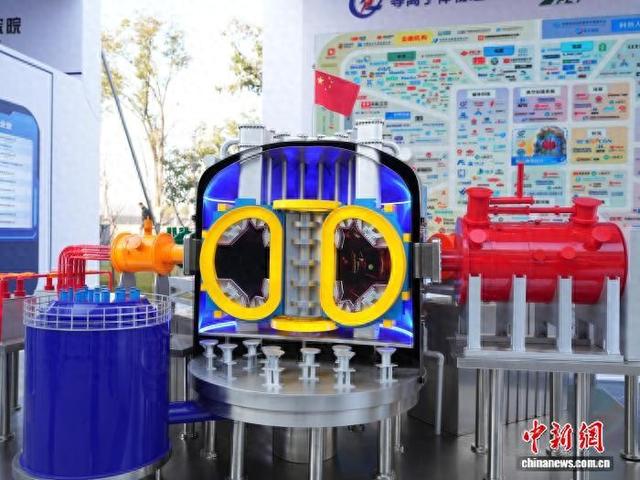
助力“人造太阳”维持上亿摄氏度高温(迈向“十五五”的创新图景)
Ren Min Wang· 2025-12-21 22:41
Core Insights - The article highlights significant advancements in China's nuclear fusion research, particularly through the EAST (Experimental Advanced Superconducting Tokamak) project, which has achieved a world record of 1 billion degrees Celsius for 1066 seconds in steady-state high-confinement plasma operation [3]. Group 1: Technological Achievements - The microwave heating system developed by the team has been crucial in supporting EAST's successful operation of high-confinement plasma for 403 seconds in 2023, with plans to extend this to 1066 seconds by early 2025 [2]. - The team has achieved a 100% localization rate in the development and construction of the ion cyclotron wave system, demonstrating international-level operational stability and engineering reliability after extensive testing [1]. Group 2: Future Prospects - The compact fusion energy experimental device (BEST) is in the assembly phase and is expected to demonstrate fusion energy generation based on the EAST project, with completion anticipated by the end of 2027 and demonstration power generation around 2030 [3]. - The industry anticipates that, following the experimental and demonstration phases, the first commercial fusion power plant could be established around 2050, contingent on overcoming key challenges such as material radiation resistance [3]. Group 3: Collaborative Efforts - The team is actively collaborating with top domestic research institutions and universities to optimize antenna structures and analyze the coupling physics between radio frequency waves and plasma, aiming for breakthroughs in wave coupling efficiency [2].
如何开展“人造太阳”聚变研究辐射安全监管?生态环境部回应
Xin Jing Bao· 2025-04-23 06:46
Core Viewpoint - The Chinese government is actively developing a regulatory framework for radiation safety in nuclear fusion research, ensuring the safe advancement of fusion technology while addressing potential radiation risks associated with various fusion devices [1][2]. Group 1: Regulatory Framework - The Ministry of Ecology and Environment has been closely monitoring the developments in fusion research and has initiated forward-looking studies to implement regulations tailored to the specific characteristics of fusion devices [1][2]. - In April 2023, the Ministry issued a notification updating the regulatory requirements for fusion devices, building on a 2016 document that outlined management requirements for small tokamak devices [2]. Group 2: Safety and Risk Management - The current fusion devices are primarily research-focused, with diverse technical routes and working media, leading to varying radiation safety risks [2]. - The Ministry has issued radiation safety licenses to 11 institutions, including the China National Nuclear Corporation and the Hefei Institute of Physical Science, indicating a structured approach to assessing and managing radiation safety risks [2]. Group 3: Future Directions - The Ministry plans to advance the development of a regulatory standard system for fusion, closely track international developments in fusion, and actively participate in the formulation of international standards [2]. - There is an emphasis on building a professional talent pool, particularly by recruiting individuals with expertise in fusion, to establish a consultation database for fusion experts [2].