六座Model Y L车型

Search documents
比亚迪年度销量首超特斯拉,后者2025年交付量下滑近9%
Xin Lang Ke Ji· 2026-01-05 00:32
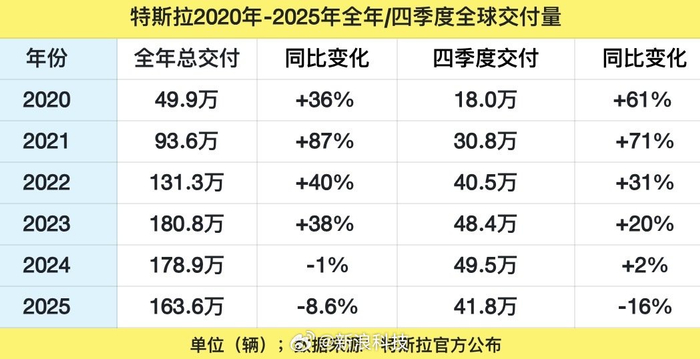
Core Insights - BYD has surpassed Tesla in annual electric vehicle sales for the first time, with BYD selling 2.2567 million units compared to Tesla's 1.636 million units in 2025, marking a significant shift in the global electric vehicle market [1][5] - Tesla's global deliveries in 2025 decreased by 8.6% compared to 2024, with a notable decline in the fourth quarter where deliveries fell by 16% year-over-year [1][5] - The competitive landscape in the Chinese electric vehicle market has intensified, with domestic brands like BYD, Li Auto, and NIO gaining substantial market share, contributing to Tesla's declining sales [3][4] Group 1: Tesla's Sales Performance - In 2025, Tesla's total deliveries were 1.636 million, down from 1.789 million in 2024, indicating a downward trend in growth [1][5] - Tesla's fourth-quarter deliveries in 2025 were 418,227, a decrease of 16% compared to the same period in 2024 [5][6] - The decline in Tesla's sales is attributed to structural changes in the Chinese market and increased competition from local manufacturers [2][3] Group 2: Market Dynamics - The Chinese electric vehicle market saw a record new registration of 11.25 million units in 2024, with a total of 31.4 million electric vehicles by the end of the year, reflecting a 53.8% year-over-year growth [3] - Tesla's wholesale sales in China from January to November 2025 were 754,600 units, down 8.3% year-over-year, while retail sales in the same period were 531,900 units, down 7.4% [3] - Domestic brands are rapidly expanding their market presence, with BYD's registrations in Europe increasing by 240% compared to Tesla's 39% decline [1][3] Group 3: Tesla's Strategic Adjustments - To maintain competitiveness, Tesla has accelerated its product launch pace in various global markets, introducing new models and variants [3][4] - Tesla has implemented multiple promotional policies in China, including zero-interest financing and cash incentives for certain models, to boost sales [4] - Despite declining sales, Tesla's stock price has shown resilience, with a 40% increase in Q3 2025 and reaching a market capitalization of $1.6 trillion, driven by advancements in autonomous driving technologies [4][5]



增收不增利,特斯拉三季度利润下滑近30%,股价一度跌近5%
Mei Ri Jing Ji Xin Wen· 2025-10-23 12:02
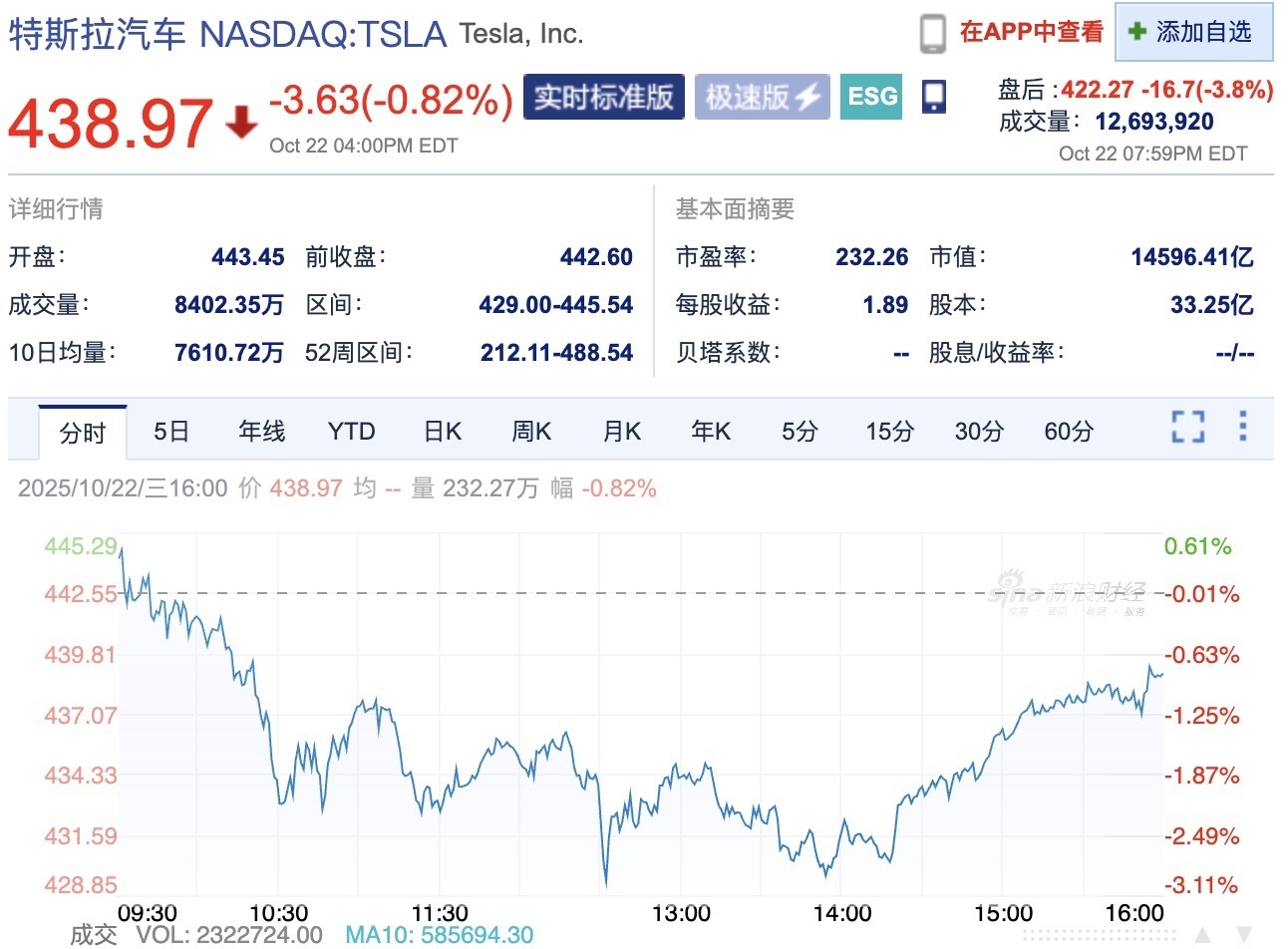
Core Insights - Tesla reported Q3 2025 revenue of $28.1 billion, a 12% year-over-year increase, but net profit fell 29% to $1.77 billion (non-GAAP) [1][4] - Following the earnings release, Tesla's stock price dropped nearly 5%, closing at $438.97 per share, down 0.82% [1] Financial Performance - Q3 2025 revenue breakdown: - Automotive revenue increased 6% to $21.2 billion - Energy generation and storage revenue surged 44% to $3.42 billion - Services and other revenue rose 25% to $3.475 billion [4][5] - Despite revenue growth, net income attributable to common stockholders (non-GAAP) was $1.77 billion, reflecting a significant decline [5] Production and Delivery Metrics - In Q3 2025, Tesla produced 447,400 vehicles, a 4.8% year-over-year decrease, while global deliveries reached 497,000, a 7.4% increase [6][7] - Model 3 and Model Y deliveries totaled 481,100, up 9% year-over-year, while other models saw a 30% decline in deliveries [6] Market Developments - In China, Tesla's sales in Q3 2025 reached 169,200 units, a 31% quarter-over-quarter increase, despite a 5.4% decline in the first half of the year [8] - Tesla has accelerated product launches in various markets, including new versions of Model Y and Model 3, to enhance competitiveness [8][9] Strategic Focus - CEO Elon Musk announced plans to launch the Optimus V3 humanoid robot in Q1 2026 and expand Robotaxi services to 8-10 regions by year-end [3][10] - The company is shifting its focus from automotive to AI and robotics, with Musk indicating that 80% of Tesla's future value may come from robotics [10][14] Regulatory and Technological Advancements - Tesla is working with regulatory bodies in China and Europe to gain approval for its Full-Self Driving (FSD) technology, which is currently operational in several countries [15]