
兴银MSCI中国A50互联互通指数发起

Search documents
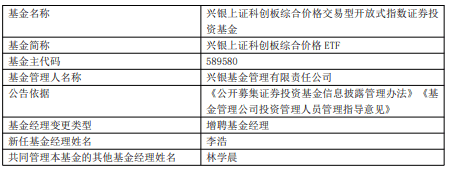
兴银基金旗下5只基金增聘李浩
Zhong Guo Jing Ji Wang· 2026-01-29 10:14
Group 1 - Xinyin Fund announced the appointment of Li Hao as a new fund manager for multiple ETFs, including the Xinyin Shanghai Stock Exchange Science and Technology Innovation Board Comprehensive Price ETF and the Xinyin National Standard New Energy Vehicle Battery ETF [1][3][4] - The Xinyin Shanghai Stock Exchange Science and Technology Innovation Board Comprehensive Price ETF, established on May 27, 2025, has a year-to-date return of 14.52% and a cumulative return of 50.20% since inception, with a net asset value of 1.5020 yuan as of January 28, 2026 [1][2] - The Xinyin National Standard New Energy Vehicle Battery ETF, established on August 6, 2021, has a year-to-date return of 2.06% and a cumulative return of -11.25% since inception, with a net asset value of 0.8875 yuan as of January 28, 2026 [1][2] Group 2 - The Xinyin CSI Science and Technology Innovation Entrepreneur 50 Index A/C, established on July 14, 2021, has year-to-date returns of 4.74% and 4.72%, and cumulative returns of 7.91% and 7.42%, with net asset values of 1.0791 yuan and 1.0742 yuan as of January 28, 2026 [2] - The Xinyin MSCI China A50 Connect Index A/C, established on August 25, 2025, has year-to-date returns of 0.04% and 0.02%, and cumulative returns of 6.26% and 6.14%, with net asset values of 1.0626 yuan and 1.0614 yuan as of January 28, 2026 [2] - The Xinyin CSI All Share Public Utilities Index A/C, established on June 4, 2025, has year-to-date returns of 1.81% and 1.78%, and cumulative returns of 2.84% and 2.67%, with net asset values of 1.0284 yuan and 1.0267 yuan as of January 28, 2026 [2]

刘帆离任兴银基金旗下9只基金
Zhong Guo Jing Ji Wang· 2025-10-14 07:49
Core Insights - Liu Fan has resigned from multiple funds managed by Xingyin Fund Management, including the Xingyin Shanghai Stock Exchange Sci-Tech Innovation Board Comprehensive Price ETF and others [1][4][5][6] - The resignation is part of a broader management change within the firm, with other fund managers continuing to oversee the affected funds [4][5][6] Fund Performance Summary - Xingyin Shanghai Stock Exchange Sci-Tech Innovation Board Comprehensive Price ETF has a cumulative return of 35.74% since its inception on May 27, 2025 [1] - Xingyin Shanghai Stock Exchange Sci-Tech Innovation Board Comprehensive Index Enhanced Fund A/C has returns of 5.89% and 5.77% since its inception on July 11, 2025 [1] - Xingyin CSI Dividend Low Volatility Index Fund A/C has cumulative returns of -3.93% and -3.95% since its inception on July 21, 2025 [1] - Xingyin CSI Sci-Tech Innovation and Entrepreneurship 50 Index A/C has a year-to-date return of 52.01% and a cumulative return of -0.37% since its inception on July 14, 2021 [2] - Xingyin National Standard New Energy Vehicle Battery ETF has a year-to-date return of 63.95% and a cumulative return of -12.60% since its inception on August 6, 2021 [2] - Xingyin MSCI China A50 Connect Index Fund A/C has a cumulative return of 2.98% since its inception on August 25, 2025 [2] - Xingyin CSI Hong Kong Stock Connect Technology ETF has a cumulative return of 16.12% and 15.87% since its inception on March 24, 2025 [2] - Xingyin CSI Hong Kong Stock Connect Technology ETF has a year-to-date return of 50.47% and a cumulative return of 53.12% since its inception on January 31, 2023 [2] - Xingyin CSI All-Index Public Utilities Index Fund A/C has cumulative returns of 4.83% and 4.74% since its inception on June 4, 2025 [3]
兴银基金刘帆:指数化投资迎来“风口”
Shang Hai Zheng Quan Bao· 2025-08-17 13:36
Core Insights - Index investment is experiencing a significant surge, with pure index fund assets surpassing 4 trillion yuan in Q2, reflecting a 7.4% increase from Q1, driven by changes in resident asset allocation and the inherent advantages of index products [1][2]. Group 1: Market Trends - The shift in resident asset allocation is characterized by an increase in risk appetite, a trend referred to as "deposit migration," and a rising demand for quality equity assets [2][4]. - The number of aggressive risk-tolerant individual investors has increased by 1.25 percentage points over the past year, indicating a growing preference for higher risk-return products in a low-interest-rate environment [2]. Group 2: Product Characteristics - Index funds are becoming essential tools for asset allocation, offering benefits such as risk diversification, enhanced returns, increased transparency, and reduced management costs [2][4]. - New product categories like sci-tech bond ETFs and cross-market ETFs are emerging, providing diversified investment options and gaining market recognition [2]. Group 3: Future Growth Potential - The value of equity asset allocation is becoming increasingly evident, with index funds viewed as high-quality tools for entering the equity market [4]. - Three types of capital are expected to inject momentum into the equity market: insurance funds favoring high-dividend large-cap assets, household savings exceeding 120 trillion yuan, and foreign capital seeking stable, liquid blue-chip stocks [4][5]. Group 4: Internationalization and Foreign Investment - The increase in A-share profitability has attracted foreign investors, who prefer fundamentally strong, liquid leading stocks and passive investment strategies, thereby promoting value and index investment concepts [5][6]. - Since A-shares were first included in the MSCI Emerging Markets Index in 2018, the proportion of foreign ownership in total circulating market value has risen from approximately 1.3% in 2012 to 3.7% in 2020, with a notable acceleration post-MSCI inclusion [6][7]. Group 5: Market Evolution - The entry of long-term foreign capital has improved liquidity, pricing efficiency, and corporate governance transparency, aligning the market with international practices [7]. - As Chinese companies gain global influence, the process of foreign capital allocation to A-shares is expected to continue, leading to further innovations in product offerings and trading mechanisms [7].