权益资产配置

Search documents
“固收+”基金规模持续扩张!零售端成申购主力
券商中国· 2026-03-11 23:40
Core Viewpoint - The "fixed income +" funds are becoming increasingly popular among residents for asset allocation amid stock market fluctuations and declining returns on financial products [1] Group 1: Fund Inflows and Growth - Since the beginning of the year, there has been a significant influx of funds into "fixed income +" funds, with ordinary individual investors becoming the main contributors, indicating a clear trend of residents moving their deposits [2][4] - A flagship "fixed income +" fund recently experienced inflows of up to 1 billion yuan in a single day, with weekly inflows reaching around 10 billion yuan [3] - The total issuance scale of newly established "fixed income +" funds has exceeded 30 billion yuan since 2026, with several funds surpassing 2 billion yuan in initial fundraising [4] Group 2: Performance and Returns - Over the past three years, more than 96% of "fixed income +" funds have achieved positive returns, with 59 funds yielding over 30% [6] - Notably, the Huaan Zhilian A fund achieved a remarkable return of 80.02%, despite a maximum drawdown of 17.64% [6] - The performance growth is reflected in the scale of funds, with "track-type fixed income +" funds showing significant growth compared to those with balanced stock allocations [6] Group 3: Market Outlook and Strategy - The fixed income team at CICC suggests that the growth of "fixed income +" funds will be driven by retail investors, as institutional demand may not see significant breakthroughs in 2026 [5] - Fund managers emphasize the importance of equity asset allocation in 2026, with expectations of moderate economic recovery and stable external demand [8] - Investment strategies will focus on structural opportunities in sectors such as AI, military, new energy, and innovative pharmaceuticals, which are expected to be key areas for equity allocation within "fixed income +" strategies [8][9]


1月份私募证券产品备案保持平稳
Xin Lang Cai Jing· 2026-02-05 23:34
Core Insights - The private equity securities product registration market remained stable in January, with a total of 680 products registered, roughly unchanged from the same period last year [1][3]. Group 1: Factors Driving Registration Enthusiasm - Four main factors are driving the continued enthusiasm for private equity registration: 1. Structural opportunities in the A-share market have emerged, enhancing the profitability of equity assets and increasing the willingness of private equity institutions to issue products [1][3]. 2. Long-term funds, represented by insurance capital, are accelerating their inflow into private equity funds, bringing additional capital to the industry [1][3]. 3. The optimization of the private equity fund registration process has improved the efficiency of quality fund managers [1][3]. 4. Collaboration between leading private equity institutions and specialized small and medium-sized institutions is continuously improving the industry's compliance ecosystem [1][3]. Group 2: Product Strategy Distribution - Stock strategy products dominated the registration, with 437 stock strategy private equity securities products registered in January, accounting for 64.26% of the total [4]. - Multi-asset strategies followed with 123 registered products, representing 18.09% of the total [4]. - Futures and derivatives strategy products ranked third with 72 registered products, while bond strategies, combination fund strategies, and other strategies had relatively fewer registrations, totaling 48 products and accounting for about 7% [4]. Group 3: Participation by Fund Manager Size - Both large and small private equity institutions actively participated in the registration process, with particularly notable performance from institutions managing over 10 billion yuan. In January, 66 such institutions registered 168 products, averaging over 2 products per institution, leading in registration efficiency [2][4]. - Institutions managing less than 500 million yuan also had a significant number of registered products due to their large numbers, contributing to a diverse participation landscape in the industry [5].
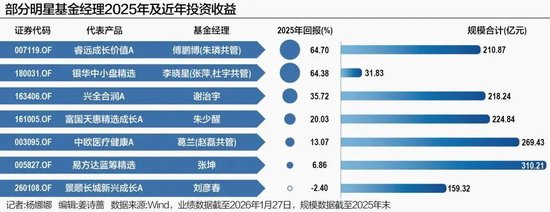
顶流基金经理最新持仓曝光,年回报率最高近65%
Xin Lang Cai Jing· 2026-01-29 06:18
Market Overview - In Q4 2025, market volatility increased, with A-shares and Hong Kong stocks ending the year amidst fluctuations. The Shanghai Composite Index rose by 2.22%, while the CSI 300 Index fell by 0.23%, and the ChiNext Index decreased by 1.08%. The Hang Seng Index dropped by 4.56%, and the Hang Seng China Enterprises Index fell by 6.72% [1][18]. Sector Performance - Despite the overall market performance being lackluster, there was a stark contrast within sectors. The technology growth sectors, represented by AI computing power and semiconductors, performed exceptionally well, while industries such as real estate, pharmaceuticals, and computers faced pressure [1][19]. Fund Manager Strategies - Star fund managers like Fu Pengbo and Li Xiaoxing achieved significant excess returns in Q4 2025, with Fu's Ruiyuan Growth Value Fund and Li's Yinhua Small Cap Select both rising over 60% for the year, driven by heavy investments in AI computing power and semiconductors [2][19]. - Balanced allocation funds, such as Zhu Shaoxing's Fuguo Tianhui Select Growth A, showed stable performance with over 20% annual growth, benefiting from diversified holdings across finance, consumption, and manufacturing sectors [2][19]. Technology Sector Focus - Fu Pengbo's Ruiyuan Growth Value Fund increased its allocation to data center liquid cooling and related companies, with the top ten holdings now concentrated at 70.38%. The fund's top three holdings include Xinyi Solar, Shenghong Technology, and CATL [4][22]. - Li Xiaoxing's Yinhua Small Cap Select emphasized AI hardware innovation and application investment opportunities, with seven of its top ten holdings in the semiconductor industry, reflecting a shift towards advanced process breakthroughs and domestic chip investments [23][24]. Traditional Value Sector - Fund managers like Zhang Kun, Liu Yanhun, and Ge Lan continued to focus on traditional assets such as consumption and pharmaceuticals. Zhang's E-Fund Blue Chip Select maintained a stable stock position, emphasizing confidence in the long-term prospects of the Chinese consumer market [24][25]. - Ge Lan's China Europe Medical Health A faced net value pressure in Q4 2025, with all top ten holdings experiencing negative returns, despite previous positive performance [26][27]. Policy and Market Sentiment - Fund managers noted that "anti-involution" policies are becoming key variables affecting corporate fundamentals, with expectations for improved business environments and competition dynamics [31]. - Despite market rebounds and rising valuations, many managers believe that equity assets still hold significant allocation value, particularly in light of changes in traditional high-yield channels [32]. Importance of Stock Selection - The emphasis on stock selection has intensified, with fund managers highlighting the need for deep research and careful selection of companies with core advantages, especially in a concentrated market environment [33].
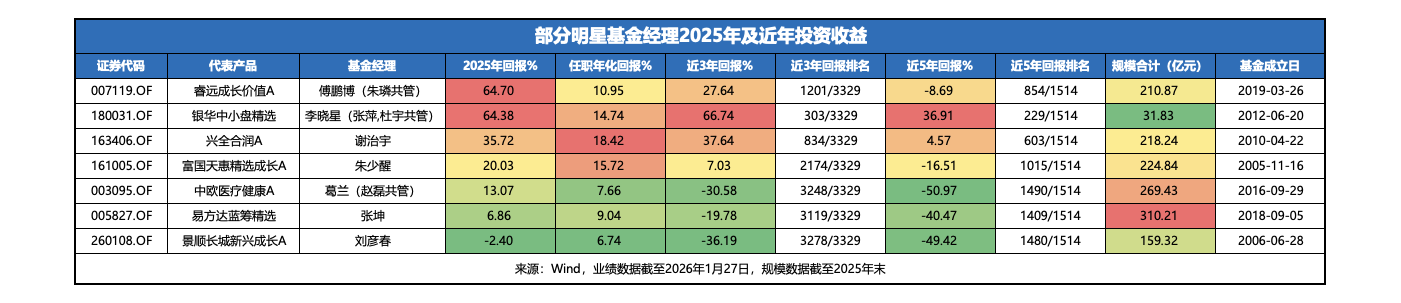
公募顶流四季报揭秘:科技冲锋与价值深蹲下的业绩分野
2 1 Shi Ji Jing Ji Bao Dao· 2026-01-28 12:31
Core Viewpoint - The market experienced increased volatility in Q4 2025, with A-shares and Hong Kong stocks showing mixed performance, while sectors like AI computing and semiconductors thrived, contrasting with weaker performances in real estate and pharmaceuticals [1] Group 1: Market Performance - The Shanghai Composite Index rose by 2.22% in Q4 2025, while the Hang Seng Index fell by 4.56% [1] - The technology growth sector, particularly AI computing and semiconductors, showed significant gains, while industries such as real estate and pharmaceuticals faced challenges [1] Group 2: Fund Manager Performance - Star fund managers like Fu Pengbo and Li Xiaoxing achieved over 60% returns in 2025, focusing on AI computing and semiconductors [2] - Balanced allocation funds, such as Zhu Shaoxing's, demonstrated stability with a 20% annual return, benefiting from diversified investments across various sectors [3][14] Group 3: Investment Strategies - Fu Pengbo's fund increased its allocation to data center cooling and computing-related companies, with a top ten stock concentration of 70.38% [5] - Li Xiaoxing emphasized AI hardware innovation and semiconductor investments, with a focus on domestic advancements in the semiconductor industry [6] Group 4: Traditional Value Investments - Fund managers like Zhang Kun and Liu Yanhun maintained positions in traditional sectors like consumer goods and pharmaceuticals, despite facing net value pressures [8][12] - Liu Yanhun's fund experienced a 5.85% decline in Q4, reflecting the challenges faced by traditional value sectors [12] Group 5: Policy and Market Outlook - Fund managers noted the impact of "anti-involution" policies on corporate fundamentals, suggesting a shift towards supply-side optimization [17] - Despite market rebounds, equity assets are still viewed as attractive, with a focus on high-quality listed companies as scarce income-generating assets [18]





22.15万亿元!私募业管理规模创新高
Shang Hai Zheng Quan Bao· 2026-01-27 18:36
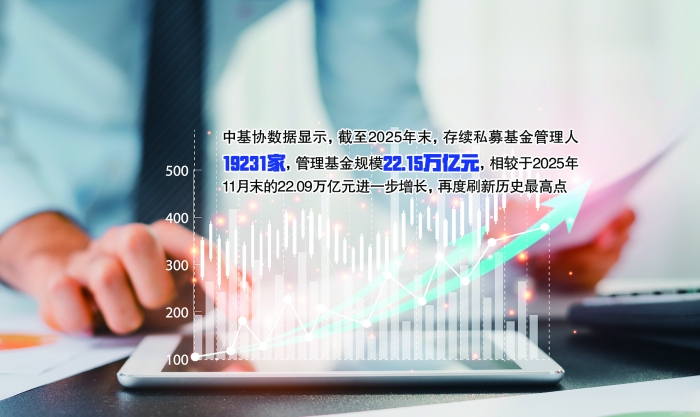
Group 1 - The core viewpoint of the article highlights that the scale of private equity funds in China is expected to reach a record high of 22.15 trillion yuan by the end of 2025, with private securities investment funds becoming the main force in the market [2][3] - As of the end of December 2025, there are 19,231 private fund managers, with the private securities investment fund scale reaching 7.08 trillion yuan and private equity investment fund scale at 11.19 trillion yuan, both showing growth compared to November 2025 [3] - In December 2025, the new registration of private funds amounted to 989 billion yuan, with private securities investment funds accounting for 541.74 billion yuan, indicating a strong performance in the issuance market [3] Group 2 - The number of billion-level private equity firms has increased to 118 as of January 26, 2026, reflecting a net increase of 5 firms since the end of 2025, with 9 new firms entering the billion-level category [4] - The rapid expansion of billion-level private equity firms indicates a recovery in market sentiment and an acceleration of the survival of the fittest within the private equity industry, attracting new capital to equity assets [5] - Long-term capital and global funds are increasingly interested in Chinese equity assets due to a declining risk-free rate, which is driving a shift in asset allocation towards equities [5] Group 3 - The current stock valuations in China are not considered overvalued, and the overall risk is low amid a moderate economic recovery, suggesting a favorable environment for structural market trends in 2026 [6] - Despite high returns in AI-related sectors in 2025, many stock price increases are driven by earnings, with current valuations remaining reasonable, indicating that AI-related fields are still worthy of investment [6] - Investment directions worth attention include technology, advanced manufacturing, consumption, and real estate, as China's innovation capabilities continue to evolve rapidly [6]
富国天成红利灵活配置混合:2025年第四季度利润1569.78万元 净值增长率2.96%
Sou Hu Cai Jing· 2026-01-23 15:26
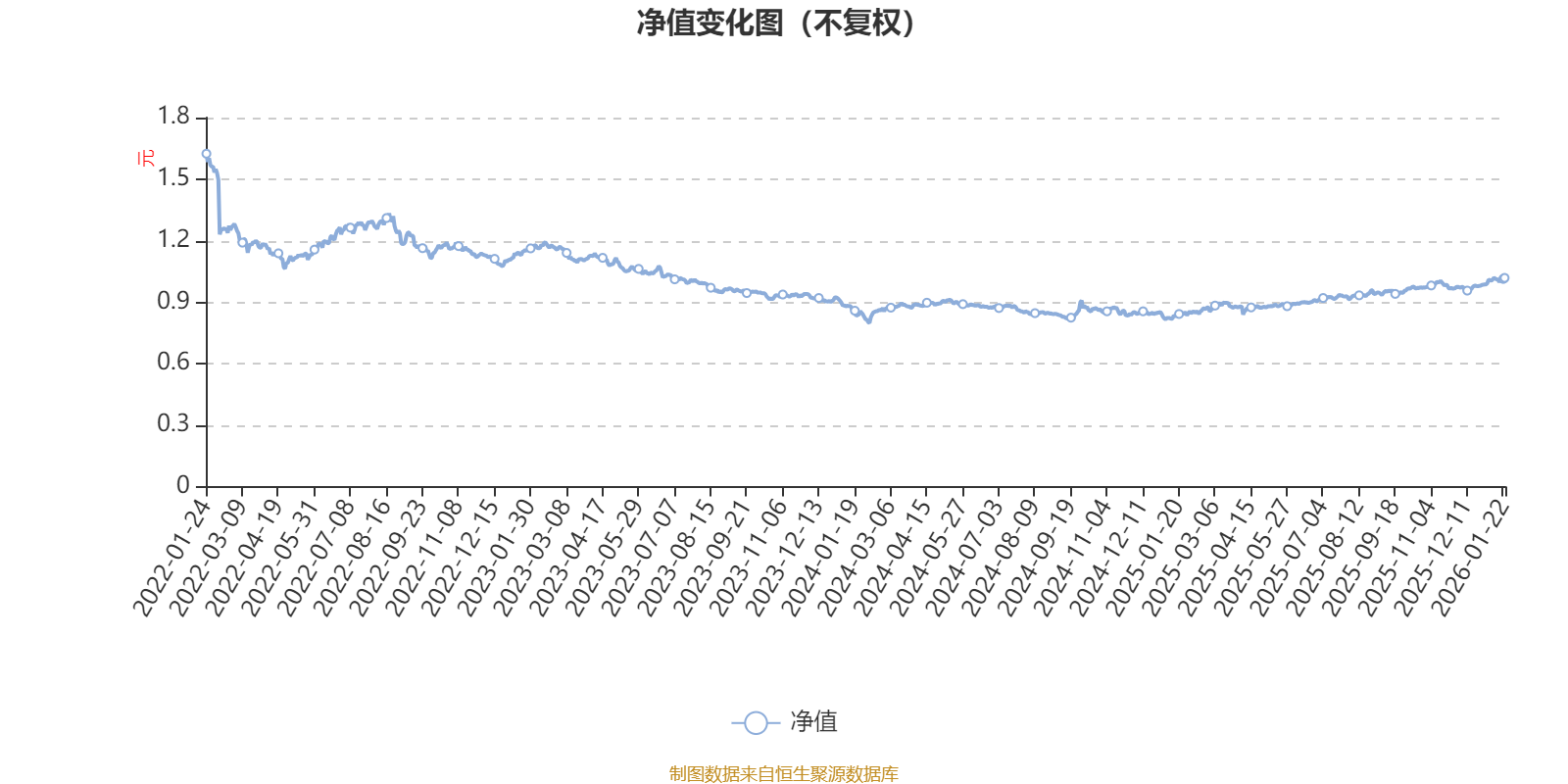
Core Viewpoint - The report highlights the performance and strategy of the FuGuo TianCheng Dividend Flexible Allocation Mixed Fund (100029) for Q4 2025, indicating a profit of 15.6978 million yuan and a net asset value growth rate of 2.96% during the quarter [2]. Fund Performance - As of January 22, the fund's unit net value was 1.018 yuan, with a three-month return of 5.18%, a six-month return of 8.87%, a one-year return of 20.48%, and a three-year return of -9.89% [3]. - The fund's Sharpe ratio over the past three years was -0.0978, ranking 1212 out of 1275 comparable funds [9]. - The maximum drawdown over the past three years was 31.26%, with the largest single-quarter drawdown occurring in Q1 2022 at 21.54% [11]. Fund Strategy and Holdings - The fund manager noted a balanced allocation strategy in Q4 2025, with a focus on stable dividend stocks and gradual increases in low-valued sectors such as travel, chemicals, and consumer goods [2]. - The average stock position over the past three years was 70.1%, compared to the industry average of 72.57% [14]. - As of Q4 2025, the fund's top ten holdings included Ningbo Bank, China Ping An, China Shenhua, China Pacific Insurance, Wens Foodstuff Group, Shaanxi Coal and Chemical Industry, Ping An Bank, Baosteel, China Southern Airlines, and Guokai Tiancheng [18]. Fund Size - The fund's total size as of the end of Q4 2025 was 535 million yuan [15].
险资出手,今年首次举牌
证券时报· 2026-01-15 04:35
Core Viewpoint - The insurance capital is actively participating in the stock market, with significant investments in listed companies, indicating a continued trend of insurance funds entering the market since 2025 [5][9]. Group 1: Recent Investments - On January 9, 2026, Taiping Life Insurance increased its stake in Shanghai Airport by acquiring 72.424 million shares through block trading, raising its total holdings to 124 million shares, which represents approximately 5.00% of the company's A-share capital [1][3]. - Prior to this acquisition, Taiping Life Insurance and its associated party held 51.9917 million shares, accounting for 2.09% of the A-share capital [3]. - The funds for this acquisition were sourced from insurance funds managed by Taiping Asset, including personal dividend product accounts and traditional insurance product accounts [3]. Group 2: Insurance Capital Trends - In December 2025, Ping An Life also made significant investments, acquiring 20% stakes in Agricultural Bank of China and China Merchants Bank, triggering mandatory disclosure [6]. - The total number of insurance capital acquisitions reached 36 in 2025, surpassing the previous high in 2020 and marking the highest since records began in 2015 [6][8]. - The insurance industry has seen a 35.92% year-on-year increase in equity asset allocation, with the total balance reaching 5.59 trillion yuan by the end of Q3 2025 [8]. Group 3: Future Outlook - A survey of insurance investment officers indicates a strong belief that opportunities in the market outweigh risks, with over 70% planning to increase their equity asset allocation in 2026 [9]. - The trend of increasing equity asset allocation is expected to continue, driven by the downward pressure on interest rates and the need for asset-liability matching [9]. - The insurance sector is adapting to a low-interest environment and regulatory changes, which are facilitating a more aggressive approach to equity investments [8][9].

险资出手,今年首次举牌
券商中国· 2026-01-14 23:18
Core Viewpoint - The article highlights the ongoing trend of insurance capital actively increasing their equity investments, with significant recent activities including the acquisition of shares in Shanghai Airport by Taibao Life Insurance, indicating a robust wave of insurance capital entering the market in 2026 [2][3][5]. Group 1: Recent Acquisitions - On January 9, Taibao Life Insurance increased its stake in Shanghai Airport by acquiring 72.424 million shares, raising its total holdings to 124 million shares, which constitutes approximately 5.00% of the company's A-share capital [2][3]. - Prior to this acquisition, Taibao Life Insurance and its asset management subsidiary held 51.9917 million shares, representing a 2.09% stake [3]. - The total value of Taibao Life Insurance's holdings in Shanghai Airport is approximately 4.067 billion yuan, accounting for 0.15% of the company's total assets as of Q3 2025 [3][4]. Group 2: Insurance Capital Trends - In December 2025, Ping An Life Insurance also made significant acquisitions, reaching a 20% stake in Agricultural Bank of China and China Merchants Bank, triggering mandatory disclosure [5]. - The frequency of insurance capital triggering the 5% disclosure threshold has become a notable trend in 2025, with a total of 36 instances recorded, surpassing previous highs [5][6]. Group 3: Equity Asset Allocation - As of Q3 2025, the total equity asset allocation by life and property insurance companies reached 5.59 trillion yuan, marking a 35.92% increase year-on-year [7]. - The equity asset allocation ratio for insurance companies has reached a historical high, with stock allocations accounting for 10% of total assets and combined stock and fund allocations exceeding 15% [7]. - Ping An Life Insurance reported an equity asset balance of 1.5 trillion yuan, which is 27.00% of its total assets, up from 19.81% in the previous year [7]. Group 4: Market Outlook and Investment Sentiment - The article notes that insurance capital is motivated by a low interest rate environment and new accounting standards, leading to a greater need for equity asset allocation [8]. - A survey of insurance investment officers indicates a prevailing sentiment that opportunities in the market outweigh risks, with over 70% planning to continue increasing equity allocations [8][9]. - The trend of reallocating assets in a declining interest rate environment is expected to further drive insurance capital towards equity investments, fostering a positive cycle of market recovery [9].





2026年保险投资官调查:九成投资官认为股市机会大于风险,超半数倾向提高权益配置
证券时报· 2026-01-14 03:29
Core Viewpoint - The insurance investment officers are generally optimistic about the investment outlook for 2026, with over 70% expressing a "optimistic" or "relatively optimistic" sentiment, indicating a significant improvement in investment sentiment compared to early 2025 [3][4][5]. Group 1: Investment Outlook - Over 70% of insurance investment officers believe the investment outlook for 2026 is "optimistic" or "relatively optimistic," with 52.63% indicating "relatively optimistic" and 23.68% "optimistic" [3][4]. - The majority of investment officers expect to increase their allocation to equity assets, with 70% indicating a tendency to "increase" their equity investments [2][16]. - The anticipated return targets for insurance funds over the next 1-3 years are expected to remain stable, with 60% of investment officers favoring a "maintain steady" approach [8]. Group 2: Investment Environment - There is a divergence in views regarding the investment environment for 2026 compared to 2025, with 36.84% believing it will be worse, while 23.68% think it will be better [6][7]. - The primary concerns for investment officers include geopolitical factors, international market conditions, and domestic economic situations, with 41.03% citing geopolitical issues as the biggest uncertainty [9][10]. Group 3: Asset Allocation Preferences - The most favored asset class for increased investment remains "stocks and stock funds," with 29.63% of investment officers indicating this preference, followed by equity investments at 18.52% [15]. - Over 70% of investment officers plan to continue increasing their allocation to equity assets, with 68.42% expecting a "slight increase" [16]. Group 4: Sector Preferences - Investment officers are particularly optimistic about sectors such as technology, cyclical, and consumer, with 26.36% favoring technology, 21.71% cyclical, and 16.28% consumer sectors [17]. - More than half of the insurance investment officers still see significant investment value in dividend assets, driven by low interest rates and the scarcity of income-generating assets [18]. Group 5: Market Sentiment - Despite concerns about stock market volatility, 89.47% of investment officers believe that opportunities in the A-share market outweigh risks [13]. - The sentiment towards Hong Kong stocks has improved, with 63.16% of investment officers viewing them as having significant opportunities, particularly due to favorable valuations compared to A-shares [19].

2026年险资举牌热度能否延续?
Jin Rong Shi Bao· 2026-01-14 02:37
Core Viewpoint - In 2025, insurance capital's shareholding activities reached a record high of 35 times, driven by regulatory encouragement, the pursuit of higher returns in a low-interest environment, and new accounting standards that help smooth profit fluctuations [1][4]. Group 1: Characteristics of Insurance Capital Shareholding - The number of shareholding activities by insurance capital in 2025 significantly exceeded the average level of recent years, marking the most active year since 2015 [2]. - A total of 14 insurance institutions participated in shareholding activities, including major listed insurance companies, bank-affiliated insurers, and Sino-foreign joint ventures, with Ping An Life being the most active, conducting 12 shareholdings [2]. - Approximately 80% of the shareholding activities were executed through the Hong Kong Stock Connect or continuous purchases in the secondary market, with other methods including agreement transfers and passive shareholding due to mergers [2]. Group 2: Strategic Logic Behind Shareholding - Insurance capital's shareholding activities were not random but followed a clear strategic logic, with a preference for the financial sector, which saw 15 shareholdings involving six banks and two insurance institutions [3]. - Other favored sectors included public utilities, transportation, and environmental protection, indicating a focus on stable, cash-generating industries [3]. - The core demand of insurance capital is for long-term, stable returns, leading to an increased allocation to equity assets as traditional fixed-income returns fail to cover liability costs [3]. Group 3: Factors Driving Shareholding Activities - Regulatory policies have encouraged long-term capital to enter the market, with measures such as increasing the investment limit for insurance companies in equity assets to 50% [4]. - Insurance institutions are responding to downward pressure on interest rates by increasing their allocation to equity assets to enhance long-term investment returns [4]. - New accounting standards impose higher requirements for asset-liability matching, allowing insurance companies to reduce the impact of market value fluctuations on current profits through shareholding [5][6]. Group 4: Future Outlook for Insurance Capital Shareholding - There is optimism that insurance capital will continue to increase equity asset allocations in 2026, with expectations of maintaining high shareholding activity levels [8]. - Analysts suggest that insurance capital's shareholding motivations will focus on stable dividend cash flows and high return on equity (ROE) targets, particularly in sectors aligned with national strategic directions such as high-end manufacturing and technological innovation [8].