
养肤粉底

Search documents
2026年,抖音电商的29个品类机会
Sou Hu Cai Jing· 2026-02-24 03:53
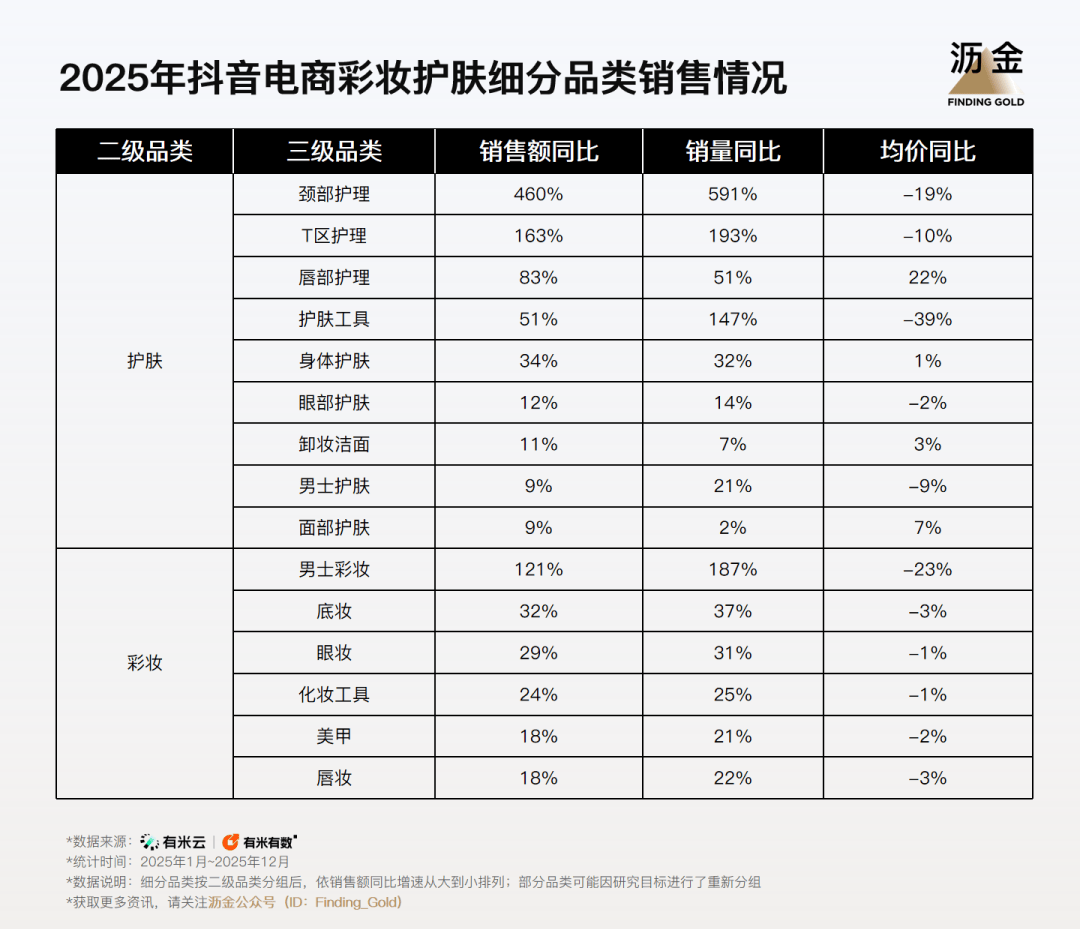
Group 1 - The core issue in Douyin e-commerce is the increasing number of products and the decreasing lifespan of popular items, leading to brands struggling with inventory and price wars [1] - The growth is shifting towards businesses that can accurately address specific life scenarios and provide solutions rather than just creating viral products [3][4] - Successful products are those that meet precise needs, such as targeted skincare solutions, rather than vague demands [4][5] Group 2 - In the skincare segment, products targeting specific issues like T-zone care and lip care are seeing significant growth, with sales increases of 460% and 83% respectively [15] - Men's beauty products are still in the exploratory phase, with low-priced items attracting initial consumers [6][8] - The overall skincare market is performing better than color cosmetics, as consumers view skincare as an investment [12][14] Group 3 - Tea consumption is shifting from gift-giving to personal enjoyment, with green tea and jasmine tea driving growth [16][17] - Coffee consumption is evolving with a focus on premium flavors, impacting traditional instant coffee markets [18][19] - Dairy products are innovating towards snack-like and functional offerings, catering to specific demographics [20][22] Group 4 - Health supplements are thriving when they address specific health issues rather than general wellness [24] - Affordable products are more appealing in the market, as consumers prefer low-cost options for daily use [25] - Beauty-related health products are seeing significant growth, particularly those targeting women's concerns [26] Group 5 - The demand for children's products is increasing, with children's shoes outperforming clothing in sales growth [30][31] - There is a notable gap in the market for products catering to mothers, indicating potential opportunities [30] Group 6 - Household cleaning products are increasingly focused on specific functions rather than multi-use capabilities [34] - The market for paper products is shifting towards quality, with consumers willing to pay more for premium options [36] - Women's hygiene products are experiencing a shift towards higher quality and comfort, with significant sales growth [40] Group 7 - Furniture consumption is polarizing, with demand for either high-quality design or cost-effective options [42][43] - DIY home renovation products are gaining popularity as consumers prefer simple, effective solutions [45] - Home products are increasingly seen as investments for personal enjoyment rather than just functional items [49] Group 8 - Electric vehicles are becoming popular, driven by both commuting needs and customization trends [57] - Outdoor equipment sales are focusing on enhancing user experience rather than extreme sports [58] - There is a strong demand for reliable and multifunctional tools among male consumers [62] Group 9 - Kitchen appliances are easily becoming popular items, especially those with strong visual appeal [65] - The computer market is diversifying, with high-performance devices for gaming and creative work seeing rapid growth [66][67] - There is a surge in demand for photography and videography equipment as content creation becomes more prevalent [68] Group 10 - The focus is shifting towards brands that embed themselves into consumers' daily lives, solving specific problems rather than offering one-size-fits-all solutions [76] - This transformation emphasizes a strategic shift from traditional marketing to demand-driven content creation [76][77]

行业报告显示:中国美妆行业迈向科技创新驱动新周期
Xin Hua Cai Jing· 2025-11-01 07:32
Core Viewpoint - The Chinese beauty industry is transitioning from "manufacturing" to "intelligent manufacturing," driven by innovation and participation in international competition, as highlighted in the recent beauty innovation report by Yatsen Group [1][2][3]. Group 1: Global Research and Development Trends - The global beauty industry is forming a new paradigm of "global co-research and localized results" due to rising consumer demand and the emergence of new market R&D capabilities. China's cosmetics export value reached 23.472 billion yuan in the first 11 months of 2024, covering major markets such as the Americas, Europe, and Southeast Asia. The compound annual growth rate (CAGR) for emerging markets is expected to exceed 10% by the end of 2025 [1]. Group 2: Consumer Demand and Scientific Beauty - Consumer demand is shifting from basic cosmetics to scientifically validated personalized solutions. The technology skincare market is projected to exceed 420 billion yuan by 2025, with a CAGR of 18%. A survey indicates that 72% of consumers prioritize efficacy, while 65% focus on efficacy verification data. Anti-aging, whitening, and repair are the three major skincare hotspots, with color cosmetics trending towards "makeup and skincare integration" [2]. Group 3: Integration of Makeup and Skincare - The concept of "makeup and skincare integration" is rapidly gaining traction globally, leading to a deep fusion of color cosmetics and skincare. A report shows that 91% of consumers are concerned about active ingredients in base makeup, and 76% recognize the skincare benefits of foundation. From 2019 to 2023, sales of tinted moisturizers in the U.S. grew by 59%, with similar demand for functional color cosmetics in Southeast Asia and the Asia-Pacific region [2]. Group 4: AI Technology Reshaping the Beauty Industry - Artificial intelligence is becoming a fundamental driver for systematic upgrades in the beauty industry. A McKinsey report predicts that generative AI could create $90 to $100 billion in value for the global beauty sector by 2025. AI technology accelerates active ingredient screening and new molecular design in R&D, enhances efficiency in manufacturing through flexible production and smart quality inspection, and drives personalized customization and precise delivery for consumers [3].