分账剧

Search documents
分账,能救长剧吗?
3 6 Ke· 2026-02-04 00:56
Core Viewpoint - The long drama market is attempting to revive itself through a new revenue-sharing model, but there are significant questions about its suitability and implementation [3][10]. Group 1: Revenue Sharing Model - The revenue-sharing policies from major platforms like Tencent Video, iQIYI, and Youku have been updated, expanding the scope of eligible content significantly [3][4]. - Tencent Video's new policy aims to support top-tier suppliers, while iQIYI's policy expands the revenue-sharing range, indicating a willingness to invest in quality content [4][5]. - The new policies may lead to a "stronger get stronger" scenario, where top projects receive more support, potentially marginalizing lower-tier projects [7][8]. Group 2: Market Dynamics - The industry is witnessing a polarization, with fewer mid-tier production companies able to sustain profitability, leading to concerns about the long-term viability of these companies [8][14]. - The new revenue-sharing model may accelerate market differentiation, favoring high-quality content while putting pressure on lower-quality projects [7][10]. - There is a concern that the focus on quick returns may stifle innovation and lead to a homogenization of content, as slower-paced, innovative projects may struggle to survive [13][17]. Group 3: Future Outlook - The ideal revenue-sharing framework may involve a hybrid model where platforms provide some guarantees to production companies, allowing for shared risks and rewards [17]. - The industry may benefit from adopting a "production-broadcast separation" model, similar to practices in mature markets, but challenges remain due to the current dynamics in the domestic market [17]. - Overall, while the revenue-sharing model presents new opportunities for long dramas, balancing market-driven approaches with content innovation remains a critical challenge for the industry [14][17].




爱优腾开“卷”分账模式,长视频主动“挤泡沫”?
3 6 Ke· 2026-01-23 12:53
Core Insights - The long video industry is facing intensified challenges in 2025, with a projected 20% decrease in effective views for the top 20 long dramas, dropping from an average of 100 million views per episode to 60 million [1] - Major platforms like iQIYI, Tencent Video, and Youku are reforming their content cooperation models to establish a profit-sharing system, indicating a shift towards a more sustainable content ecosystem [1][2][5] - The rise of profit-sharing content signifies a move away from the era of "traffic inflation," emphasizing a return to quality content as the foundation for attracting viewers [1][6] Group 1: Industry Trends - iQIYI's new profit-sharing regulations cover various content types, including dramas, variety shows, films, and animations, aiming for a unified revenue calculation based on platform income and tiered ratios [2] - Tencent Video has introduced new collaboration policies for horizontal and vertical screen dramas, enhancing incentives for both pure profit-sharing and guaranteed plus profit-sharing projects [4] - The collective shift towards profit-sharing models is a response to external pressures and aims to create a more sustainable and mutually beneficial ecosystem for platforms and content creators [7] Group 2: Content Quality and Market Dynamics - The implementation of the Effective Play Index (EPI) by platforms like Youku is designed to provide a clearer picture of content performance, linking creator income directly to viewer engagement and advertising effectiveness [5][8] - Successful examples of profit-sharing dramas, such as "Old Uncle," demonstrate the potential for high-quality content to thrive under this new model, breaking previous revenue records [10][11] - The transition to a profit-sharing model is expected to lead to a more competitive landscape, where content quality and audience engagement become the primary drivers of success, rather than reliance on star power [12][14]

2025分账剧火了谁?
3 6 Ke· 2025-09-08 01:34
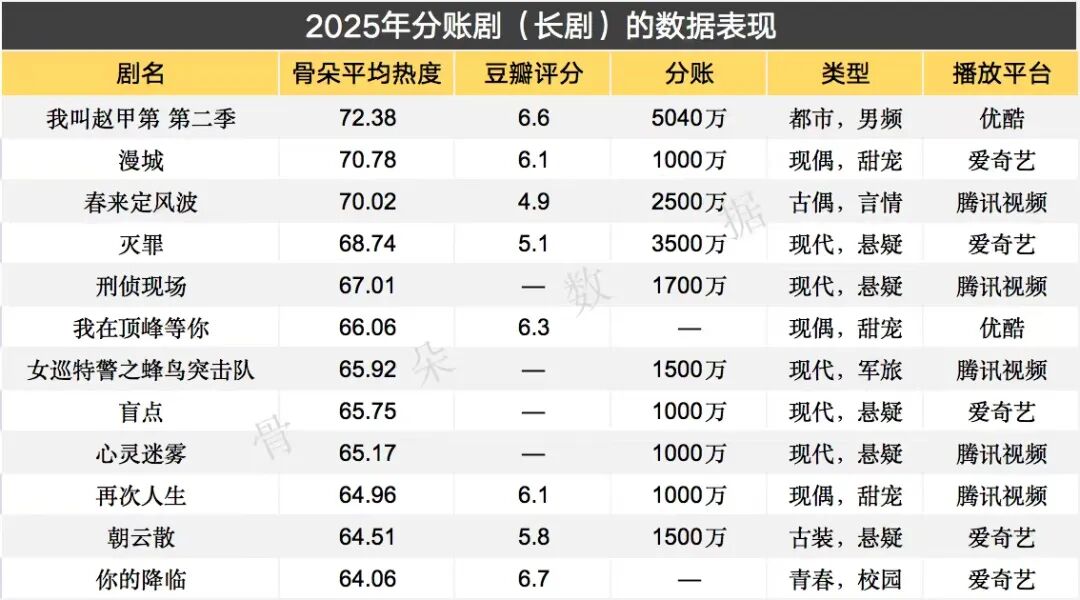
Core Insights - The summer season is concluding with limited hit series, with "Sheng Wan Wu" being a standout, while the split-revenue drama sector has seen several low-cost productions achieving significant returns [1][4] - Key genres driving success in the split-revenue market include male-oriented, suspense, and romance, indicating strong audience demand [1][4][13] Split-Revenue Drama Performance - "I Am Zhao Jia Di Season 2" achieved a split revenue of 50.4 million, leading the long drama category, while other notable performances include "Mian Cheng" at 10 million and "Chun Lai Ding Feng Bo" at 25 million [2] - In the medium and short drama categories, "Zhu Que Tang" stands out with a revenue of 37 million, while "Bi An Deng Ta" and "Xian Xu" also performed well with revenues of 15 million and 16 million respectively [2][11] Genre Trends - Male-oriented dramas are gaining traction, with "I Am Zhao Jia Di Season 2" being the only long drama hit this year, while other successful titles like "Ming Bu Xu Chuan" and "Ni Zai Li Hun Jin Xing Shi" are primarily in medium and short formats [4][6] - Suspense dramas are also thriving, with titles like "Mie Zui" and "Xing Zhen Xian Chang" contributing significantly to the market, showcasing a diverse range of storytelling [8][11] Audience Engagement - The success of male-oriented dramas indicates a growing focus on male audiences, with narratives often centered around themes of empowerment and success [6][14] - Suspense dramas are attracting viewers through engaging plots and character dynamics, with a notable trend towards reducing romantic subplots to enhance narrative focus [16][18] Innovative Storytelling - New narrative frameworks are emerging in both male-oriented and suspense genres, with elements like "rebirth" and "golden finger" becoming prevalent in male-centric stories [14][20] - In romance, innovative settings and unconventional plots are being introduced, such as virtual reality scenarios and dual-time narratives, to captivate audiences [18][20] Conclusion - The split-revenue drama market is evolving, with a mix of traditional and innovative storytelling approaches catering to diverse audience preferences, reflecting a significant shift in viewer engagement and content consumption [20][21]