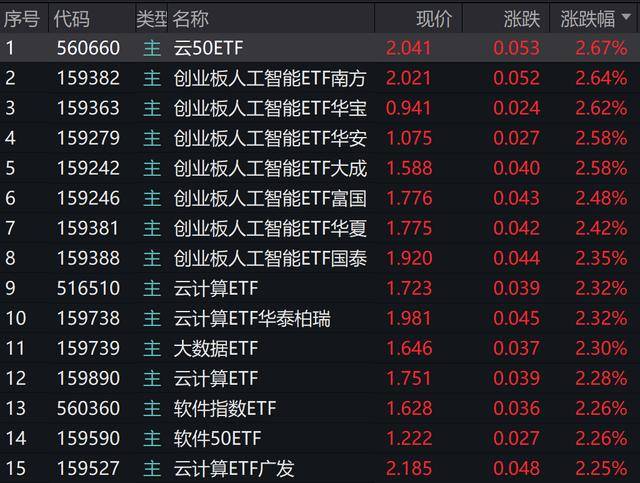
创业板人工智能ETF南方等

Search documents
行业轮动周报:指数回撤下融资资金净流出,ETF资金大幅净流入,GRU调入传媒-20251125
China Post Securities· 2025-11-25 04:54
Quantitative Models and Construction Methods 1. Model Name: Diffusion Index Model - **Model Construction Idea**: The model is based on the principle of price momentum, aiming to capture upward trends in industries and sectors[22][23] - **Model Construction Process**: The diffusion index is calculated for each industry based on its price momentum. The model ranks industries by their diffusion index values and selects the top-performing industries for portfolio allocation. The model has been tracking out-of-sample performance since 2021, with adjustments made monthly or weekly based on updated diffusion index rankings[22][23] - **Model Evaluation**: The model has shown strong performance in capturing industry trends during momentum-driven markets but struggles during market reversals[22][36] 2. Model Name: GRU Factor Model - **Model Construction Idea**: This model leverages minute-level price and volume data processed through a GRU (Gated Recurrent Unit) deep learning network to generate industry factors for rotation strategies[37] - **Model Construction Process**: The GRU model uses historical price and volume data as input to train a deep learning network. The network identifies patterns and generates factors that are used to rank industries. The top-ranked industries are selected for portfolio allocation. The model is updated weekly to reflect changes in the rankings[30][31][37] - **Model Evaluation**: The GRU model performs well in short-term trading environments but has shown limited effectiveness in long-term scenarios. It is also sensitive to extreme market conditions[37] --- Backtesting Results of Models 1. Diffusion Index Model - **Weekly Average Return**: -5.50% - **Excess Return over Equal-Weighted CSI First-Level Industry Index**: -0.42% - **November-to-Date Excess Return**: -1.13% - **Year-to-Date Excess Return**: 1.22%[26][22][23] 2. GRU Factor Model - **Weekly Average Return**: -4.71% - **Excess Return over Equal-Weighted CSI First-Level Industry Index**: 0.35% - **November-to-Date Excess Return**: 2.92% - **Year-to-Date Excess Return**: -2.74%[35][30][31] --- Quantitative Factors and Construction Methods 1. Factor Name: Diffusion Index - **Factor Construction Idea**: The diffusion index measures the momentum of industries by analyzing price trends and ranks industries based on their momentum[22][23] - **Factor Construction Process**: The diffusion index is calculated for each industry using price momentum data. Industries are ranked based on their diffusion index values, and the top-ranked industries are selected for portfolio allocation. The index is updated weekly or monthly to reflect changes in industry momentum[22][23] - **Factor Evaluation**: The factor effectively captures upward trends in industries but may underperform during market reversals[22][36] 2. Factor Name: GRU Industry Factor - **Factor Construction Idea**: The GRU industry factor is derived from minute-level price and volume data processed through a GRU deep learning network to identify patterns and rank industries[37] - **Factor Construction Process**: The GRU model processes historical price and volume data through a deep learning network. The network generates factors that are used to rank industries. The top-ranked industries are selected for portfolio allocation, with updates made weekly[30][31][37] - **Factor Evaluation**: The factor is effective in short-term trading environments but less so in long-term scenarios. It is also sensitive to extreme market conditions[37] --- Backtesting Results of Factors 1. Diffusion Index Factor - **Weekly Average Return**: -5.50% - **Excess Return over Equal-Weighted CSI First-Level Industry Index**: -0.42% - **November-to-Date Excess Return**: -1.13% - **Year-to-Date Excess Return**: 1.22%[26][22][23] 2. GRU Industry Factor - **Weekly Average Return**: -4.71% - **Excess Return over Equal-Weighted CSI First-Level Industry Index**: 0.35% - **November-to-Date Excess Return**: 2.92% - **Year-to-Date Excess Return**: -2.74%[35][30][31]
AI算力股走强,A股冲破4000点!逾20只算力相关ETF涨超2%
Sou Hu Cai Jing· 2025-10-28 06:15
Core Viewpoint - The A-share market has surpassed the 4000-point mark, driven by strong performance in AI-related sectors such as computing hardware and domestic software [1] Group 1: Market Performance - AI and computing hardware concepts have shown significant strength, contributing to the A-share index crossing the 4000-point threshold [1] - Zhongji Xuchuang has reached a new historical high, while Jingwang Electronics has achieved two consecutive trading limits, and Rongji Software has hit a daily limit [1] Group 2: ETF Performance - AI and computing ETFs are leading the market, with the Cloud 50 ETF (560660) showing a 2.67% increase, the highest in the market [2] - Over 20 AI-related ETFs have risen more than 2%, including Southern AI ETF (159382), Huabao AI ETF (159363), and others [2] Group 3: Market Outlook - Huaxi Securities reports that short-term risk appetite is expected to improve, indicating that the "slow bull" market in A-shares will continue [1] - The focus will be on the upcoming earnings reports from A-share companies and US tech giants, with AI capital expenditure guidance becoming a key point of interest [1]