功能性涤纶长丝

Search documents
汇隆新材筹划易主,2月26日开市起停牌
Zhong Guo Ji Jin Bao· 2026-02-25 12:11
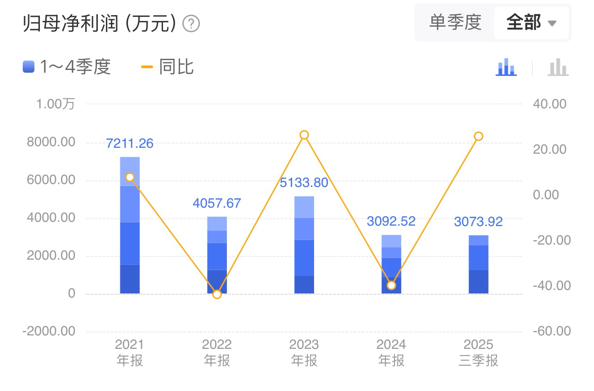
Core Viewpoint - Huilong New Materials is planning a major change in control, leading to a suspension of its stock trading starting February 26, 2026, to ensure fair information disclosure and protect investor interests [2][4]. Group 1: Company Overview - Huilong New Materials is the first publicly listed company in China specializing in colored polyester yarns, offering over 500 types and more than 2000 color variations of differentiated colored polyester filaments, functional polyester filaments, and customized polyester yarns [4]. - The company operates in various sectors, including home textiles, outdoor camping, automotive interiors, and sportswear [4]. Group 2: Financial Performance - For the first three quarters, Huilong New Materials reported a revenue of 674 million yuan, representing a year-on-year increase of 11.26% [4]. - The net profit attributable to shareholders was approximately 30.74 million yuan, reflecting a year-on-year growth of 25.88% [4]. Group 3: Strategic Initiatives - Huilong New Materials is entering the pet industry by investing in a joint venture, Hangzhou Zhalipet Technology Co., Ltd., with a registered capital of 5 million yuan, where Huilong will contribute 3.25 million yuan for a 65% stake [6]. - The pet industry is viewed as having strong growth potential, and the joint venture aims to leverage Huilong's expertise in green functional fiber materials to create a well-known brand of functional fiber materials for pet health products [9]. Group 4: Market Position - As of February 25, 2026, Huilong New Materials' stock closed at 44.91 yuan per share, with a market capitalization of approximately 5.253 billion yuan [10].


停牌!301057,筹划重大事项
Zhong Guo Ji Jin Bao· 2026-02-25 12:06
Core Viewpoint - Huilong New Materials is planning a major event that may lead to a change in company control, resulting in a stock suspension starting February 26, 2026, for up to two trading days [1] Group 1: Company Overview - Huilong New Materials (301057) is the first publicly listed company in China specializing in colored polyester yarns, offering over 500 types and more than 2000 color variations of differentiated colored polyester filament, functional polyester filament, and customized polyester yarns [1] - The company serves various industries including home textiles, outdoor camping, automotive interiors, and sportswear [1] Group 2: Financial Performance - For the first three quarters, Huilong New Materials reported a revenue of 674 million yuan, representing a year-on-year increase of 11.26% [1] - The net profit attributable to shareholders was 30.74 million yuan, showing a year-on-year growth of 25.88% [1] Group 3: Strategic Initiatives - Huilong New Materials is entering the pet industry by planning to establish a joint venture, Hangzhou Zhali Pet Technology Co., Ltd., with a registered capital of 5 million yuan, where Huilong will contribute 3.25 million yuan for a 65% stake [3] - The pet industry is viewed as having strong growth potential, and the joint venture aims to leverage Huilong's expertise in green functional fiber materials to create a well-known brand of functional fiber materials for pet health products [5]
“圣诞老人”催涨海运费,聚酯为何不提“钱”抢出口?
Qi Huo Ri Bao· 2025-12-24 23:47
Core Viewpoint - The shipping market is experiencing a seasonal uptick in freight rates due to the holiday season, but polyester exports are not seeing a corresponding surge in demand, indicating a shift in market dynamics and constraints on export activities [1][2]. Group 1: Shipping Market Dynamics - The Shanghai Containerized Freight Index (SCFI) has seen a rebound, with freight rates on key routes such as Europe and the US West Coast increasing by approximately 9.5% and 20% respectively [1]. - Traditionally, rising shipping costs would lead to a rush in polyester exports, but this year, companies are exhibiting restraint due to multiple factors including changes in demand and profit margins [1][2]. Group 2: Demand and Supply Constraints - Global end-consumer demand is recovering slowly, with inflation pressures in Europe and the US limiting consumer spending power [2]. - Overseas clients have completed their basic inventory stocking and are now favoring small-batch, high-frequency replenishment, which reduces the urgency for large-scale orders [2]. - The increase in shipping costs is not driven by strong demand but rather by seasonal shipping patterns and capacity constraints, leading to a unique situation of price increases during a traditionally slow period [2]. Group 3: Impact of Tariff Policies - The imposition of tariffs under the "Trump 2.0" era has disrupted the usual shipping patterns, resulting in a year-on-year decline of about 5% in shipping volumes from Asia to North America [3]. - The expected increase in tariffs led to a temporary spike in exports last year, but this year has seen an earlier decline in export volumes due to the impact of tariff policies [3]. Group 4: Structural Changes in Orders - The absence of a "rush for orders" reflects a structural adjustment in overseas orders, characterized by a focus on essential needs, increased differentiation, and a more diverse regional distribution [5][6]. - High-end polyester products are primarily exported to Europe and Turkey, while lower-end products face intense competition in Southeast Asia, leading to compressed profit margins [5]. Group 5: Future Outlook - Short-term projections indicate that shipping rates may remain high but lack the demand support for sustained increases, suggesting a stable export environment for polyester [7]. - Long-term trends point towards a restructuring of the polyester export landscape, emphasizing the need for differentiation, market expansion, and improved supply chain efficiency [7][8]. - Companies are optimistic about 2026, anticipating a resilient textile export market supported by stable monetary policies and potential growth in emerging markets [8].