半导体基板

Search documents
芯片关键材料,持续紧缺
半导体芯闻· 2026-03-30 10:36
Core Viewpoint - The supply shortage of T-Glass produced by Nittobo is expected to worsen despite the company's efforts to expand production capacity, driven by strong demand from major tech companies [2][3]. Group 1: Market Dynamics - Prismark predicts that the demand for T-Glass will exceed Nittobo's production capacity starting in the second half of 2024, as major tech companies like Nvidia, Google, and Amazon seek to procure T-Glass for semiconductor substrates [3]. - Nittobo currently has a production capacity of 500,000 square meters (㎡) of T-Glass, which is significantly higher than its competitors, including Taiwan Glass (100,000㎡), Taishan Glass (50,000 to 100,000㎡), Grace Technology (100,000㎡), and Nanya Plastics (50,000㎡) [3]. Group 2: Competitive Landscape - Nittobo plans to invest $530 million in its T-Glass division, aiming to double its production capacity by 2028, which is projected to hold a market share of 55% compared to 45% for all other competitors combined [4]. - The supply shortage of T-Glass is expected to persist this year and next, with predictions indicating that the situation will worsen by 2028 if major tech companies continue to exclusively use Nittobo products [4]. Group 3: Technical Advantages - T-Glass is characterized by a low coefficient of thermal expansion (CTE), which minimizes warping during high-temperature processes, thus meeting the demands for larger substrate sizes and miniaturized circuits [4].

博通预警:芯片产能告急
半导体芯闻· 2026-03-24 10:53
Group 1 - Broadcom's supply chain is facing constraints due to capacity limitations from manufacturing partner TSMC, highlighting the impact of surging AI chip demand on the tech industry [1] - TSMC's capacity is described as having reached its limits, with expectations for capacity increases only by 2027, indicating a bottleneck in the supply chain [1] - The supply constraints extend beyond chips to various technology supply chains, including laser technology and printed circuit boards (PCBs), which are also experiencing unexpected bottlenecks [1] Group 2 - Many customers are signing long-term agreements with suppliers to secure capacity commitments for three to five years, reflecting a desire for long-term supply security [2] - LG Innotek plans to double its semiconductor substrate production capacity due to strong market demand, with decisions on new expansion sites expected in the first half of the year [3] - LG Innotek's existing production lines are operating at full capacity, with server-related semiconductor substrates expected to begin mass production next year [3] Group 3 - LG Innotek's revenue for the previous year was 20.6 trillion KRW, with operating profit at 830 billion KRW, indicating a strong financial position [3] - The company is shifting its focus from camera-centric products to substrates and automotive components, with a significant portion of revenue coming from optical solutions [3] - LG Innotek's automotive parts business is expected to grow at an annual rate of approximately 20%, driven by the production of autonomous driving application processor modules [5] Group 4 - The company is transitioning from simple component supply to software integration, aiming to enhance value through complex module and middleware combinations [5] - LG Innotek is actively expanding into new business areas, including humanoid robot components, with initial mass production expected after 2027 [5] - The company maintains a strong cash flow to support investments and dividends, with plans to increase dividend payout rates over time [6]


基板缺货潮要来了?
半导体行业观察· 2026-03-24 03:20
Core Viewpoint - LG Innotek plans to double its semiconductor substrate production capacity due to strong market demand, with a decision on new expansion sites expected in the first half of this year [2]. Group 1: Production and Capacity Expansion - The current substrate production is operating at full capacity, with expectations for server-related semiconductor substrates to achieve full production by the second half of next year [2]. - Some server substrates are expected to enter mass production next year, while high-value products with advanced internal substrate structures are anticipated to be commercialized by the end of next year or the following year, contributing significantly to revenue by around 2028 [2]. Group 2: Financial Performance - LG Innotek reported revenue of 20.6 trillion KRW and an operating profit of 830 billion KRW last year, with optical solutions contributing over 70% of total revenue [2]. - The company is shifting its business focus from camera-centric structures to substrate and automotive components [2]. Group 3: Business Strategy and New Ventures - The company is transitioning from simple component supply to software integration, aiming to enhance value through complex module and middleware combinations [3]. - LG Innotek is actively expanding into new businesses, with humanoid robot components entering preliminary mass production, and large-scale production expected to start after 2027 [3]. Group 4: Automotive Sector Growth - The automotive business is entering a growth phase, with significant revenue increases expected from the production of autonomous driving application processor modules [4]. - The automotive parts business is projected to grow at an annual rate of approximately 20% [4]. Group 5: Investment Strategy - LG Innotek prioritizes partnerships with companies possessing software capabilities over large-scale acquisitions, with upcoming announcements expected regarding collaborations with autonomous driving companies [4]. - The company aims to maintain shareholder returns while supporting investments, with sufficient cash flow to increase dividend payout rates and total dividends over time [4].

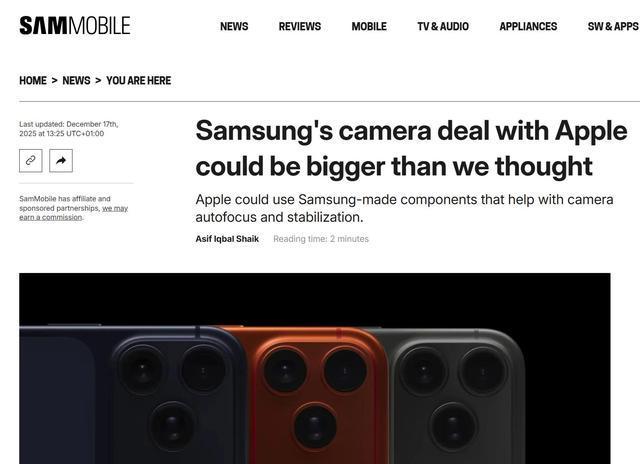
三星电机切入苹果相机供应链,微距线圈或成iPhone 18对焦防抖新核心
Huan Qiu Wang Zi Xun· 2025-12-18 04:54
Group 1 - Samsung Electro-Mechanics is becoming a key supplier for a major global technology company, widely believed to be Apple, particularly in camera technology [1][4] - The collaboration will deepen, focusing on components such as micro-coils for autofocus and stabilization functions [1] - Samsung will expand its supply beyond traditional multi-layer ceramic capacitors (MLCC) and semiconductor substrates to include camera-related components [4] Group 2 - The partnership is driven by the alignment of interests between Samsung and Apple due to changes in the global smartphone market [4] - Components expected to be involved in the collaboration include actuators, camera modules, and lenses, with a notable mention of a wide-angle camera using global shutter technology [4] - Discussions on specific terms such as pricing and supply quantities are progressing well, indicating a strong mutual interest in finalizing the agreement [4]