华为AI眼镜

Search documents
华为、字节、Meta同台竞技,AI眼镜势必记住2026这一年
3 6 Ke· 2026-02-26 11:06
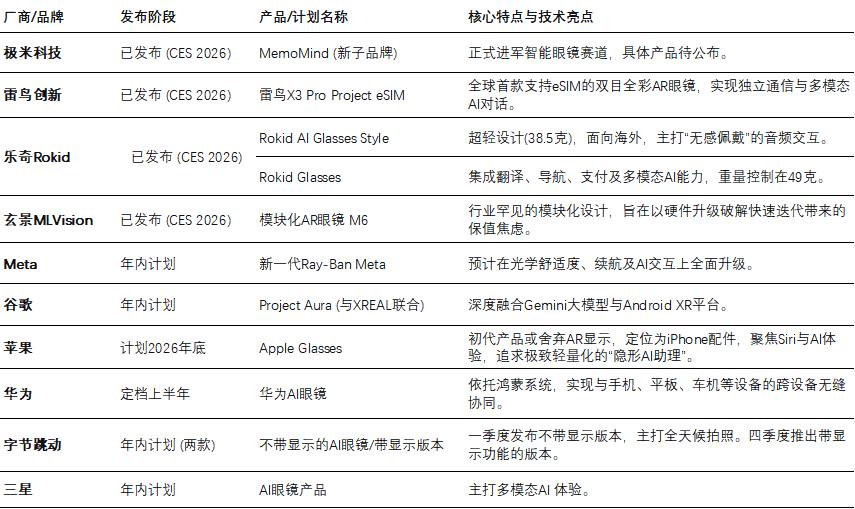
Core Insights - The AI glasses market in 2026 is characterized by intense competition, with numerous companies, including major tech giants and startups, launching new products and strategies, marking a shift from niche gadgets to essential tools for various applications [1][2][4] Group 1: Market Dynamics - The AI glasses market is witnessing a "full-scale war" with major players like Meta, Google, Apple, and domestic companies like Huawei and ByteDance all actively participating [1][2] - The CES 2026 event served as a platform for companies to showcase their innovations, with significant product announcements from various manufacturers [2][4] - The trend of "lightweight" and "independence" is evident, as companies prioritize user comfort and reduce reliance on smartphones through features like eSIM and independent processing capabilities [9][10] Group 2: Product Launches and Innovations - Key product launches include: - XGIMI's MemoMind brand entering the smart glasses market [8] - Thunderbird's X3 Pro Project eSIM, the first dual-lens AR glasses with independent connectivity [8] - Rokid's ultra-light AI glasses weighing only 38.5 grams, emphasizing comfort and audio interaction [8] - Modular AR glasses M6 from Xuanjing, designed for hardware upgrades [3][8] - Meta plans to enhance its Ray-Ban Meta glasses, aiming for improved optical comfort and AI interaction [4][8] - Google's three-step strategy includes launching audio smart glasses and collaborating on Project Aura with XREAL [4][8] - Apple is expected to release Apple Glasses by the end of 2026, focusing on a lightweight design and AI integration [4][8] Group 3: Industry Trends and Drivers - The industry is driven by three main factors: cost reduction in the supply chain, advancements in AI interaction, and growing market demand [10][11] - The rapid decrease in component costs, particularly in chips and optical displays, has made AI glasses more affordable for consumers, with prices now in the 2000-3000 yuan range [11] - The introduction of national subsidies for smart glasses is expected to boost market penetration and consumer adoption [14][15] Group 4: Future Competition Landscape - The competition is shifting from hardware specifications to user experience, ecosystem integration, and technological innovation [16][17] - Companies are focusing on creating compelling reasons for daily use, with examples like Rokid's integration of AI glasses into automotive systems and educational tools [17][18] - The future of the industry will depend on ecosystem development, with companies like Google and Huawei aiming to create comprehensive platforms that integrate AI capabilities and user data [20][21]





华为AI眼镜被曝上半年发布
Guan Cha Zhe Wang· 2026-01-22 02:51
Core Viewpoint - Huawei is set to release its AI glasses in the first half of this year, featuring various functionalities and a lightweight design, supported by the HarmonyOS for seamless cross-device collaboration [1][3]. Group 1: Product Features and Market Trends - The upcoming Huawei AI glasses will come in three colors and support functions such as photo and video capture, audio playback, and real-time translation [1]. - The global smart eyewear market is projected to see significant growth, with an expected shipment of 4.296 million units by Q3 2025, marking a year-on-year increase of 74.1% [3]. - The Chinese market is also expected to grow, with a forecasted shipment of 4.508 million units by 2026, reflecting a year-on-year growth of 77.7% [3]. Group 2: Industry Competition and Consumer Sentiment - Major tech companies, including Meta, Google, Xiaomi, Alibaba, and Baidu, are entering the AI glasses market, indicating a shift from niche products to a growing demand for smart eyewear [3]. - Despite the high interest in smart glasses, consumer feedback highlights concerns over the redundancy of features compared to smartphones, comfort issues due to weight, and battery life limitations [4]. - The market is transitioning from viewing smart glasses as smartphone accessories to recognizing them as independent smart devices, with AI integration becoming more prevalent [4]. Group 3: Policy Support and Market Dynamics - The introduction of government subsidies for smart glasses priced under 6000 yuan, offering a 15% discount up to 500 yuan, is expected to encourage consumer adoption [4]. - The competition in the smart eyewear market is shifting towards user experience, with comfort, practical AI functionalities, and ecosystem completeness becoming critical factors [5]. - Leading manufacturers are focusing on ecosystem collaboration and innovative scenarios to transform smart glasses from novelty items to everyday smart assistants [5].

曝华为 AI 眼镜暂定上半年登场:支持拍照和音频,鸿蒙系统 + 跨端无缝协同
Xin Lang Cai Jing· 2026-01-20 13:45
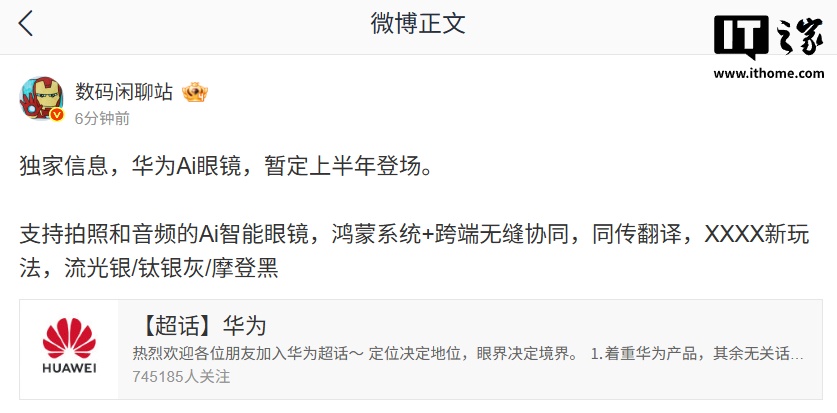
IT之家 1 月 20 日消息,据博主 @数码闲聊站 今日(1 月 20 日)爆料,华为 AI 眼镜暂定上半年登场,支持拍照和音频,鸿蒙系统 + 跨端无缝协同,同传翻 译,XXXX 新玩法,流光银 / 钛银灰 / 摩登黑。 博主还称,这款眼镜内置了 3 块锂电池,设计看起来也是属于轻量化的 AI 眼镜。 11:00 y 居 颜值出色 时尚百搭设计 高效防晒 实力遮阳 UV400 防护镜片 | 100% 隔绝紫外线1 11层镜片镀膜 无惧反光 IT之家查询发现,华为曾推出带有音频功能的智能眼镜,主打听音乐、打电话、健康播报等。如今随着 AI 的兴起,智能眼镜行业也纷纷上马 AI,以及自带 摄像头、显示屏的 AI 眼镜也不断推新。 镜片随心换 夏日更出彩 据 IDC 预测,智能眼镜产品成为 2025 年消费电子赛道的"黑马",相应产品在中国市场出货量预计达到 290.7 万台,同比增长 121.1%。业内人士普遍认为,这缘于技术突破、市场需求释放以及产业链成熟等多重因素。 汇丰控股认为,智能眼镜市场仍处于加速扩张阶段。分析师预计,智能眼镜的用户规模将在未来十多年内迎 来爆发式增长,到 2030 年代末将达到 2. ...