华夏野村日经225ETF(QDII)

Search documents
QDII基金交易火热 部分产品限购
Bei Jing Shang Bao· 2025-11-25 16:40
Core Viewpoint - Multiple fund managers have issued warnings regarding the premium risk of QDII funds, indicating that over 20 funds may be trading at a premium in the secondary market, despite strong performance in the year, with over 90% of these funds achieving positive returns [1][2]. Group 1: Premium Risk Warnings - On November 25, several fund management companies, including Huaxia, GF, and others, released announcements about the potential premium risk associated with their QDII funds, affecting more than 20 products [2]. - The premium risk is attributed to factors such as supply-demand imbalance, failure of arbitrage mechanisms, and short-term speculation driven by the "T+0" trading system [3]. Group 2: Performance of QDII Funds - As of November 21, 92.16% of the 689 QDII funds recorded positive returns for the year, with the highest performing fund, Huaxia Hong Kong Advantage Selected Mixed QDII, achieving a return of 122.7% [4]. - A total of 52 QDII funds have reported returns exceeding 50% for the year, indicating strong overall performance in the sector [4]. Group 3: Fund Subscription Restrictions - As of November 25, 165 QDII funds have suspended subscriptions or limited large subscriptions to protect the interests of existing fund holders, with some funds imposing strict limits on subscription amounts [5][6]. - The tightening of QDII quotas has contributed to these restrictions, with only one increase in quotas occurring in June, resulting in a total QDII investment quota of $1708.69 billion as of the end of October [6].
资管一线 | 规模超9000亿元,跨境ETF缘何成资产配置“新宠”?
Xin Hua Cai Jing· 2025-11-14 14:47
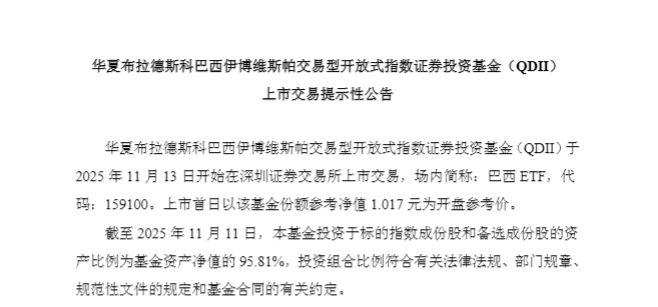
Core Insights - The popularity of cross-border ETFs has surged in 2023, with the number of domestic cross-border ETFs increasing from 139 to 191 and total assets growing from 428.48 billion to 928.62 billion yuan, indicating a doubling in size within ten months [2][5] - The investment landscape for cross-border ETFs is expanding, now including emerging markets in Latin America, as evidenced by the recent listing of two Brazilian ETFs on domestic exchanges [2][5] - Despite the growth, high premium risks are emerging as a significant concern for investors, with instances of ETFs trading at prices significantly above their net asset values [7][9] Investment Trends - Cross-border ETFs are defined as those tracking indices outside of A-shares and listed on domestic exchanges, becoming increasingly attractive to investors seeking global asset allocation [2][5] - The core markets for these ETFs remain Hong Kong and the US, with Hong Kong-related products accounting for 74.69% of the total market size, while US-related products make up 17.72% [5][6] - The top 22 cross-border ETFs have assets exceeding 10 billion yuan, with several surpassing 40 billion yuan, highlighting a pronounced head effect in the market [5][6] Risks and Concerns - High premium rates pose a risk, as seen with the Huaxia Nomura Nikkei 225 ETF, which maintained a premium rate above 5% since November 5, prompting warnings from the fund manager [7][9] - Historical instances of extreme price movements and high turnover rates have raised alarms, with the Jiashi Germany DAX ETF experiencing a 61.27% price increase over 13 trading days earlier this year [8][9] - The underlying causes of high premiums include market sentiment and the inefficacy of arbitrage mechanisms during extreme market conditions, leading to sustained premium situations [9][10] Future Outlook - Experts believe that the cross-border ETF market has significant growth potential, driven by increasing global asset allocation needs among domestic investors [6][10] - The ongoing opening of China's financial markets and the growing wealth of residents are expected to further enhance the demand for cross-border ETFs [10]