
华泰保兴健康消费A

Search documents
刚刚过去的蛇年,你的基金赚钱了吗?
Sou Hu Cai Jing· 2026-02-25 09:15
Core Insights - The A-share market experienced a significant structural bull market during the Snake Year (January 29, 2025 - February 16, 2026), with the Shanghai Composite Index returning to 4000 points after ten years, while global capital markets showed a trend of strong stocks and stable bonds, alongside a historic surge in precious metals [2][3]. Market Performance - The A-share market saw substantial gains, with the Shanghai Composite Index rising by 25.58%, the Shenzhen Component Index by 38.84%, and the ChiNext Index by 58.73%. The Hong Kong market also performed well, with the Hang Seng Index increasing by 32.04%. Precious metals saw remarkable increases, with the Wande Silver Industry Index and Wande Gold Industry Index rising by 295.37% and 127.66%, respectively [3][4]. Fund Performance - The Snake Year was a "harvest year" for the public fund industry, with an average return of 24.13% across 12,027 funds, where 97.41% of funds achieved positive returns. Commodity funds led with an average return of 60.78%, while active equity funds averaged 39.82% with nearly 99% achieving positive returns. Index funds also performed well with an average return of 37.97%, and bond funds provided stable returns averaging 3.85% [4][5]. Top Performing Funds - A total of 170 funds achieved returns exceeding 100%, with six funds surpassing 150%. The top three funds were all focused on technology themes, with returns of 221.41% for Yongying Technology Select A, 171.25% for Huashang Balanced Growth A, and 163.23% for AVIC Opportunity Navigator A. Additionally, several funds related to non-ferrous metals also performed strongly, with returns exceeding 120% [5][6]. Underperforming Funds - Despite the overall strong market performance, 311 funds recorded negative returns, with 15 funds experiencing declines of over 10%. The worst performer was Tongtai Huize A, with a return of -21.17%, attributed to a change in fund management and a shift in investment focus [7][9].


2025年华泰保兴健康消费下跌15% 牛市现两位数跌幅
Zhong Guo Jing Ji Wang· 2026-01-14 07:57
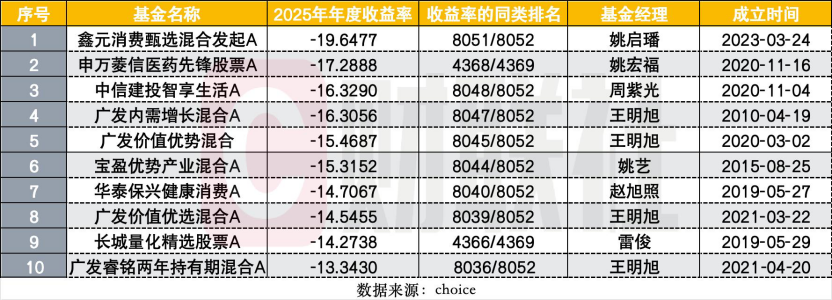
Group 1 - The core viewpoint of the article highlights the performance of Huatai Baoxing Health Consumption C and A funds, which experienced declines of 15.23% and 14.71% respectively in 2025 [1][2] - The top ten holdings of the funds are heavily concentrated in the biomedical sector, including companies such as Yuyue Medical, Mindray Medical, United Imaging, Aohua Endoscopy, Nanwei Medical, Anjiesi, Kaili Medical, Huitai Medical, Aibo Medical, and New Industry [1] - The fund manager, Zhao Xuzhao, has a background as a researcher at Guotai Junan Securities and has been with Huatai Baoxing Fund Management since December 2016, managing public funds for over seven years [1] Group 2 - The cumulative unit scale of Huatai Baoxing Health Consumption C is 0.04 billion, and for A it is 0.01 billion, both established on May 27, 2019 [2] - The net value growth rates for Huatai Baoxing Health Consumption C and A are -15.23% and -14.71% respectively, with their net values recorded at 0.9016 and 0.9441 [2]

2025年谁流落亏损榜?“亏损王”爱调仓折腾,多位知名老将在列
Feng Huang Wang· 2026-01-03 23:21
Core Viewpoint - The A-share market in 2025 exhibited a clear structural bull market, with significant performance disparities among active equity funds, highlighted by the top-performing fund achieving a record annual return of 233.29% while others faced substantial losses, including the worst performer with a -19.65% return [1][4]. Group 1: Market Performance - The Shanghai Composite Index, Shenzhen Component Index, ChiNext Index, and Sci-Tech Innovation 50 Index rose by 18.41%, 29.87%, 49.57%, and 35.92% respectively in 2025 [1]. - A total of 4888 active equity products from 160 public fund institutions reported positive returns, while 144 products from 68 institutions experienced losses [1][9]. Group 2: Fund Performance Disparities - The top-performing fund, Yongying Technology Smart Selection, achieved a record annual return of 233.29%, surpassing the previous record set by Wang Yawei in 2007 [1]. - The worst-performing fund, Xinyuan Consumption Selection, recorded a -19.65% return, marking a significant gap of 252.94% from the top performer [2][4]. Group 3: Xinyuan Consumption Selection Analysis - Xinyuan Consumption Selection's poor performance is attributed to aggressive trading strategies, frequent personnel changes, and scale challenges, leading to a lack of coherent investment logic [3][5]. - The fund's industry allocation showed erratic shifts, moving from heavy investments in pharmaceuticals to technology and later to media, missing key market trends [5][6]. Group 4: Fund Manager Insights - Notable fund managers, including Wang Mingxu and Han Weijun, saw their products listed among the worst performers, with their total managed assets shrinking by over 70% compared to previous peaks [3][9][12]. - Xinyuan Consumption Selection faced a critical challenge to meet its scale assessment, needing to grow from 0.29 billion to 2 billion within three months [7][8]. Group 5: Institutional Investment Trends - Institutional ownership in Xinyuan Consumption Selection dropped from over 95% to 42.94% by mid-2025, indicating a significant withdrawal of institutional funds [7]. - The trend of multiple products from the same fund manager appearing on the loss list highlights a broader issue within the industry, affecting even previously successful managers [9][10].
依赖固收业务 权益业务薄弱 华泰保兴基金“偏科”陷困局
Shen Zhen Shang Bao· 2025-10-11 05:41
Core Viewpoint - Huatai Baoxing Fund Company exhibits a common issue among insurance-related public funds, being more proficient in fixed income business while relying heavily on it, resulting in weaker equity business and difficulties in expansion [1][2] Group 1: Company Overview - Huatai Baoxing Fund was established on July 26, 2016, initiated and controlled by Huatai Insurance Group, with its registered location in Shanghai [3] - As of October 25 last year, the China Securities Regulatory Commission approved Ande Co., Ltd. as the actual controller of Huatai Baoxing Fund, marking its transition to a foreign-funded public fund company [3] Group 2: Fund Performance and Structure - As of the end of Q3 this year, Huatai Baoxing Fund managed a total of 34 products with a combined management scale of 67.707 billion yuan, ranking 76th among peers [1] - The company’s management scale remained below 40 billion yuan until mid-2024, but reached 46.7 billion yuan by the end of Q3 2024, and surpassed 50 billion yuan by the end of 2024, reaching 51.9 billion yuan [1] - Fixed income products dominate the product structure, significantly contributing to the company's recent scale growth, with bond fund sizes increasing from below 30 billion yuan until mid-2024 to 57.446 billion yuan by mid-2024 [1] Group 3: Equity Business Challenges - The equity business of Huatai Baoxing Fund has been weak, with the number of stock funds remaining at one until 2025, and its scale shrinking from 475 million yuan at the end of 2021 to 91 million yuan [2] - The recent establishment of two new equity funds in May 2024 has led to a significant increase in stock fund scale, approaching 400 million yuan [2] - The performance of equity funds has been poor, with the Huatai Baoxing Health Consumption A fund showing negative returns over various time frames, underperforming its benchmark by at least 25 percentage points since its inception [2]