
单晶硅光伏板

Search documents
螃蟹+光伏,唱响科技养殖“渔光曲”
Xin Hua Ri Bao· 2025-12-25 21:32
Core Viewpoint - The integration of photovoltaic power generation and modern ecological aquaculture in Zhenglu Town has transformed the local crab farming industry, improving both economic returns for farmers and ecological conditions in the area [1][2][3]. Group 1: Project Overview - The "fishing and solar integration" model combines solar power generation with crab farming, addressing previous issues of scattered small crab ponds and poor water quality [2][3]. - The project covers over 2,800 acres, allowing at least 50% of the pond area to receive sunlight, which benefits both crab growth and solar power efficiency [2]. Group 2: Environmental and Economic Impact - The "Three Pools and Two Dams" renovation has improved water quality and temperature regulation, resulting in minimal impact on crab production during extreme heat [3]. - The project is expected to increase annual income for local farmers by 6 to 8 million yuan, while also producing high-end aquatic products [3][4]. - The photovoltaic system is projected to generate over 160 million kilowatt-hours of electricity annually, reducing carbon emissions by approximately 135,000 tons [3]. Group 3: Benefits to Farmers - Farmers receive a base rent of 1,500 yuan per acre annually, with potential increases based on farming efficiency, leading to total annual earnings exceeding 2,000 yuan per acre [4]. - The model provides job opportunities for younger farmers while ensuring financial security for older farmers through guaranteed rental income [4].
在一座绿色建筑里上班,是什么体验(美丽中国·身边的绿色故事)
Ren Min Ri Bao· 2025-12-23 22:31
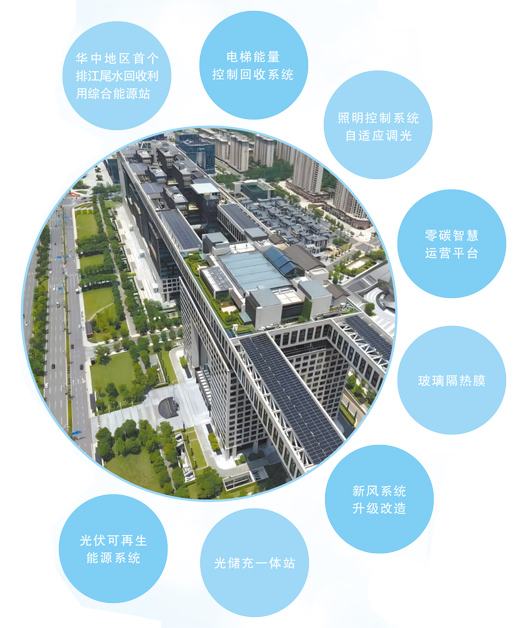
Core Viewpoint - The article highlights the advancements in green building technologies implemented by China State Construction Engineering Corporation (CSCEC), showcasing their efforts in energy efficiency and carbon reduction through innovative solutions in their headquarters and the surrounding industrial park [2][4]. Group 1: Building Innovations - The headquarters building in Wuhan features 14,000 square meters of monocrystalline silicon photovoltaic panels, contributing to energy generation [2]. - The installation of energy recovery devices in elevators has improved operational smoothness and allowed for energy regeneration, enhancing overall energy efficiency [2]. - The building's glass curtain wall has been treated with a special heat-insulating film, achieving a heat insulation rate of 72%, which results in an annual energy saving of 252,000 kWh and a reduction of approximately 126 tons of CO2 emissions [2]. Group 2: Smart Operations - The development of a "zero-carbon smart operation platform" integrates over 3,000 device parameters, utilizing IoT and AI technologies to optimize indoor air quality and energy use, leading to an annual carbon reduction of about 87.6 tons [3]. - The building's comfort has been enhanced through modifications such as the installation of air curtains and adjustments to heating systems, resulting in a temperature increase of approximately 9 degrees Celsius in the lobby during winter while minimizing energy loss [3]. Group 3: Energy Management - A newly constructed underground comprehensive energy station utilizes wastewater heat pump technology, converting effluent from a nearby treatment plant into a secondary energy source, which is expected to reduce carbon emissions by 2,300 tons annually [4]. - The industrial park features a photovoltaic system with a capacity of 2.1 MW, generating 2,156,000 kWh of electricity per year, equivalent to a reduction of 1,078.2 tons of CO2 emissions [4]. - The lighting system operates on a demand basis, contributing to an annual carbon reduction of 67.5 tons, while a new energy storage system lowers energy costs by 23% [4]. Group 4: Overall Impact - The overall carbon reduction achieved by the industrial park is 30%, while the headquarters building has achieved a 45% reduction in carbon emissions through these various upgrades and innovations [4].

全国首座500千伏“近零能耗”变电站成赛事“能量心脏” 一年能减少碳排放约565吨
Zhong Guo Fa Zhan Wang· 2025-09-12 07:12
Group 1 - The core idea of the articles revolves around the innovative green energy solutions implemented by the Guangzhou Power Supply Bureau to support the 15th National Games, emphasizing low-carbon and reliable power supply [1][2][3] - The 500 kV Kebe Substation, as the first "near-zero energy consumption" substation in China, will significantly reduce carbon emissions by approximately 565 tons annually, equivalent to planting a large forest [2][3] - The substation integrates green building standards and smart low-carbon technologies, achieving 100% green electricity supply for its office and living facilities [2][3] Group 2 - The hydrogen energy emergency power vehicle developed by the Guangzhou Power Supply Bureau can provide stable power for up to 6 hours, featuring zero emissions and low noise, making it suitable for events [4] - The "Hydrogen Rotation" drone, equipped with a hydrogen fuel cell system, achieves zero-carbon flight and can cover over 70 kilometers, enhancing the efficiency of power line inspections during the event [5][6] - The drone operates in a "hydrogen-electric hybrid" mode, ensuring stable performance in extreme temperatures, thus contributing to the safety and stability of the power grid during the games [6]