厢式压滤机

Search documents
景津装备(603279):中标南方锰业集团有限责任公司采购项目,中标金额为198.00万元
Xin Lang Cai Jing· 2026-02-26 14:17
Group 1 - The company, Jingjin Equipment Co., Ltd. (603279.SH), won a procurement project from Southern Manganese Industry Group with a bid amount of 1.98 million yuan [1][2] - In 2024, the company's operating revenue was 6.129 billion yuan, with a revenue growth rate of -1.92% [2] - The net profit attributable to the parent company for 2024 was 848 million yuan, showing a net profit growth rate of -15.86% [2] Group 2 - For the first half of 2025, the company's operating revenue was 2.826 billion yuan, reflecting a revenue growth rate of -9.62% [2] - The net profit attributable to the parent company for the first half of 2025 was 328 million yuan, with a net profit growth rate of -28.51% [2] - The company operates in the industrial sector, primarily focusing on environmental machinery, with the main product composition in 2024 being diaphragm filter presses (54.04%), chamber filter presses (16.73%), supporting equipment (13.15%), filter plates (7.81%), filter cloths (5.44%), other accessories (2.37%), and other businesses (0.48%) [2]

景津装备(603279):中标中国海洋石油集团有限公司采购项目,中标金额为572.35万元
Xin Lang Cai Jing· 2026-02-10 12:39
Group 1 - The core point of the news is that Jingjin Equipment Co., Ltd. has won a procurement project from China National Offshore Oil Corporation with a bid amount of 5.7235 million yuan [1][2][3] Group 2 - Jingjin Equipment (603279.SH) reported a revenue of 6.129 billion yuan in 2024, with a revenue growth rate of -1.92% [2][3] - The net profit attributable to the parent company for 2024 was 848 million yuan, reflecting a net profit growth rate of -15.86% [2][3] - The return on equity (ROE) for the company was 18.82% in 2024 [2][3] - In the first half of 2025, the company generated a revenue of 2.826 billion yuan, with a revenue growth rate of -9.62% [2][3] - The net profit attributable to the parent company for the first half of 2025 was 328 million yuan, showing a net profit growth rate of -28.51% [2][3] - The company operates in the industrial sector, primarily focusing on environmental machinery [2][3] - The main product composition for 2024 includes diaphragm filter presses (54.04%), box filter presses (16.73%), supporting equipment (13.15%), filter plates (7.81%), filter cloths (5.44%), other accessories (2.37%), and other businesses (0.48%) [2][3]
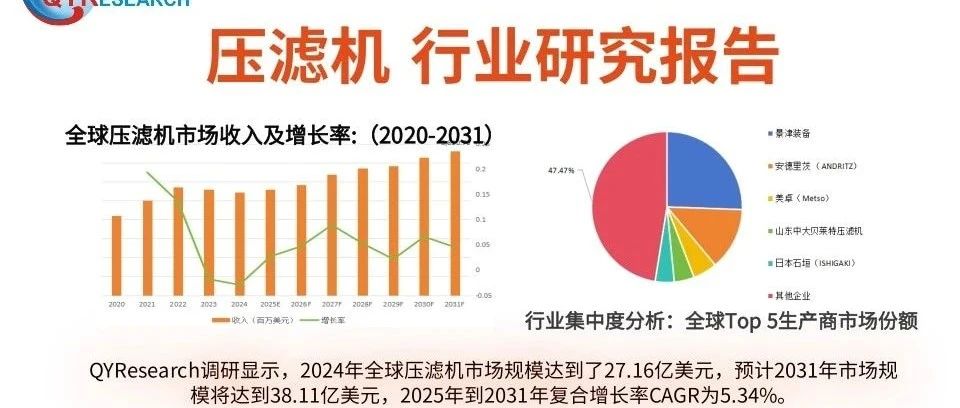
2025-2031全球及中国压滤机行业研究及十五五规划分析报告
QYResearch· 2025-05-06 09:47
Core Viewpoint - The global filter press market is projected to grow from $2.103 billion in 2021 to $2.789 billion by 2025, with a CAGR of 2.67% during this period, and is expected to reach $3.81 billion by 2031, reflecting a CAGR of 5.34% from 2025 to 2031 [3][5]. Market Overview - The filter press is primarily used for solid-liquid separation and finds applications in various industries such as wastewater treatment, mining, chemicals, pharmaceuticals, food, and metallurgy [5][9]. - In 2024, the Chinese filter press market revenue is expected to reach $1.177 billion, with a projected CAGR of 6.53% from 2025 to 2031 [7]. Regional Insights - The Asia-Pacific region is the largest consumer market for filter presses, accounting for approximately 60% of global market revenue, driven by rapid economic growth and stringent environmental policies in countries like China and India [9]. - North America and Europe are also significant markets, but the demand in the Asia-Pacific region is expected to continue increasing due to industrialization and urbanization [9]. Market Segmentation - The main types of filter presses include chamber filter presses, diaphragm filter presses, and plate-frame filter presses, with diaphragm filter presses holding a significant market share of about 66% in 2024 [9]. - Wastewater treatment is the most important application market for filter presses, accounting for approximately 48% of the global market [9]. Growth Drivers - Stringent environmental regulations globally are driving the growth of the wastewater treatment industry, thereby increasing the demand for filter presses [10]. - Advances in automation technology have led to modern filter presses that offer higher efficiency, lower energy consumption, and longer service life, expanding market opportunities [10]. - Diverse demand from various industries such as mining, chemicals, and food and beverage is fostering technological innovation and market growth [10]. Challenges - High initial investment costs for filter presses can be a barrier for small and medium-sized enterprises, limiting their ability to procure advanced equipment [11]. - Increasing competition in the filter press market poses challenges for smaller companies in terms of technological innovation and quality assurance [11]. - The complexity of maintenance and operation, especially in high-load and high-pollution environments, can lead to higher costs and technical requirements [11]. Barriers to Entry - The filter press industry has high technical requirements, necessitating strong R&D capabilities and technical reserves to meet diverse industry needs [12]. - Capital barriers exist due to high costs associated with production equipment, R&D, and raw materials, requiring substantial financial backing for new entrants [12]. - Market barriers arise from the diverse applications of filter presses across various industries, necessitating in-depth market understanding for new entrants [12].