
双芯智慧大脑

Search documents
视频丨宁波舟山港年吞吐量破14亿吨 这里藏着哪些效率密码?
Xin Lang Cai Jing· 2026-01-08 13:53
Core Insights - Ningbo-Zhoushan Port is a crucial container deep-sea port in China, projected to exceed a cargo throughput of 1.4 billion tons by 2025 [1] Group 1: Cargo Operations - The port is currently handling a significant volume of operations, with 12 container ships working simultaneously in the Meishan port area, and an expected container handling volume of over 40,000 standard boxes in a single day [3] - In the first week of 2026, Ningbo-Zhoushan Port has already completed over 750 ship unloadings, achieving a container throughput of 826,000 standard boxes, representing a year-on-year growth of over 10% [5] Group 2: Technological Advancements - The port's operational efficiency has greatly improved due to a comprehensive smart system that allows for the seamless operation of both automated and manually driven container trucks [6] - The port has developed an autonomous "dual-core smart brain" that enhances the precision of automated container handling and loading processes [8] Group 3: Infrastructure Development - The port has entered a "dual-channel" era with the operational phase of a second 300,000-ton deep-water main channel, which began on December 26, 2025 [8] - The two 300,000-ton channels are expected to save over 230 million yuan in transportation costs annually, reflecting the growing connectivity between China and the world [10]


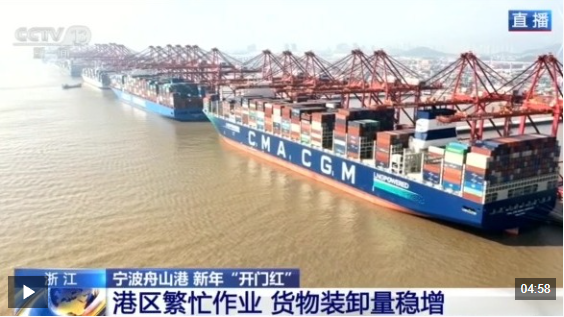
宁波舟山港年吞吐量破14亿吨 这里藏着哪些效率密码?
Yang Shi Wang· 2026-01-07 06:29
Core Insights - Ningbo-Zhoushan Port is a crucial container deep-sea port in China and the largest iron ore and crude oil transshipment base domestically, with cargo throughput expected to exceed 1.4 billion tons by 2025 [1] Group 1: Cargo Operations - The port is experiencing steady growth in cargo handling, with a forecasted container throughput of over 43 million standard containers in 2025, maintaining a position among the top three globally [4] - In the first week of 2026, Ningbo-Zhoushan Port has already handled over 750 vessels, achieving a container throughput of 826,000 standard containers, representing a year-on-year increase of over 10% [4] Group 2: Technological Advancements - The port's operational efficiency has significantly improved due to a comprehensive smart system, allowing for seamless operations between automated and manually driven vehicles [5][7] - The port has developed an autonomous "dual-core smart brain" that enhances the precision of automated container handling and unloading [7] Group 3: Infrastructure Development - The second 300,000-ton deep-water main channel at the core port area officially entered a substantial operational phase on December 26, 2025, marking the beginning of the "dual-channel" era for Ningbo-Zhoushan Port [9] - The two 300,000-ton channels are expected to save over 230 million yuan in transportation costs annually, reflecting the increasing connectivity between China and the world [9]
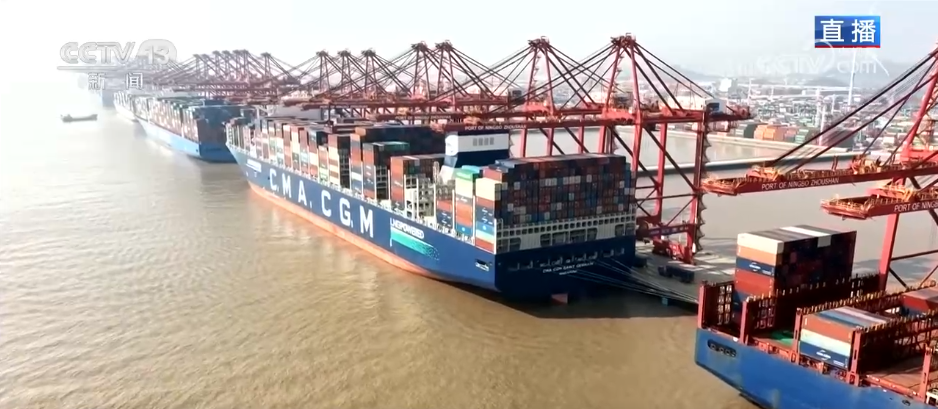
在全球第一大港感知开放新脉动
Xin Hua Wang· 2025-10-06 11:13
Core Insights - Ningbo-Zhoushan Port has achieved a record-breaking container throughput of over 30 million TEUs by September 11 this year, surpassing last year's figures by 23 days, highlighting its robust operational performance [1][2] - The port's growth is attributed to the release of foreign trade momentum in the Yangtze River Delta and nationwide, with significant exports in high-tech products such as new energy vehicles and photovoltaic products [1][2] - The port has expanded its logistics capabilities with the launch of new shipping routes, including a fast container route to Europe via the Arctic, reducing transit time to 18 days, significantly faster than traditional routes [2] Container Throughput and Shipping Routes - Ningbo-Zhoushan Port operates over 300 container shipping routes, with an average of nearly 300 vessels arriving and departing daily, connecting major ports across five continents [2] - The introduction of the Arctic shipping route marks a significant improvement in shipping efficiency, with a transit time of only 18 days to Felixstowe, compared to 25 days via the China-Europe Railway Express and up to 50 days via the Cape of Good Hope [2] Technological and Operational Innovations - The port utilizes advanced technologies such as remote-controlled cranes and AI navigation systems, which have improved operational efficiency, reducing the deviation rate of external trucks by over 10% and increasing gate passage efficiency by 7% [3] - Ningbo-Zhoushan Port has implemented a ship berthing reservation system to optimize operations and alleviate congestion, ensuring that vessels can dock and operate promptly [3] Economic Resilience and Future Outlook - The performance of Ningbo-Zhoushan Port reflects the strong resilience of the Chinese economy amid complex external conditions, with ongoing efforts to enhance the efficiency of its logistics and transportation systems [3] - The port aims to continue improving its service offerings to contribute to the construction of a new development pattern in the economy [3]