司机贷

Search documents
从阿里员工到百亿富豪,满帮张晖走到十字路口
Sou Hu Cai Jing· 2025-11-19 11:07
Core Viewpoint - The financial report of Manbang Group for Q3 2025 presents a mixed picture, showing revenue growth but a significant decline in net profit, indicating underlying cost issues and diminishing marginal returns [2][3]. Financial Performance - The company reported a revenue of 3.36 billion yuan, a year-on-year increase of 10.8%, and a core fulfillment order volume growth of 22.3% [3]. - Adjusted net profit for the quarter was 988 million yuan, down 20.4% year-on-year, highlighting a disparity between profit growth and revenue growth due to high costs [3]. Governance Issues - Manbang, originally founded to eliminate freight intermediaries, is now criticized for becoming a major intermediary itself, with persistent subcontracting issues undermining trust [4]. - The platform's growth strategy has led to a reliance on financial services, which may distract from addressing core operational challenges [5]. Business Model Challenges - The platform's business model has evolved to include financial services, with credit business revenue reaching 1.7 billion yuan in 2024, but this has not resolved fundamental issues like high costs and subcontracting [4][11]. - The reliance on financial services may lead to a short-term focus on profits at the expense of long-term operational health [5][20]. Market Position and Competition - Manbang has established a dominant position in the digital freight market, with a projected market penetration rate of 18% by 2025 [10]. - The platform's high commission rates and reliance on order volume growth expose it to regulatory scrutiny and market risks [11]. Founder’s Influence - Founder Zhang Hui's personal wealth has increased, reflecting a disconnect between his financial success and the platform's operational challenges [6][19]. - Zhang's control over the company, with 77.3% voting power, allows him to steer strategic decisions, but also raises concerns about governance and accountability [19][20]. Regulatory and Compliance Issues - The financial services offered by Manbang have faced scrutiny for high-interest rates and compliance issues, leading to customer complaints about aggressive debt collection practices [12][13]. - The platform's approach to credit and debt collection may pose systemic risks, particularly if economic conditions worsen [12][20].



满帮营收创新高背后:一边抽佣,一边放贷
凤凰网财经· 2025-09-03 23:57
Core Viewpoint - Manbang Group's Q2 2025 financial report shows record revenue of 3.239 billion yuan and a net profit increase of 50.5% to 1.265 billion yuan, interpreted as a victory for freight digitization, but the company warns of a significant drop in Q3 revenue growth to 1.3%-4.6% due to rising costs and loss of shippers [1][2] Group 1: Tax Rebate Decline - The freight brokerage service, contributing 36.3% of total revenue, saw only a 1.1% increase in Q2 2025 revenue to 1.178 billion yuan, revealing its vulnerability tied to tax rebates [1][2] - In Q1 2023, tax rebates accounted for 66.92% of freight brokerage revenue, indicating a heavy reliance on government subsidies [2] - As local government financial pressures increase, the growth of tax rebates is slowing, forcing Manbang to pass costs onto shippers [2][5] Group 2: High Interest Rates and Driver Trust Crisis - Manbang's financial products, such as "Driver Loans" and "Manbang Loans," have led to high profits but also significant driver debt issues, with 62% of loan disputes showing actual annual interest rates exceeding 36% [6][8] - Complaints regarding high-interest loans and account suspensions have surged, indicating a growing trust crisis among drivers [8] - Regulatory scrutiny is increasing, with penalties imposed for failing to disclose loan information, highlighting the risks associated with the company's financial practices [8][10] Group 3: Competitive Pressures and User Retention - Despite a marketing spend of 120 million yuan in Q2 2025, new user growth has plummeted from 35% to 12%, and driver order acceptance rates have dropped from 68% to 52% [9] - Competitors like Huolala and Didi Freight are gaining market share, exacerbating Manbang's challenges in maintaining user retention and pricing stability [9][10] - Manbang is attempting to pivot by reducing R&D spending and investing in autonomous driving technology to restructure its cost base [9][10] Group 4: Financial Model and Market Response - Manbang's non-subsidy gross margin is only 15.2%, significantly below the industry expectation of 25%, indicating a need for a sustainable profit model [12] - Following the financial report, the stock price rose by 9.81%, but institutional ratings diverged, reflecting concerns over policy risks and user attrition [12] - The company's reliance on fiscal subsidies and financial arbitrage raises questions about the sustainability of its profit growth [12]

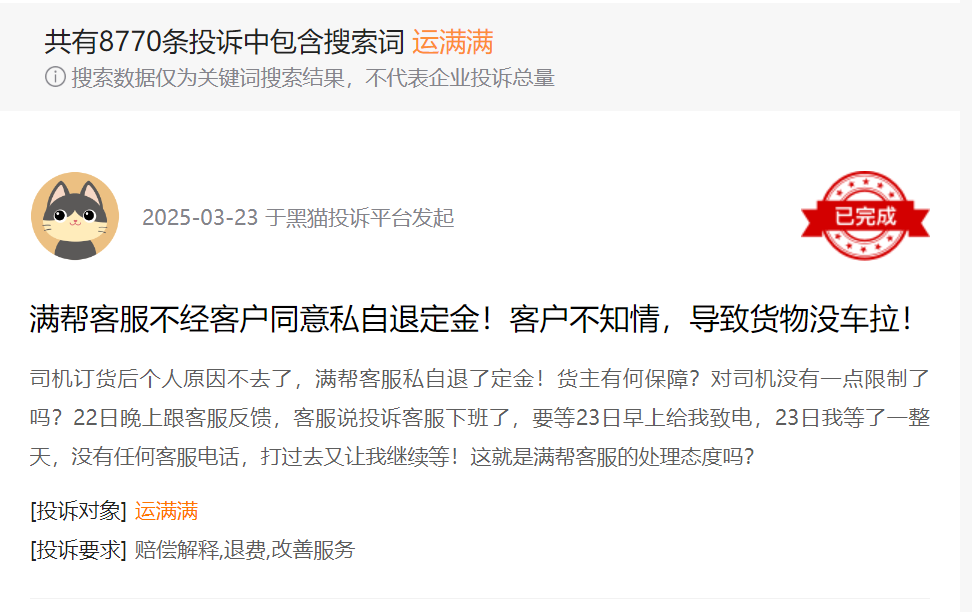
“货运版滴滴”满帮集团:张晖一手打造“数字货运第一股”,如今收获8770条黑猫投诉和2140条法律诉讼
Jin Rong Jie· 2025-04-22 11:44
Core Insights - Manbang Group, known as the "Didi of freight," reported a total net revenue of 31.743 billion RMB for Q4 2024, marking a year-on-year increase of 31.8%, and an annual total net revenue of 112.386 billion RMB, up 33.2% [1] - The company achieved a net profit of 31.234 billion RMB for the year, reflecting a significant year-on-year growth of 40.2% [1] - Despite these impressive financial results, the company faces a surge in complaints from consumers and truck drivers, leading to substantial legal risks [1] Financial Performance - In a generally sluggish freight market, Manbang Group's revenue growth is notable, with the national social logistics total reaching 360.6 trillion RMB in 2024, a 5.8% year-on-year increase [2] - The core business of freight matching services generated 94.551 billion RMB in revenue, a 34.0% increase, accounting for 84% of total revenue [2] - The revenue from transaction services saw a significant increase of 66.7%, amounting to 38.487 billion RMB, while freight brokerage services generated 47.270 billion RMB, up 20.7% [2] Value-Added Services - The value-added services, particularly the credit business, contributed 17.835 billion RMB in revenue, a 29.0% increase, representing 15.87% of total revenue [3] Company Background - Manbang Group was formed through the merger of Jiangsu Manyun Software Technology Co., Ltd. and Guizhou Huochebang Technology Co., Ltd. in 2017, and it went public on the New York Stock Exchange in June 2021 [4] - The company's stock peaked at 22.168 USD on its first day of trading, with a market capitalization exceeding 230 billion USD, but has since declined to 45% of its initial listing price, with a current market cap of 109 billion USD [5] Customer and Driver Complaints - The company has seen a significant increase in complaints, with 8,770 complaints related to "Yunmanman" and 2,829 related to "Manbang," primarily concerning service quality and high commission rates [6] - Complaints from drivers focus on high commission fees and low freight prices, which hinder their profitability [6] Legal Challenges - Manbang Group faces numerous legal challenges, with 2,140 legal cases reported, including 673 filed cases and 1,422 court announcements [15] - The majority of lawsuits involve Jiangsu Manyun Software Technology Co., Ltd., particularly related to transportation contract disputes [15] Future Outlook - The company projects Q1 2025 revenue between 26.3 billion and 26.8 billion RMB, reflecting a conservative year-on-year growth of 15.9% to 18.1% [16] - Manbang plans to enhance AI-driven freight matching efficiency and explore blockchain applications in logistics credit, with a commitment to increase R&D investment to 10% over the next three years [16] - The company must improve its core competitiveness through technology innovation, service quality, and brand influence to navigate the competitive landscape effectively [17]

满帮灵魂一问:“数字货运帝国”靠放贷续命?
Sou Hu Cai Jing· 2025-04-14 01:18
Core Insights - Manbang Group has successfully transformed the traditional logistics industry by leveraging internet, big data, and AI technologies, achieving impressive financial results [2] - Despite strong performance, underlying challenges such as over-reliance on transaction commissions and membership fees, as well as intensified competition, raise concerns about sustainable growth [3] Financial Performance - In Q4 2024, total net revenue reached 3.1743 billion RMB, a year-on-year increase of 31.8%, while total annual net revenue was 11.2386 billion RMB, up 33.2% [2] - Annual net profit surged to 3.1234 billion RMB, reflecting a significant year-on-year growth of 40.2% [2] - The core business of freight matching services generated 9.4551 billion RMB in revenue, a 34.0% increase, accounting for 84% of total revenue [4] Revenue Breakdown - Revenue from transaction services rose by 66.7% to 3.8487 billion RMB, while freight brokerage services generated 4.7270 billion RMB, up 20.7% [4] - Value-added services, primarily credit services for drivers, contributed 1.7835 billion RMB, marking a 29.0% increase and accounting for 15.87% of total revenue [5] User Engagement - The average monthly active freight owners reached 2.93 million in Q4, a 31.3% increase, indicating improved user engagement and platform dependency [6] - The number of freight owner members surpassed 1 million, highlighting increased user loyalty [6] Long-term Growth Concerns - The platform's reliance on a large driver base, which reached 4.14 million active drivers, is crucial for sustaining current revenue growth [7] - However, dissatisfaction among drivers regarding high commission rates poses a risk to long-term loyalty and operational stability [8] Competitive Landscape - The freight industry is experiencing heightened competition, with new platforms emerging, which could erode Manbang's market share if it fails to address its profitability issues [9] - The company faces challenges in balancing profitability with driver interests, which is essential for maintaining a sustainable business model [9] Future Outlook - Manbang projects Q1 2025 revenue between 2.63 billion and 2.68 billion RMB, reflecting a conservative year-on-year growth of 15.9%-18.1% [10] - The company plans to enhance AI-driven freight matching efficiency and explore blockchain applications in logistics, with a commitment to increase R&D investment to 10% over the next three years [11] - Improving user experience and addressing credit service controversies are critical for restoring brand reputation and ensuring long-term competitiveness [11]