吉利国际EX5(银河E5)

Search documents
每10辆就有1辆中国造,中国车企在欧洲卖爆了
凤凰网财经· 2026-01-01 12:37
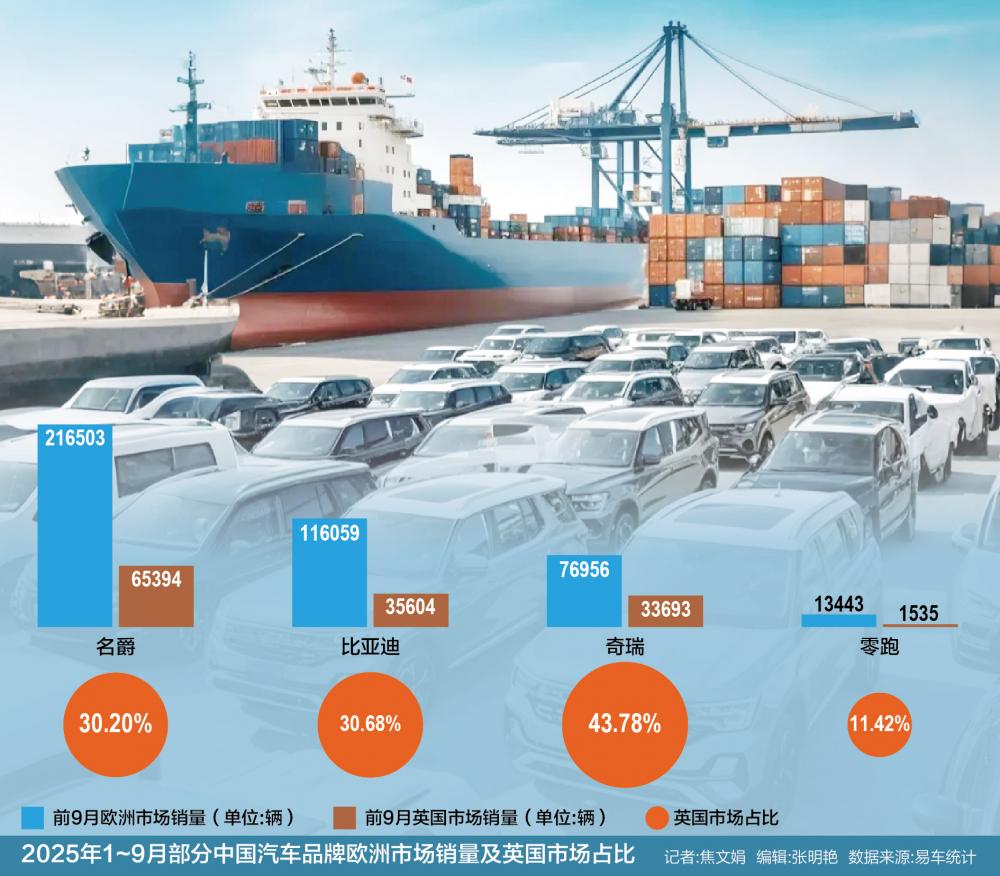
Core Viewpoint - By 2025, Chinese electric vehicles (EVs) will become a common sight on European streets, achieving significant market penetration despite high tariffs and competition from established local brands [1][2][3]. Group 1: European Market Share - Chinese brands are projected to capture 12.8% of the European EV market by 2025, marking a historical high, with hybrid vehicles exceeding 13% market share [6]. - In the UK, Chinese car sales reached 187,800 units in the first 11 months of the year, doubling from the previous year, with expectations to surpass 200,000 units and maintain a 10% market share by 2025 [7][9]. - Spain and Norway also show strong performance, with one in ten new cars sold being from Chinese brands, and the average market share in Western Europe reaching 6% [10]. Group 2: Sales Growth and Performance - SAIC MG registered 274,000 units, a year-on-year increase of 26.1%, while BYD's market share surged to 160,000 units, reflecting a staggering 276% growth [12][13]. - In key markets like Germany and Italy, BYD's sales have even surpassed those of Tesla [14]. - Geely reported a 61.8% year-on-year increase in sales in Europe for the first three quarters of the year [15]. Group 3: Competitive Advantages - Chinese EVs benefit from a mature supply chain that ensures stable supply and cost advantages, contrasting with European manufacturers facing high production costs and battery supply shortages [20][21]. - Chinese companies are strategically localizing production to mitigate tariff impacts, with firms like BYD and Chery establishing assembly operations in Europe [24]. - Innovations in battery technology, such as BYD's blade battery and CATL's high-energy-density batteries, meet European demands for longer range and safety [25][26]. Group 4: Challenges Ahead - Trade barriers, including a 45% anti-subsidy tax, and upcoming regulatory requirements for battery "digital passports" pose significant challenges for Chinese manufacturers [28][29]. - Service and brand recognition remain weaker compared to established European brands, affecting customer retention and service quality [31]. - Adapting to stringent European standards for charging interfaces and carbon footprints adds to the operational costs and complexity for Chinese EVs [33].







吉利登陆英国市场
2 1 Shi Ji Jing Ji Bao Dao· 2025-10-27 23:06
Core Insights - Geely has officially entered the UK market with the launch of its electric vehicle, Geely International EX5, which is priced competitively compared to local competitors like BYD and Tesla [1][4][5] - The company aims to establish a significant presence in the UK, targeting annual sales of 100,000 units by 2030, which requires a growth rate significantly higher than the local market average [4][6] - Geely plans to introduce 15 new models in Europe over the next five years and establish over 1,000 sales outlets, focusing on the UK as a strategic entry point into the European market [2][4] Market Positioning - The pricing strategy for the Geely International EX5 is competitive, with starting prices lower than BYD ATTO3 and Tesla Model 3, making it attractive in the UK market [1][5] - The UK market is seen as a "buffer zone" for Chinese brands due to lower policy risks and a more open consumer attitude towards new brands [6][7] - Geely's strategy includes a dual approach of promoting both electric and fuel vehicles, aiming to compete with established brands like Toyota in the fuel vehicle segment while achieving high growth in the electric vehicle market [7][8] Sales and Distribution Strategy - Geely has established 25 sales service outlets in the UK, with plans to double this number by the end of the year and reach 100 by 2026 [4][6] - The company is leveraging its past investments in the UK, including in London Electric Vehicle Company and Lotus, to build brand recognition and market presence [4][5] Performance Metrics - In the first nine months of the year, Geely's total sales in Europe grew by 61.8%, with significant increases in Latin America as well [10] - Geely's overall sales reached 2.17 million units, with nearly 300,000 units exported, indicating a strong demand for its electric vehicles [9][10] - The company reported a 214% year-on-year increase in exports of its new energy vehicles, reflecting growing international demand [10]