吹叶机

Search documents
行业聚焦:全球园林工具行业头部生产商市场份额及排名调查
QYResearch· 2025-11-17 01:21
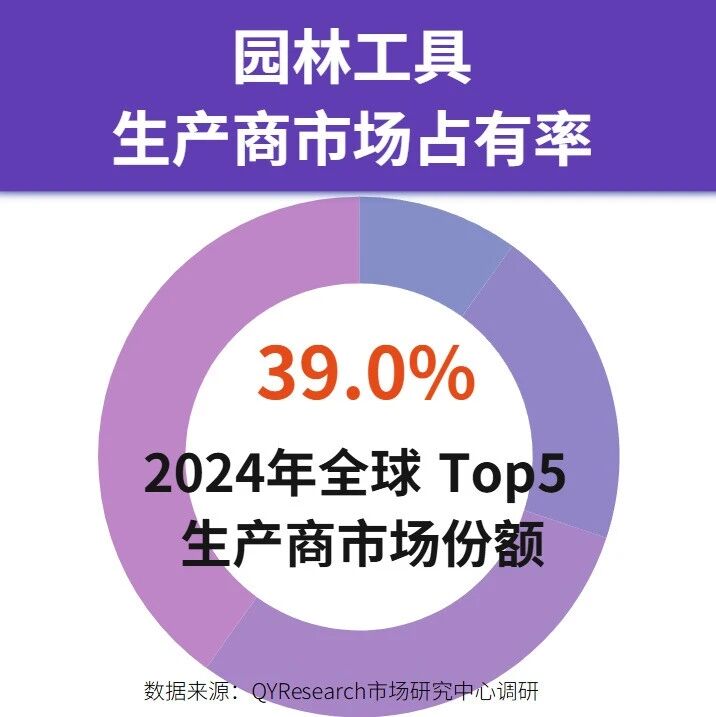
Core Viewpoint - The garden tools market is expected to experience steady growth driven by increased environmental awareness, the rise of home gardening culture, and the proliferation of smart battery-powered devices, with a projected market size of $34.9 billion by 2030 and a CAGR of 4.3% in the coming years [2][4]. Market Overview - Garden tools are specifically designed to assist in gardening, landscaping, and horticultural activities, helping users manage plants, lawns, and soil efficiently [1]. - The market is seeing a shift towards sustainable and durable tools due to global trends in sustainability and urban greening [2]. Market Trends - The global garden tools market is expanding due to the increasing popularity of home gardening, urban beautification, and sustainable lifestyles [14]. - There is a growing demand for smart, ergonomic, and battery-powered garden tools, with innovations such as lithium-ion battery technology and robotic lawn mowers gaining traction [14]. Market Drivers - Key drivers of the garden tools market include the growth of residential construction, urban greening projects, and the rise of leisure gardening and outdoor aesthetics [15]. - Increased disposable income and heightened environmental sustainability awareness are making gardening a lifestyle choice [15]. Market Size and Segmentation - The global garden tools market is projected to reach $34.9 billion by 2030, with a CAGR of 4.3% [4]. - As of 2024, the top five manufacturers hold approximately 39.0% of the market share, with major players including Husqvarna, Stihl, and Toro [9]. - In terms of product type, lawn mowers currently dominate the market with a share of about 39.8% [11]. - Offline sales represent the primary demand source, accounting for approximately 74.5% of the market [13]. Supply Chain Dynamics - The garden tools industry relies on raw materials such as carbon steel, stainless steel, aluminum, plastic, and rubber for manufacturing [17]. - Distribution occurs through retail chains, hardware stores, and e-commerce platforms, serving home gardeners, landscaping companies, and municipal departments [17].

智能锂电园林工具获数千万融资,团队来自头部硬件公司,聚焦欧美高端市场|硬氪首发
3 6 Ke· 2025-09-29 01:35
Company Overview - Laonikex Technology (Nanjing) Co., Ltd. has recently completed angel round financing of several tens of millions, with funds primarily allocated for product R&D, team talent development, and overseas marketing [1] - Established in January 2025, the company focuses on the development and production of garden tools and smart devices, providing intelligent solutions for various garden and lifestyle scenarios [1] Industry Insights - The garden tools industry has shown steady growth, with the global lawn and garden equipment market reaching $39.7 billion in 2023 and expected to grow to $45.45 billion by 2025, reflecting a compound annual growth rate (CAGR) of approximately 7.0% [2] - China holds about 70% of the global garden tool production capacity and nearly 80% of component supply, yet domestic brands maintain a market share of less than 10% in the end-user market [2] Market Opportunities - The mismatch between production capacity, supply chain strength, and brand influence presents opportunities for Chinese hardware companies to build their own brands and engage in global competition [3] - The garden tools industry is experiencing a transformative shift from gasoline to electric products, with the global lithium battery garden tools market projected to reach $5.6 billion by 2025 [3] Product Development - Laonikex aims to address core pain points in the garden tools industry, such as performance issues in lawn mowers and brush cutters, through systematic technology and hardware innovations [6] - The company has introduced turbocharging technology in its lawn mowers to enhance cutting performance and prevent clogging, along with an intelligent self-driving system for improved user experience [6][7] Product Launch and Sales Strategy - Laonikex has completed product mold development and is in the validation phase, with plans to launch products by the end of Q4 this year and start sales in February-March 2026, expecting revenue to reach several hundred million [9] - The initial product lineup will focus on the 60V series, including lawn mowers, brush cutters, leaf blowers, and hedge trimmers, complemented by battery packs and chargers [9][11] Market Penetration - The company plans to leverage existing channels for smart lawn mowers while targeting mainstream markets in Europe, including Germany, France, and the UK, to establish a comprehensive sales network [11] - Laonikex offers a warranty of up to 6 years, which is double that of mainstream brands, enhancing its market competitiveness by aligning with young consumers' preferences for high-quality, technologically advanced products [11]

美国人不扫地,院子和马路为何那么干净?
Hu Xiu· 2025-08-03 06:44
Group 1 - The article discusses the reliance on tools in American society, highlighting how tools like lawn mowers and leaf blowers have become essential for outdoor maintenance, similar to how dishwashers and vacuum cleaners are viewed in indoor settings [6][10][20] - It contrasts American and Chinese attitudes towards manual labor, noting that Americans tend to favor efficiency and time-saving tools, while Chinese culture often values hands-on labor as a sign of diligence [7][22][24] - The article points out a cultural shift in the U.S., where younger generations are increasingly reluctant to engage in manual labor, leading to a decline in skilled trades and a growing skills gap in the workforce [12][18][19] Group 2 - The article cites data from the U.S. Bureau of Labor Statistics indicating that there are approximately 414,000 job vacancies in the manufacturing sector as of May 2025, reflecting ongoing recruitment challenges [15] - It emphasizes that the perception of blue-collar jobs has changed, with traditional skilled trades being marginalized in favor of "clean" professions like technology and finance [13][18] - The discussion includes the notion that tools not only enhance efficiency but also shape societal values and attitudes towards work, with a focus on the importance of understanding and creatively using tools rather than merely relying on them [37][42][44]