
国家基本药物目录调整

Search documents
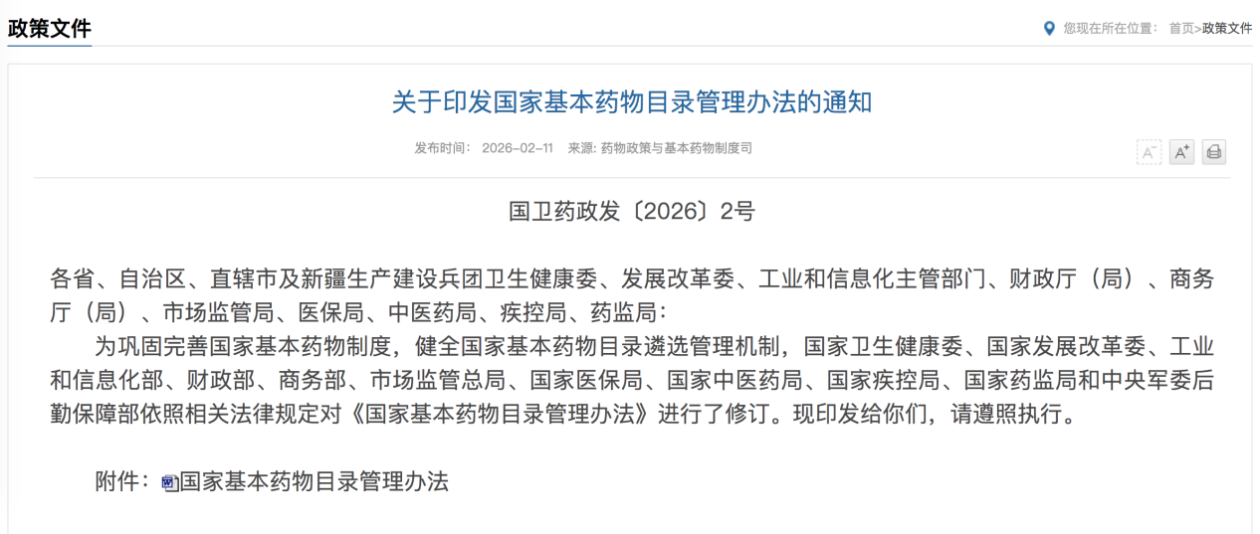
国家新版基药目录调整在即,11部门联合发文强化政策衔接
Huan Qiu Wang· 2026-02-12 02:08
Core Viewpoint - The release of the "National Essential Medicines Directory Management Measures" signals an important adjustment to the national essential medicines list, which has not been updated for eight years, indicating a shift in the drug supply assurance system in China [1][3][5] Group 1: Key Aspects of the New Measures - The new measures improve the directory management mechanism, linking essential medicines supply with tiered diagnosis and treatment, centralized procurement, and reimbursement policies [3] - The selection of drugs will focus on clinical value and will be dynamically adjusted based on changes in disease spectrum, clinical application practices, drug standards, and newly approved drugs [3] - The directory will include only drugs approved by the National Medical Products Administration and those produced according to national standards, with specific exclusions for certain types of drugs [3][4] Group 2: Implications for the Pharmaceutical Industry - The current essential medicines directory, last updated in 2018, includes 685 varieties, and the new measures suggest that many newly approved drugs may soon be included, enhancing market opportunities for innovative drug companies [4][5] - The adjustment of the essential medicines list is expected to emphasize economic evaluations and cost-effectiveness, prompting pharmaceutical companies to adjust their R&D and pricing strategies [5] - The ability of generic drug companies to enter the essential medicines directory through centralized procurement will be crucial for maintaining market share, indicating a significant shift in market competition dynamics [5]

中成药批文为何主动走向退场? 业内:更像是一场行业的主动“瘦身”
Mei Ri Jing Ji Xin Wen· 2026-01-29 12:56
Core Viewpoint - The new regulations for traditional Chinese medicine (TCM) registration, referred to as the "death clause," will require that key safety information be clarified by July 1, 2026, or the products will face delisting. However, many industry insiders view this as an opportunity for the industry to eliminate "zombie approvals" that are no longer commercially viable [1][2][4]. Group 1: Regulatory Changes - The "New Regulations for TCM Registration" will take effect on July 1, 2026, mandating that any TCM product with unclear safety information will not be re-registered [2][3]. - Most of the TCM products likely to be eliminated are considered "zombie approvals," which are low-value, highly homogeneous products with minimal or zero market sales [2][4]. - The cost for updating safety information for TCM products ranges from thousands to tens of thousands of yuan, with an additional application fee of 9,600 yuan per approval [3][6]. Group 2: Industry Response - Industry experts believe that the impact of the new regulations on the overall sales volume of TCM will be minimal, as many products are already in excess supply [4][6]. - Companies are expected to take advantage of the three-year buffer period to either update their products or voluntarily abandon non-core approvals [10][11]. - The time frame for compliance is seen as generous, allowing companies ample opportunity to meet the new requirements without significant financial strain [8][10]. Group 3: Market Dynamics - The upcoming adjustments to the national essential drug list and the TCM centralized procurement process are viewed as more pressing concerns for the industry than the new registration regulations [10][11]. - The centralized procurement process, set to take place in November 2025, will involve 90 products and a market scale of over 45 billion yuan, raising concerns about future pricing and competition [11][12]. - The adjustment of the essential drug list is anticipated to be a critical window for TCM companies, with significant implications for core product viability and profitability [12].
不良反应等“尚不明确”不能注册,大量中成药将退出市场!多位业内人士:被淘汰的绝大部分是“僵尸品种”,不会影响正常供应
Mei Ri Jing Ji Xin Wen· 2026-01-28 16:31
Core Viewpoint - The new regulations for traditional Chinese medicine (TCM) registration, effective July 1, 2026, are perceived as a "survival deadline" for TCM products, requiring clear safety information or facing market exit. However, the industry views this as an opportunity to eliminate "zombie approvals" that have little market value and are not actively sold [1][2]. Group 1: Regulatory Changes - The new regulation mandates that if any safety information in TCM product labels remains "unclear" after three years, re-registration will be denied, leading to potential market exit for those products [2][3]. - Most of the approvals likely to be eliminated are considered "zombie approvals," which are low-value, highly homogeneous products with minimal or zero market sales, thus not impacting the overall market supply [2][3]. - The cost for companies to update their product information to comply with the new regulations is manageable, ranging from thousands to tens of thousands of yuan, with a registration fee of 9,600 yuan per approval [2][3]. Group 2: Industry Response - Industry insiders believe that the impact of the new regulations on total sales volume will be minimal, as many companies are already prepared for the changes and have completed re-registration for key products [4][5]. - The time frame provided by the new regulations is considered sufficient for companies to adapt, with many already having completed necessary updates for core products [6][7]. - The registration process is seen as a manageable task rather than a high-cost project, with companies able to utilize existing databases and literature to fulfill safety data requirements [5][6]. Group 3: Market Dynamics - The upcoming centralized procurement of TCM and adjustments to the national essential drug list are viewed as more significant threats to the industry than the registration regulations, with potential impacts on core product profitability [7][8]. - The centralized procurement process is expected to reshape market dynamics, as it may favor unique products while creating challenges for demonstrating clinical equivalence among similar TCM products [8][9]. - The adjustment of the essential drug list is anticipated to be a critical period for TCM companies, with significant implications for their future development and market positioning [9].
桂林三金(002275) - 002275桂林三金投资者关系管理信息20250723
2025-07-24 08:14
Group 1: Company Strategy and Market Conditions - Biopharmaceuticals are a crucial part of the company's "one body, two wings" strategy, facing high investment and long R&D cycles, with the industry currently experiencing a downturn [1] - The CDMO supply side has seen some capacity idling due to a competitive environment, impacting overall profitability [1] - The company is focusing on cost control and optimizing personnel structure to minimize losses [1] Group 2: Product Development and Pipeline - The BC006 injection project is nearing completion of Phase I clinical trials, with a focus on balancing R&D progress and operational performance [1] - The company is actively seeking partnerships in the biopharmaceutical sector [1] Group 3: Sales Performance of Secondary and Tertiary Products - Secondary and tertiary products are showing good growth trends, with specific products like "Gaojie Dingchuan Capsules" expected to maintain last year's growth rate [2] - The "Dizziness Ning" series surpassed 100 million CNY in sales in 2021, aiming for double-digit growth this year [2] - Other products, such as "Shu Yan Qing Spray" and "Compound Cold Granules," are also expected to achieve significant sales growth [2] Group 4: Regulatory and Market Access - The national essential drug list adjustment is led by relevant government departments, and the company has not engaged in any application processes during this period [2] - The timeline for the announcement of the new essential drug list remains uncertain [2]
