
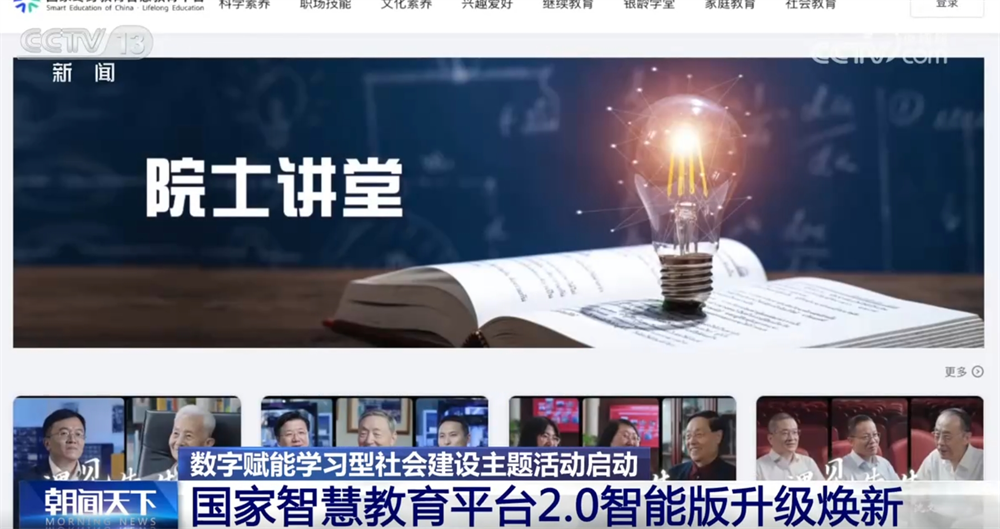
国家智慧教育平台2.0智能版

Search documents
数字赋能让学习型社会建设按下“加速键” 全民终身学习向“新”而行
Yang Shi Wang· 2025-06-27 02:57
Core Viewpoint - The "Digital Empowerment for Learning Society Construction Theme Activity" has been launched to enhance lifelong learning through a comprehensive digital learning network and upgraded educational resources [1][10]. Group 1: Digital Learning Network - The initiative aims to establish a five-level digital learning network covering provinces, cities, counties, towns, and villages to promote learning cities and communities [10]. - Participating universities will leverage digital learning resources to open and share with society, enhancing their social service functions [12]. Group 2: National Smart Education Platform - The National Smart Education Platform 2.0 has been upgraded, featuring 3,000 new courses and specialized sections for job competency and artificial intelligence education [1]. - The platform includes intelligent features such as smart search and upgraded smart companions, enhancing user experience [4]. Group 3: Internationalization and Community Engagement - The National Open University has established a new learning center in São Paulo, Brazil, expanding its international teaching platform to 35 overseas learning centers in 29 countries [9]. - The initiative supports non-degree online education and improves the digital service system for credit banks, facilitating lifelong learning [12].

教育部:将组织研发实用AI工具、引导企业研发数字化教育产品
Xin Jing Bao· 2025-04-16 13:23
Core Viewpoint - The Ministry of Education and nine other departments have released an opinion to accelerate the digitalization of education, emphasizing the integration of artificial intelligence to transform educational practices [1] Group 1: Digital Education Strategy - The opinion outlines 22 policy measures to implement a national education digitalization strategy, focusing on the integration of management information systems for schools, students, and teachers [1] - A national smart education platform 2.0 will be developed, incorporating advanced AI tools to enhance the mastery of AI skills among teachers and students [1][7] Group 2: Resource Integration and Accessibility - The opinion proposes the enhancement of the national smart education platform's public service functions, aiming for unified access and resource sharing across various educational levels [2] - It emphasizes the need for a comprehensive digital education resource market to guide enterprises in developing relevant digital education products and solutions [4] Group 3: Data Governance and Infrastructure - Establishment of a national education big data center is highlighted, with a focus on unifying data standards and improving data governance to enhance educational management [3] - The opinion calls for the standardization of smart campus construction and the gradual implementation of wireless network coverage in schools [4] Group 4: International Collaboration and Standards - The opinion encourages the internationalization of digital education resources, promoting shared development and collaboration with other countries and international organizations [4] - It stresses the importance of developing and revising digital education standards to cover various aspects, including software, hardware, and data security [4] Group 5: Content Regulation and Security - A strict content review system is mandated to ensure the political, scientific, and public welfare aspects of educational resources are maintained [5] - The opinion emphasizes the need for robust data protection measures to prevent data tampering and misuse [5] Group 6: AI Development in Education - The development of specialized AI models for education is prioritized, with plans to involve teachers and students in optimizing these models [6][7] Group 7: Employment and Skills Development - The opinion introduces the "Double Thousand Plan," aiming to create over 1,000 micro-specialties and training courses to meet urgent employment needs in various fields [7]
国家智慧教育平台2.0智能版发布,上新智慧学伴、课程资源
Xin Jing Bao· 2025-03-31 07:30
Core Insights - The National Smart Education Platform 2.0 has officially launched, focusing on AI learning, application, creation, and protection [1] - A total of 9,161 new classes have been added to the primary and secondary school platform, 6,560 to the smart vocational education platform, 15,111 to the smart higher education platform, and 1,925 to the lifelong education platform [1] - The platform has introduced 12 new government service items, forming 8 categories and 51 government services [1] Group 1: Lifelong Education - The Lifelong Education Smart Education Platform has undergone a comprehensive intelligent upgrade, introducing four major intelligent applications: Bai Ze Smart Companion, AI Intelligent Search, AI Video Summary, and AI Video Navigation [1] - The platform now features 2,000 courses, creating a diverse resource system for lifelong learning [2] - New sections for family education and social education have been added, along with a national reading section to support the "Book Aroma China" initiative [2] Group 2: Higher Education - A new initiative called the "Double Thousand Plan" aims to enhance college students' employment competitiveness, offering specialized course groups and vocational training courses [3] - The higher education section includes core competency enhancement courses, AI general courses, and public courses on domestic large model applications, primarily targeting undergraduate students [3] - The vocational education section features courses aimed at improving employment capabilities, with 1,107 courses selected from the National Vocational Education Smart Education Platform [3] Group 3: Government Services - The National Smart Education Public Service Platform has launched 12 new educational government service items, including scholarship inquiries and various certification queries [2] - By 2025, the platform aims to enhance service efficiency by reducing the need for public visits, focusing on high-frequency demands such as inter-provincial transfers for primary and secondary students [2][4]