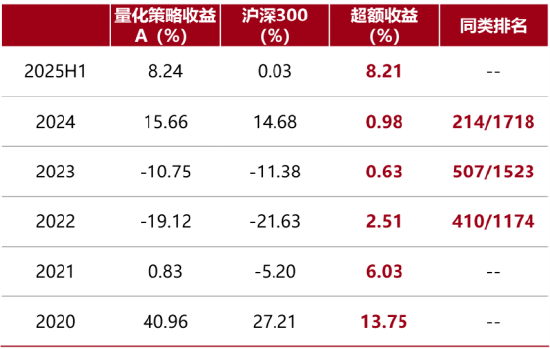
国泰量化策略收益

Search documents
公募指增及量化基金经理精选系列九:量化选股策略洞察,解析多元灵活魅力
SINOLINK SECURITIES· 2025-09-25 14:25
Group 1 - The report highlights the significant role of quantitative stock selection funds in the public fund market, with a total of 277 funds managing a combined scale of 90.32 billion yuan as of the end of Q2 2025, offering broader investment scope and higher style exposure flexibility compared to standard index-enhanced funds [3][12][13] - The report focuses on five fund managers with distinctive investment frameworks in quantitative stock selection, including Feng Xixiang from Xinda Australia Fund, Gao Chongnan from Guotai Fund, Lin Jingyi from Xinda Australia Fund, Shi Yunchao from Penghua Fund, and Zhai Zijian from Western Li De Fund, providing insights into their strategies and product positioning [3][12][13] Group 2 - Feng Xixiang employs a unified framework emphasizing the effectiveness of factors and the universality of alpha models, integrating static multi-factor linear models with machine learning dynamic weighting models since 2023, achieving balanced allocation in his representative products [4][16][23] - Gao Chongnan focuses on the Calmar ratio, selecting high dividend, quality, and growth styles to enhance the stability of risk-return profiles, with a product positioning aimed at low volatility value style [4][35][36] - Lin Jingyi implements a "HI+AI" approach using an integrated research platform, employing a three-step method to replicate successful peer consensus and enhance index tracking through multiple alpha models [5][22] - Shi Yunchao's strategy combines multi-factor linear models with a higher proportion of non-linear models, focusing on short prediction cycles and higher turnover rates, while maintaining a diversified portfolio to mitigate risks [6][24] - Zhai Zijian adopts an AI quantitative investment strategy with a "core + satellite" multi-strategy balanced configuration, utilizing machine learning for long-term predictions and high-frequency data analysis [6][24] Group 3 - The report indicates that as of the end of Q2 2025, Feng Xixiang manages a total of 4.54 billion yuan across seven quantitative stock selection products, with representative products achieving cumulative returns of 40.66% and 74.91% since inception, significantly outperforming their benchmark indices [17][21] - Gao Chongnan's strategy iteration has led to improved performance, with the National Strategy Yield Fund achieving an annualized return of 28.72% in 2024, reflecting a notable enhancement in risk-adjusted returns [36][37] - The quantitative team at Xinda Australia Fund consists of experienced professionals, with a comprehensive product line that includes 11 quantitative stock selection products and 2 quantitative fixed income + strategy products, aiming to reduce volatility while seeking absolute returns [32][33]
用红利应对牛市的分歧
Xin Lang Ji Jin· 2025-08-29 02:26
Market Overview - The market experienced significant volatility, with the Shanghai Composite Index dropping over 1% before recovering to gain over 1%, while the ChiNext Index rose by 3.82% [1] Key Points of Divergence - The first key point of divergence is the historical resistance level of 3900 points for the Shanghai Composite Index, which has not been sustained since 2015. This level is psychologically significant for investors expecting a "slow bull" market. A breach of 3900 points could lead to a push towards the 4000-point mark, often seen as a signal for accelerated market activity. Profit-taking from investors who have gained from lower levels, particularly those who entered below 3000 points, is expected to increase, leading to intensified market fluctuations around this level [2][3] - The second divergence involves a leading liquor company's market valuation, which has been impacted by the stock price movements of a leading chip company. When the chip company's stock briefly surpassed the liquor company's, it triggered a market pullback [2][3] Valuation Dynamics - The market's valuation logic is influenced by the "valuation anchoring effect" associated with the liquor company. When new high-value stocks surpass the liquor company, it prompts a reevaluation of valuations, as the new stocks often rely on high growth expectations that have yet to be validated. This leads to profit-taking and increased market divergence, resulting in temporary market fluctuations [3] Investment Strategy - In the current market environment, focusing on dividend-paying stocks is advisable as they provide a "safety cushion" amid volatility. The high-growth sectors, particularly in communications, have been the driving force of the current bull market. The stability of dividend stocks complements the high growth characteristics of tech stocks, creating a "barbell strategy" that allows investors to benefit from growth opportunities while securing a stable income [4] - The Guotai Dividend Smart Selection fund is introduced as a quant-driven product that balances between "value dividends" and "growth dividends." The fund aims to maintain a balanced portfolio to avoid significant underperformance even in a rising market. It may also include high-yield Hong Kong stocks to capitalize on that market's performance [5][6] Performance Metrics - The Guotai Quantitative Strategy has shown strong performance since its transformation into a quantitative long-only product at the end of 2018, outperforming benchmarks and the CSI 300 Index across multiple periods. For instance, the fund achieved a return of 14.40% over the last two years and has consistently outperformed the CSI 300 Index over the past five years [6][7]