城市级智能体

Search documents
会思考会决策的城市长啥样?
Xin Lang Cai Jing· 2026-01-06 19:29
Core Insights - The conference in Changzhou highlighted the progress in developing "city-level intelligent agents," showcasing their integration into various sectors such as industrial upgrades, public services, and urban governance [1][2][3] Group 1: Definition and Importance of Intelligent Agents - Intelligent agents are defined as intelligent systems capable of perception, decision-making, execution, and learning, serving as "digital partners" to solve problems in various settings [2] - City-level intelligent agents represent an evolution from traditional smart cities, focusing on "smart collaboration" to enhance resource allocation efficiency [2][3] - IDC predicts that by 2026, approximately 50% of data teams in China's top 500 companies will utilize intelligent agents for data preparation and analysis, marking them as key drivers of industrial intelligence transformation [2] Group 2: Challenges and Opportunities in Urban Development - Urban development faces challenges such as aging populations, traffic congestion, and resource scarcity, with intelligent agents positioned as crucial solutions [3] - Jiangsu province, with its robust industrial system and digital economy, provides a fertile ground for the application of intelligent agent technology, creating a virtuous cycle of technological innovation and urban governance modernization [3][4] Group 3: Local Implementation and Policy Support - Jiangsu cities are advancing intelligent agent construction tailored to local conditions, with Changzhou's model focusing on industry, ecology, and application scenarios [4][6] - Changzhou has established a significant industrial base, with over 1,500 typical smart manufacturing scenarios, facilitating the practical application of intelligent agents [4][5] - Local governments are enhancing support through policies, funding, and platform development, with Changzhou announcing a talent policy offering up to 10 million yuan for AI talent and a 5 billion yuan special fund for intelligent agent development [6] Group 4: Real-World Applications and Impact - Intelligent agents are being integrated into various sectors, such as transportation, healthcare, and urban governance, demonstrating their practical benefits [7] - For instance, the "regional cloud bus" in Changzhou has reduced average waiting times to under 5 minutes, while AI-assisted medical systems have streamlined patient processing [7] - The implementation of intelligent agents in public safety and urban management has improved efficiency and responsiveness in large events and daily governance [7][8] Group 5: Future Directions and Collaborative Efforts - Future development plans include deepening collaboration with academic institutions like Tsinghua University to foster innovation and talent in AI [8] - Jiangsu aims to build a public foundation for digital twin cities, enhancing support for intelligent agents and promoting cross-regional collaboration [8][9] - The construction of urban intelligent agents is seen as a pathway to modernize urban governance and improve citizens' quality of life, with ongoing efforts to overcome challenges such as data sharing barriers [8][9]


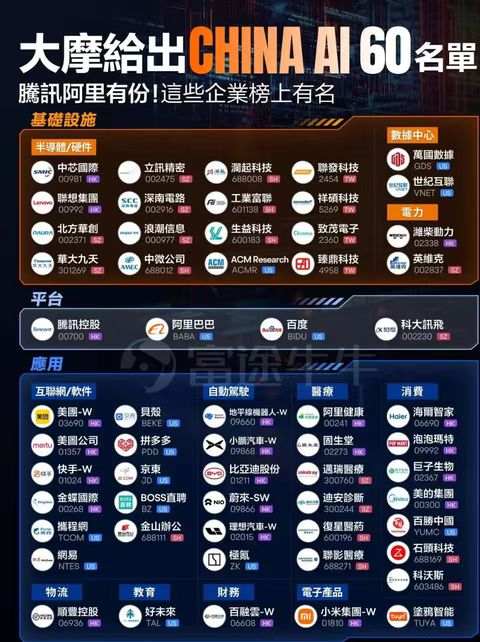
大摩中国AI 60强榜单曝光!未来6至12个月将是中国AI企业的关键期
智通财经网· 2025-05-18 02:05
Core Insights - Morgan Stanley's report highlights China's ambition to become a global leader in artificial intelligence (AI) technology, driven by a robust ecosystem of talent, innovation, data, and infrastructure [1][3] - The report emphasizes the importance of applying AI to the "real economy" and commercializing AI products to enhance productivity in traditional industries [1][2] - China is focusing on market-driven AI applications, particularly in sectors like autonomous driving, smart manufacturing, and digital customer service, contrasting with the U.S. focus on broader consumer applications [1][2] Infrastructure Sector - China's AI GPU self-sufficiency is projected to increase from 34% in 2024 to 82% by 2027, with companies like Huawei and Cambricon leading innovations in chip development [5] - Lenovo's business segments are expected to benefit from the AI revolution, with a 60% year-on-year growth in its ISG segment for Q4 2024 [6] Data Center Sector - The data center industry is anticipated to see a significant increase in new bookings, growing from 2.1 GW in 2024 to 3.7 GW annually from 2025 to 2027, representing a 76% increase [8] - The rental pricing in China's data center sector has stabilized at lower levels, with improving return rates due to lower bank financing costs and faster client onboarding [8] Platform Sector - The rapid development of AI applications is expected to accelerate growth in China's IaaS/PaaS market, benefiting cloud service providers like Alibaba and Tencent [9] - Tencent's cloud business is projected to accelerate growth starting Q2 2025, as it reallocates resources to external cloud clients [9] Application Sector - In the 2C domain, AI applications are rapidly evolving, with platforms like WeChat leveraging user data to enhance user experience and drive profitability [11] - The 2B application speed is expected to surpass previous public cloud cycles, with a subscription model becoming prevalent for enterprise AI applications [11] Automotive and Robotics - The penetration rate of L2+ autonomous driving in China is expected to reach 25% by 2025, benefiting manufacturers like BYD and Geely [12] - By 2030, China's humanoid robot inventory is projected to reach 252,000 units, with significant growth anticipated in both commercial and household humanoid robots by 2050 [12] Energy and Quantum Computing - AI-driven data centers are expected to account for 10% of China's total electricity demand by 2035, with green energy initiatives gaining traction [14] - China's advancements in quantum computing, exemplified by the "Zuchongzhi 3" prototype, are set to provide new computational capabilities that will benefit AI and other industries [14] Conclusion - Despite U.S. chip restrictions, China's AI computing capabilities are advancing, with domestic semiconductor companies innovating rapidly to close the performance gap with U.S. counterparts [15]