城市轨道交通线路

Search documents
2026年北京将继续推进亦庄线至5号线、10号线联络线工程
Xin Lang Cai Jing· 2026-02-03 13:39
Core Viewpoint - The 2026 Beijing Urban Rail Transit Construction Plan has been officially released, outlining significant expansions in both urban rail and suburban railway systems [2] Group 1: Urban Rail Transit Expansion - Beijing will advance the construction of 9 urban rail lines totaling 150.6 kilometers in 2026 [2] - Key projects include the new airport line (Caoqiao to Lize Business District), Phase 1 of Line 3 (Guanzhuang Road West to Caogezhuang North), and Line 12 (Dongba North to Dongba North Street) [2] - Additional projects involve the enhancement of Line 13, the M101 Line Phase 1, and the connection of Yizhuang Line to Lines 5 and 10 [2] Group 2: Suburban Railway Development - The plan includes the construction of 2 suburban railway lines totaling 90.5 kilometers [2] - The Northeast Ring Line of the suburban railway will also be developed, comprising 9 segments [2] - Ongoing projects include the addition of a new station at Wangjing South on the Capital Airport Line [2]


“十四五”收官在即,谁是最强轨交“黑马”?
Mei Ri Jing Ji Xin Wen· 2025-12-13 03:38
Core Insights - The report highlights the progress of urban rail transit construction and operation in China during the "14th Five-Year Plan" period, with significant achievements in new city openings and operational mileage [1][6]. Group 1: Urban Rail Expansion - From the end of 2020 to November 2023, 10 new cities have opened urban rail transit, adding nearly 100 lines and over 3,500 kilometers of operational mileage [1]. - Notable cities such as Shaoxing, Nantong, Wuhu, and Luoyang have achieved their first operational rail lines [1]. Group 2: Mileage Rankings - As of November 2023, a total of 54 cities in China have operational urban rail transit, with Beijing, Shanghai, Guangzhou, Chengdu, and Shenzhen leading in operational mileage, each exceeding 600 kilometers [6]. - Guangzhou is expected to surpass Hangzhou in operational mileage by the end of the year, following the opening of multiple new lines [9]. Group 3: Emerging Cities and Trends - Smaller cities like Haining, Kunshan, and Juyuan are entering the urban rail scene, challenging larger cities that have not yet established rail systems [6]. - Foshan has made significant progress, moving from 43rd to 23rd in the national rankings for operational mileage over the past five years [13]. Group 4: Future Focus - The approval for new urban rail projects has tightened, with a shift in focus towards improving existing lines' passenger flow and operational efficiency [13][17]. - The next five years will require cities to optimize operations and manage existing infrastructure effectively, moving from expansion to sustainability [17].

城轨协会:2025年城轨新增里程有望超800公里
Zhong Guo Jing Ying Bao· 2025-07-02 14:01
Core Insights - The China Urban Rail Transit Association reported that as of June 30, 2025, there are 58 cities in mainland China operating urban rail transit lines totaling 12,381.48 kilometers, with a new operational line length of 220.70 kilometers in the first half of 2025, representing a 13.73% increase year-on-year, but a 53.92% decrease compared to the peak in 2021 [1] - It is expected that approximately 600 kilometers of urban rail transit lines will be opened in the second half of 2025, with a total new operational line length for the year projected to exceed 800 kilometers, continuing a downward trend from 936.23 kilometers in 2024 [1] - The investment in urban rail construction is projected to be around 339.18 billion yuan in 2025, a decrease of 28.59% compared to 2024, indicating a sustained decline in investment and new line construction over recent years [1] Industry Trends - The peak period for urban rail transit investment and construction occurred between 2017 and 2020, with record high construction mileage and investment each year. However, since 2018, the central government has raised the approval thresholds for urban rail projects, leading to a significant reduction in construction activities [2] - The "Document No. 52" issued by the State Council in July 2018 emphasized the need for prudent planning and management of urban rail transit, increasing the financial and GDP requirements for project approvals, which has contributed to the slowdown in new projects [2] - Design firms in the urban rail industry, such as Guangzhou Metro Design Institute, are experiencing project reductions and talent loss due to the decline in construction activities, prompting them to explore opportunities in municipal, highway, and real estate development projects [2] Operational Developments - In the first half of 2025, there were no new cities added to the urban rail transit network, but nine cities, including Hangzhou, Chongqing, and Guangzhou, opened new lines or extensions [3]
城市24小时 | 东西两大省会,冲刺“700公里俱乐部”
Mei Ri Jing Ji Xin Wen· 2025-06-18 16:09
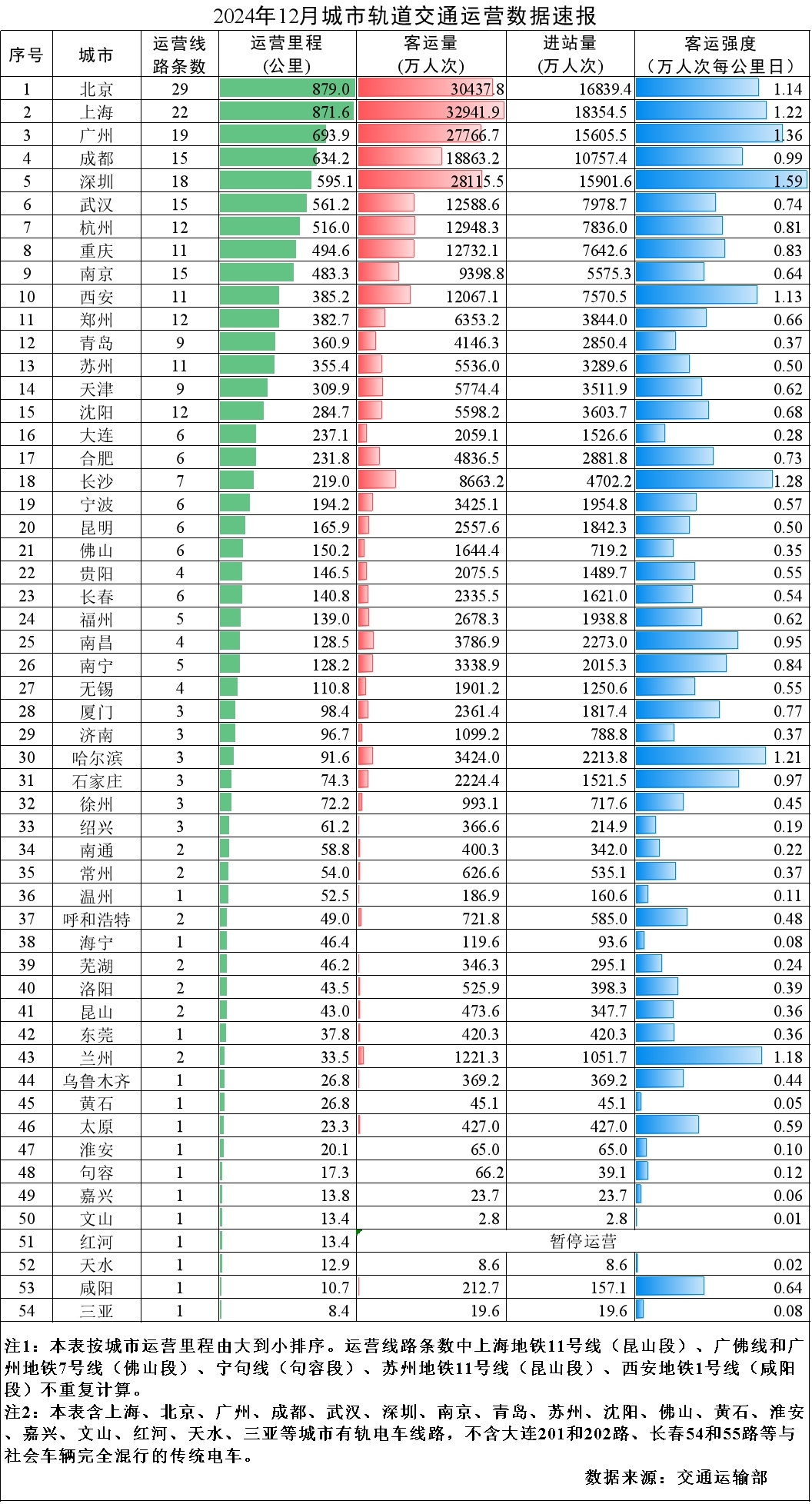
Group 1 - Chengdu's urban rail transit is accelerating with the full launch of trial operations for multiple new lines, including Line 10 Phase III, Line 17 Phase II, and Line 30 Phase I, aiming for initial operation this year [1] - The total length of the four lines expected to open this year in Chengdu is 87.5 kilometers, contributing to a projected total urban rail transit operating mileage of over 700 kilometers by the end of the year [1] - Chengdu's previous significant operational expansion occurred in 2020, when seven lines totaling over 200 kilometers were opened, pushing its urban rail transit mileage past 500 kilometers and ranking it fourth nationally [1] Group 2 - By the end of 2024, major cities like Beijing and Shanghai are expected to exceed 800 kilometers in urban rail transit operating mileage, creating a significant gap with other cities [2] - Guangzhou ranks third with an expected operating mileage of 693.9 kilometers, placing it in the same category as Chengdu, which is also projected to surpass 700 kilometers [2] - Other cities such as Shenzhen, Wuhan, and Hangzhou have also surpassed 500 kilometers in operating mileage, while Chongqing and Nanjing are at 400 kilometers [2] Group 3 - The operational statistics for major cities show that Beijing leads with 879 kilometers and a passenger volume of 30.44 million, followed by Shanghai with 871.6 kilometers and 32.94 million passengers [3] - Chengdu has 634.2 kilometers of operational rail with a passenger volume of 18.86 million, indicating a lower passenger intensity compared to other major cities [3] Group 4 - Guangzhou's government report indicates plans to complete three new metro lines totaling 74.5 kilometers this year, which will help it maintain its position as the third-largest urban rail system in China [7] - Both Chongqing and Nanjing are in a competitive race to expand their urban rail systems, with Nanjing's government aiming to open several new lines this year [8] Group 5 - Several cities, including Guangzhou, Suzhou, Zhengzhou, and Xi'an, have outlined plans to accelerate the approval of new urban rail transit construction projects in their government reports [9] - The trend indicates that urban rail construction will continue to focus on first-tier and economically strong second-tier cities, while approvals for third and fourth-tier cities will be more cautious [9]